
Most people default to principal and interest loans because that’s what they’re told to do with their home loan. Investment property is different. The goal isn’t to pay off the loan as fast as possible. The goal is to maximise cash flow, maximise tax deductions, and use the freed-up capital to buy the next property.
Interest-only loans on investment property are a strategic choice, not a shortcut. Here’s the math behind why most investors use them, and when it makes sense to switch. With rates climbing through 2026, cash flow preservation matters more than ever, and we cover that angle in the May 2026 RBA decision read.
The 5-year cash flow comparison
On a $600,000 investment loan at current rates (April 2026):
Principal & interest (P&I) at 6.20%:
- Monthly repayment: ~$3,672
- Annual repayment: ~$44,064
- Loan balance after 5 years: ~$545,000
- Total interest paid over 5 years: ~$165,320
- Total principal paid: ~$55,000
Interest only (IO) at 6.40%:
- Monthly repayment: ~$3,200
- Annual repayment: ~$38,400
- Loan balance after 5 years: $600,000 (unchanged)
- Total interest paid over 5 years: ~$192,000
- Total principal paid: $0
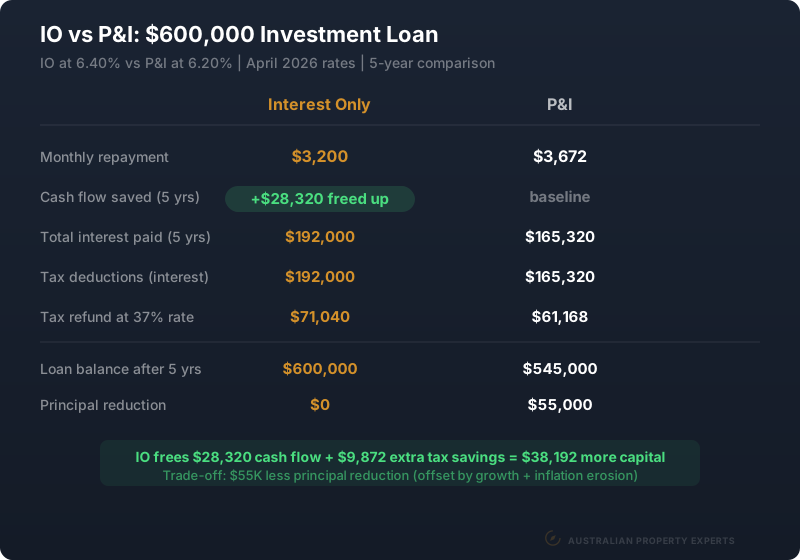
The IO loan costs $472 less per month. Over 5 years, that’s $28,320 in freed-up cash flow. You pay more total interest ($26,680 more over 5 years), but the cash flow difference changes your entire investment position.
Why the extra interest is worth it
That $472 per month isn’t just sitting in your bank account. In a well-structured portfolio, it does three things:
1. Improves your serviceability. Lower repayments mean the bank sees less risk. That improves your borrowing capacity for the next purchase. Across two or three IO investment loans versus P&I, the serviceability difference can unlock $50,000-$100,000+ in additional borrowing capacity. For how banks calculate that number in 2026, see our borrowing capacity breakdown.
2. Keeps you cash-flow positive (or close to it). On a $600,000 property renting for $550 per week ($2,383/month), the IO repayment of $3,200 leaves a monthly gap of $817. On P&I, the gap is $1,289. That’s a 58% bigger out-of-pocket cost for the same property. For investors holding multiple properties, the cumulative difference determines whether the portfolio is sustainable or a strain.
3. Preserves capital for the next deposit. The $28,320 saved over 5 years on a single property is a meaningful contribution toward a deposit on property two. If you’re building a portfolio, accelerating the timeline to the next purchase matters more than paying down a loan that inflation is eroding anyway.
The tax deduction difference
This is the part most IO-vs-P&I comparisons miss.
Interest on an investment loan is tax deductible. Principal repayments are not. On an IO loan, 100% of your repayment is deductible. On a P&I loan, only the interest component is deductible, and that component shrinks every year as more of each payment goes toward principal.
On the $600,000 example:
- IO deductions over 5 years: ~$192,000 in deductible interest
- P&I deductions over 5 years: ~$165,320 in deductible interest (declining each year)
- Difference: ~$26,680 in additional deductions on IO
At a 37% marginal tax rate, that $26,680 in extra deductions saves approximately $9,872 in tax over 5 years. At 45%, it saves $12,006.
Model your after-tax position with interest-only repayments. See how negative gearing offsets your holding costs.
Use the calculator →
When you factor in the tax benefit, the “extra cost” of IO largely disappears. You pay $26,680 more in interest but get back $9,872-$12,006 in tax deductions. The net extra cost is $14,674-$16,808 over 5 years, or roughly $245-$280 per month, while freeing up $472 per month in cash flow.
The math favours IO for anyone on a marginal rate above 30%. For a deeper look at how investment property deductions work, see our EOFY tax tips guide.
The inflation erosion argument
A $600,000 loan today will not feel like a $600,000 loan in 10 years. Inflation erodes the real value of debt over time.
At 3.5% annual inflation (roughly the current CPI trajectory), $600,000 in today’s dollars is equivalent to about $424,000 in purchasing power after 10 years. You’re repaying tomorrow’s debt with tomorrow’s cheaper dollars, while the property’s value and rental income both grow with inflation.
On an IO loan, you’re deliberately choosing not to pay down the principal during the growth phase of your investment. Instead, you’re letting inflation do the work. The loan balance stays at $600,000 in nominal terms, but its real value shrinks every year.
This is why paying down an investment loan early is generally not the priority for portfolio investors. Pay down your home loan (not deductible) first. Keep the investment loan balance high (deductible) for as long as it makes strategic sense.
When to switch to P&I
IO periods typically run for 5 years before automatically reverting to P&I. Most major lenders allow you to roll over into another IO period (subject to approval), with total IO periods of up to 10-15 years for investment loans.
Consider switching to P&I when:
- Your portfolio is mature and you’re no longer acquiring new properties. At that point, building equity through debt reduction becomes more valuable than cash flow flexibility.
- Your borrowing capacity is no longer a constraint. If you’ve finished scaling, the serviceability benefit of IO doesn’t matter as much.
- You’re approaching retirement and want to reduce your overall debt exposure. The transition from accumulation to income phase means the strategy shifts.
- Interest rates drop significantly and P&I repayments become close to what IO was costing. When the gap narrows, the principal reduction becomes more attractive.
For most investors in their 30s-40s who are actively scaling, IO is the right tool for the first 5-10 years of each property. For a deeper look at how this fits into a portfolio scaling strategy, see our guide to building a property portfolio.
The IO rate premium in 2026
As of April 2026, the IO premium on investment loans is typically 0.10% to 0.25% above the equivalent P&I rate. The lowest variable IO investment rates start from around 5.74%, with the average sitting closer to 6.0-6.4%.
This premium has compressed significantly from 2018-2019 when IO rates carried a 0.5-1.0% premium. At 0.10-0.25%, the cash flow benefit of IO far outweighs the modest rate premium for most investors.
Your mortgage broker can compare IO and P&I rates across multiple lenders and structure the loan to maximise both cash flow and future flexibility. This is one of those areas where a broker who understands investment lending makes a material difference.
Don’t confuse IO with affordability
One important distinction: interest-only loans are a strategic tool, not a way to buy a property you can’t afford. If you can’t comfortably service the P&I repayment on a property, the IO version is masking a cash flow problem, not solving it.
IO works best when you can afford P&I but strategically choose IO to improve cash flow, maximise deductions, and accelerate portfolio growth. The property still needs to stack up on the numbers. If you want help finding properties where the numbers work in the first place, here’s what a buyers agent costs.
For a full picture of how investment property cash flow works, try our cash flow calculator.
This is general information only and not financial advice. Lending structures have significant tax and financial implications. Speak to your mortgage broker and accountant about how IO and P&I apply to your specific situation.
See how we find properties where the numbers work.
If you’re structuring a portfolio and want to understand how lending fits your strategy, book a free discovery call.