The hardest property purchase to make is the second one. Most investors who set out to build a portfolio buy one investment property, then stop. Income is the same and lender appetite has changed. The playbook for how the next deposit comes together was never really there.
This is the loop we run with clients. Buy the right kind of property in the right kind of market, force a bit of equity, get it revalued, pull the equity, repeat. Our equity recycling modeller shows when each repeat becomes possible. The mechanics aren’t complicated. The discipline to keep running the loop while life gets in the way is the part most people underestimate.
Get the first property right
Your first investment is the foundation for everything that follows. If property one doesn’t grow, doesn’t yield, or doesn’t suit a renovation, the next two years stall.
What we look for: an established house on a decent block in an affordable market with strong fundamentals. Three-bedroom, often 1970s to 1990s build. Sound bones, dated finish. The land should be big enough to give you options later. That might be a granny flat, a subdivision or just a better land-to-asset ratio for capital growth.
What we avoid: brand new builds (the developer’s margin is baked in), off-the-plan apartments (no scarcity, oversupply risk), house-and-land packages on the urban fringe (long lead times, capital trapped). For more on what makes a good first investment, the beginner’s guide walks through the fundamentals in detail.
The other big trap on property one is buying close to home because the market feels familiar. Many investors shouldn’t buy in their home city, especially if home is Sydney or Melbourne. The right first investment is often interstate, which raises a different set of questions covered in our interstate investing guide.
Use interest-only loans early on
Interest-only is the standard structure most experienced investors use on investment property, rather than an aggressive play. There are two reasons for that.
The first is cash flow. New investor variable loans averaged 6.4% in July 2026 (RBA table F6). On a $500,000 loan at that rate, principal-and-interest repayments over 30 years are about $3,128 a month. Interest-only is about $2,667 ($500,000 x 6.4% / 12). The $461 a month difference matters across a portfolio. At three properties that’s around $16,600 a year ($461 x 12 x 3) to reinvest or hold against the next rate move.
The second is tax. Interest on an investment loan is deductible, but principal repayments are not. Holding the loan balance higher for longer maximises the deduction. It also lets inflation slowly erode the real value of the debt.
One change applies to new purchases. Losses on established dwellings bought after 7.30pm on 12 May 2026 carry forward from 2027-28 against rental income and gains, not salary. Talk to your accountant before changing anything. The right structure depends on your tax position and overall borrowing strategy.
The pricing gap is narrow. In July 2026, new interest-only investor loans averaged 6.50% against 6.32% for principal and interest, a gap of 0.18 percentage points (RBA F6). Interest-only does not lift your borrowing capacity. Under APG 223 the bank still assesses the loan as principal and interest, at its rate plus a 3-point buffer. On the average rate that comes to about 9.4%.
When an interest-only period ends, you can ask to roll into a new one. The bank will reassess serviceability first. The piece that matters is having a plan, not drifting onto P&I by default because nobody set a calendar reminder. Our interest-only vs P&I breakdown walks through the trade-offs.
Force equity through cosmetic work
Organic capital growth is the slow lane. Cosmetic renovation is the way you compress two or three years of growth into six months on a property that suits it.
Cosmetic means paint, flooring, kitchen, bathroom, fixtures and landscaping, rather than knocking out walls, re-stumping or re-roofing. Structural work eats budget and timelines without returning the same uplift. It also pulls you into council and trade approval territory you don’t want as a remote investor.
What the work typically costs across Australian capitals and major regional centres in 2026:
- Full interior and exterior repaint on a three-bedroom house: $8,000 to $14,000.
- Replace worn carpet with hybrid plank or vinyl through living areas: $5,000 to $12,000.
- Cosmetic kitchen refresh (new doors, benchtop, tapware, splashback, sometimes appliances): $10,000 to $22,000.
- Cosmetic bathroom refresh (new vanity, tapware, paint, accessories, retiling if needed): $8,000 to $15,000.
- Landscaping, fencing, letterbox, front door, light fittings: $3,000 to $6,000.
A full cosmetic package on the right property runs $35,000 to $55,000. In our experience it adds $60,000 to $100,000 in valuation uplift over the next 6 to 12 months. Returns vary by suburb, by valuer and by how dated the property was before you touched it. The further behind the comparable sales the property started, the bigger the gap to close.
A reno only works on properties that suit one. If the place is already updated, organic growth is the play. The skill is knowing the difference at inspection. For a deeper read on which renos move the valuation, see our post on cosmetic renovations that force equity.
Refinance and recycle the equity
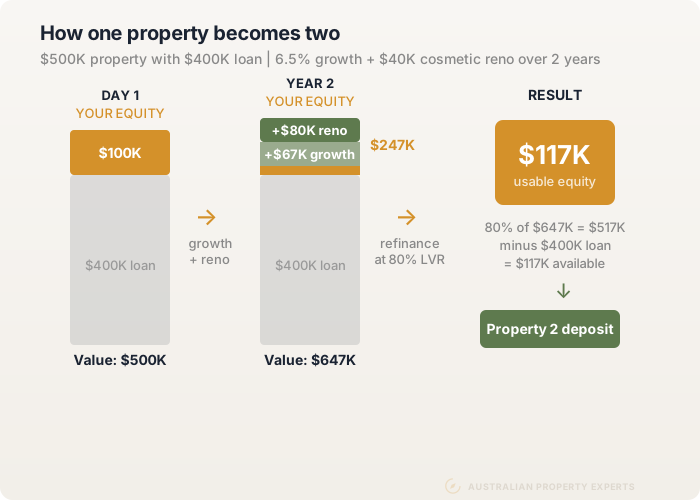
Once the work is done and the market has caught up, the next step is the revaluation. We have run the full sequence with real numbers in equity recycling: one property into three.
Australian dwelling values rose 66.5% over the ten years to August 2026, about 5.2% a year compounded (Cotality). On a $500,000 property, that’s roughly $26,000 a year of organic growth ($500,000 x 5.2%) before you’ve done anything. Growth is not guaranteed in any single year. National values were 3.6% below their March 2026 peak at the end of August. Add a $40,000 cosmetic reno that lifts the valuation by $80,000 and you’re sitting on $100,000+ of equity within 12 to 18 months of settlement.
Most lenders will release equity up to 80% of the new valuation without lenders mortgage insurance. If your $500,000 property revalues at $620,000, the new 80% line is $496,000. Subtract your current loan balance and you’ve got the deposit and stamp duty for the next purchase, plus a buffer. Work out the stamp duty on the next one first, because it changes what deposit you actually need. The stamp duty calculator has the rates for every state.
Model the cash flow on your next investment property before you buy.
Use the calculator →
The full cycle starts at settlement. Reno over three to four months, then lease at the new market rent. Wait six to nine months for the lease and organic growth to season. Order a revaluation. Refinance the released equity into a split or cash-out facility. That funds the deposit on property two.
On the numbers above, property two can be two to three years away. A strong reno in a rising market can shorten that. When it takes five years, check the loan structure before blaming the market.
Build the team before you need it
You don’t scale a portfolio alone. Four professionals matter, and they come in roughly this order:
A good investment-savvy mortgage broker is the single most important relationship in the whole exercise. The right broker spreads your loans across multiple lenders to keep your borrowing capacity intact. They keep every loan stand-alone rather than cross-collateralised and set up interest-only and offset accounts. They also tell you when you’re about to hit a serviceability wall before you find it on settlement day. A bank lending manager can’t do this. They only know their own product.
A buyers agent comes in for sourcing, due diligence and negotiation, especially on interstate purchases where your knowledge of the market is thin. The negotiation savings on a single deal can cover the fee. The bigger value is access to off-market stock, which we cover in how to find off-market properties. For the fee side in plain numbers, see how much a buyers agent costs.
A property-savvy accountant matters from property one. They handle depreciation schedules, negative gearing claims, the question of whose name to buy in, and (later) when a trust starts to pay off. A general accountant doing your business returns is not the right person for this.
A financial adviser fits in once the portfolio is big enough that property is one piece of a wider picture. They look at superannuation, insurance, cash flow, risk tolerance, and how the portfolio fits with the rest of your financial life.
Paying these four people well across the life of the portfolio costs little next to one purchase gone wrong because you tried to do it alone.
When trust structures make sense
For your first property or two, your personal name is usually the right answer. The compliance and tax-return cost of a trust outweighs the benefits while you’re still building the foundations.
The conversation shifts somewhere between property two and property four. A discretionary family trust with a corporate trustee lets you stream rental income to lower-tax-bracket beneficiaries. It gives you asset protection separate from your business or profession. It also creates a vehicle that can hold property across generations. Setup runs around $1,500 to $4,000 in the first year, depending on state stamp duty, the trust deed, and the corporate trustee company. Annual maintenance is roughly $1,000 to $3,500 plus ASIC’s $342 annual review fee for the company (from 1 July 2026).
State land tax matters here. In NSW, a discretionary trust loses access to the individual land tax threshold ($1,075,000 in 2026). That makes trust ownership more expensive once your land holdings cross a certain line. Other states treat trusts differently. Your accountant should model this for your specific position before you commit. Our deeper guide to trust structures for property investors covers the trade-offs.
Other structures sit further down the road: unit trusts for joint ventures, SMSFs for buying inside super, company structures as corporate trustees. None of them are starter moves. Don’t over-engineer property one.
Spread across markets, not just suburbs
A portfolio concentrated in one capital city is a portfolio that moves with one market cycle. When that cycle turns, every property turns at the same time.
We buy across every Australian state because the best opportunity at any given moment is rarely the city you live in. Brisbane, Adelaide and Perth values have more than doubled over ten years, with rises of 64% to 80% in the last five alone (Cotality, August 2026). All three have eased since their 2026 peaks. At current price points the risk-reward equation has narrowed. Melbourne, Hobart and Canberra are still below their 2022 peaks, which puts them at a different point in the cycle.
A balanced portfolio usually mixes capital city growth properties with regional yield plays. The growth properties build the equity that funds the next purchase. The yield properties cover holding costs so the portfolio is sustainable when interest rates move. You need both, which is the argument inside our capital growth vs rental yield post.
The path beyond the first few
Properties one and two are usually established houses in affordable, high-growth markets, bought in personal name, with cosmetic reno on at least one. Properties three and four bring in interstate diversification and the first real conversations about trust structuring. From property five onwards the toolkit widens: granny flats for cash flow uplift, dual-income, dual-key, small unit blocks. Development and commercial property come much later.
Timelines vary, and life gets in the way, which is fine. The variable that separates the investors who get there from the ones who don’t isn’t income. It’s whether they keep running the loop. For the maths on what portfolio size actually funds a retirement, see our guide on how many investment properties you need to retire.
A note on waiting
Every year there’s a fresh reason to delay. Rates are rising, rates are falling, an election is coming, a recession is being forecast, a war is escalating, a virus is spreading. Each one feels different. Each one passes.
A property bought at fair value in a strong location is a long hold. Even after this year’s dip, national values are 66.5% higher than ten years ago (Cotality, August 2026). The risk that gets less attention is the risk of waiting. That means analysing window sizes and bedroom dimensions for three years while the market compounds without you. Education and the right team get you ready. Buying is what actually moves the portfolio forward.
This is general information only and not financial advice. Speak to a qualified professional before making investment decisions.
See how we source the properties that build a portfolio.
If you’d like to map out a portfolio strategy that fits your income, goals and timeline, book a free discovery call.


.jpg)