The single most common question we get from investors starting out is “should I buy in a trust?” The short answer is usually no. The longer answer is that a trust structure for property investment in Australia can be powerful, but only at the right stage and only if the numbers actually stack up for your situation. Our investment structure calculator runs the same portfolio through all three options, so you can see what your own name, a company and a trust each leave you before you pay anyone to set one up.
This is general information, not financial advice. Trust structures involve tax, legal, and asset protection trade-offs that depend entirely on your personal circumstances. Always speak to a qualified accountant before setting one up.
The common myth
The myth is that sophisticated investors buy everything in a trust from day one. Buying your first one or two properties in a trust usually loses you money. You pay $2,000 to $5,000 in setup costs, another $1,000 to $2,500 per year in extra accounting fees, and you forfeit the ability to offset rental losses against your PAYG income. For most first-time investors on a solid salary, negative gearing in personal names produces a bigger tax refund than any benefit a trust can offer at that stage.
Trusts start making sense when the portfolio is generating positive income, not losses. That usually means property three, four, or beyond.
Types of trust structures you’ll hear about
Four structures come up in property conversations. Each does a different job.
Discretionary (family) trust. The most common. The trustee has discretion to distribute income and capital gains between a defined class of beneficiaries each year. Useful when you want to stream income to a lower-income spouse or adult children. This is what most accountants mean when they say “trust”.
Unit trust. Beneficiaries hold fixed units with fixed entitlements, like shares in a company. Less flexibility on distributions, but cleaner for unrelated investors pooling capital or for certain borrowing structures. Some lenders treat unit trusts more favourably for loan servicing.
Company as trustee. Not a trust type itself, but a structural choice. Instead of you personally acting as trustee, a Pty Ltd company does. Costs roughly $800 to $1,500 extra to set up and around $290 per year in ASIC fees, but it gives you cleaner asset protection and makes succession easier when directors change.
Hybrid trust. A mix of discretionary and fixed interests. ATO has been sceptical of these for negative gearing outcomes since the mid-2000s. Most accountants avoid them now.
A corporate beneficiary (a Pty Ltd company that receives distributions from the trust and pays tax at the 25% or 30% company rate) is a common add-on once the trust is producing meaningful income. That layer comes later, not at setup.
When a trust starts making sense
A few scenarios where the maths starts to work:
- Portfolio of three or more properties with positive gearing, so you’re distributing income rather than losses.
- High-income earner with a lower-income spouse who can receive distributions at a lower marginal rate. The ability to stream income to the lower earner each year is one of the core tax benefits.
- Estate planning priority. Trusts survive the death of an individual in a way that personally held assets don’t. If you want properties to pass cleanly to the next generation without triggering a CGT event at your death, a trust changes the picture.
- Asset protection. If you work in a profession with litigation exposure (medical, legal, construction, directors), holding investment assets outside your personal name matters. A trust with a corporate trustee is a standard move.
- Future plans to scale into commercial or development. Trusts fit naturally with more complex structures later, so starting one before the portfolio gets large can avoid restructuring costs down the track.
The land tax problem
This is where trusts get hit hardest, and where most of the online commentary glosses over the reality.
In NSW, a discretionary trust is a “special trust” and does not receive the $1,075,000 tax-free land threshold that individuals get. Land tax applies from the first dollar of taxable land value, at a flat 1.6% up to the premium threshold, then 2%. A fixed trust can qualify for the individual threshold, but only if the trust deed meets strict conditions and is registered with Revenue NSW. On a portfolio with $1.5 million of land that gap is worth about $17,100 a year, every year you hold, which the structure calculator works out for whichever state you are buying in.
In Victoria, trusts pay a surcharge rate on top of the general land tax once the trust’s taxable land value hits $25,000, versus the $50,000 individual threshold. For land values between $25,000 and around $1.8 million, the surcharge adds roughly 0.375% on top of the general rate. Combined with Victoria’s COVID debt levy running through to 2033, VIC land held in a trust is expensive.
In Queensland, a trustee is liable for land tax once the total taxable value of freehold land held for the trust hits $350,000. Individuals get $600,000. Hold three QLD properties in a trust and you’re paying land tax far sooner than you would in personal names.
In South Australia, trust land is subject to a separate trust surcharge unless the trust is designated as a fixed trust and beneficial interests are notified to RevenueSA.
In Western Australia, trusts don’t get a separate penalty, but all land held by the same trustee is aggregated, which can push a portfolio over thresholds faster than expected.
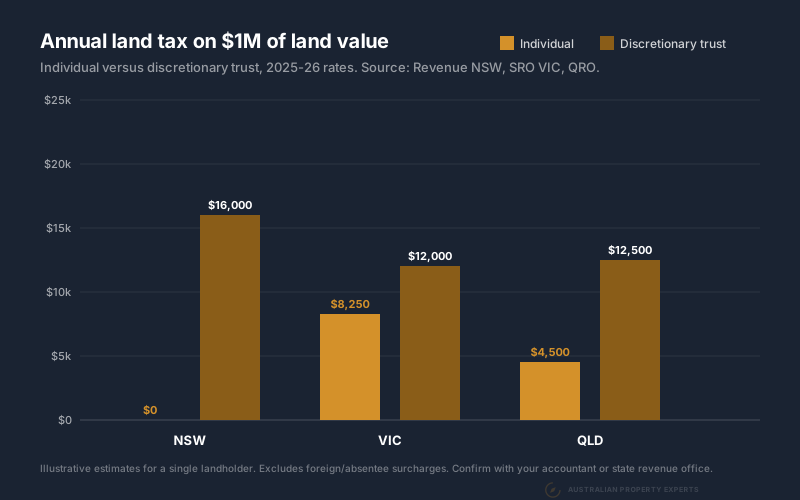
The tax is deductible against rental income, but it’s still a real annual holding cost that needs to be modelled before you settle. For a full state-by-state breakdown, see our land tax by state guide.
Negative gearing doesn’t work the same way
This is the single biggest reason trusts don’t suit early-stage investors. Rental losses inside a trust are trapped. The trust can carry them forward to offset future income or capital gains, but beneficiaries cannot use those losses to reduce their own taxable salary.
In personal names, if your investment property runs at a $15,000 loss for the year, that loss sits on your tax return and reduces your PAYG taxable income. At a 37% marginal rate, that’s around $5,500 back in your refund. In a trust, that same $15,000 loss stays inside the trust, waiting for a future year when the trust produces positive income to offset it.
For investors still in the growth phase, where cash flow is tight and negative gearing is doing real work in the personal return, holding in a trust actively costs you money. For a refresher on how gearing works, see our negative gearing changes guide.
Setup and ongoing costs
Real numbers, based on what accountants and trust deed providers charge in 2026:
- Trust deed: $500 to $1,500 through a deed provider, or $2,000 to $3,500 through a solicitor if you want it drafted specifically to your situation.
- Corporate trustee company: $800 to $1,500 to register with ASIC, including company constitution.
- Set-up consultation and structuring (accountant): $500 to $1,500.
- Annual ASIC fee for the corporate trustee: around $290 per year.
- Ongoing accounting premium: $1,000 to $2,500 per year on top of your normal individual tax return, because the trust needs its own return, distribution resolutions before 30 June, and financial statements.
All in, a trust with a corporate trustee runs roughly $2,500 to $5,000 to establish and an extra $1,300 to $2,800 per year to maintain. Over a decade that’s $13,000 to $28,000 in ongoing costs alone. The tax savings need to outweigh that to make the structure worthwhile.
When individuals still win
For many investors, especially early in a portfolio, personal names remain the better option.
- Cheap to set up. No deed, no ASIC company, no separate tax return.
- Negative gearing flows through. Rental losses reduce your PAYG taxable income immediately.
- 50% CGT discount applies. Individuals holding property for more than 12 months get the 50% discount on capital gains. Trusts can also pass this through to individual beneficiaries, but companies holding property do not get the discount at all. Note: from 1 July 2027 the discount is replaced by indexation with a 30% minimum rate for individuals and trusts alike, with gains accrued before that date grandfathered. The maths is worked through in our 2027 negative gearing and CGT playbook. Run your own numbers through our capital gains tax calculator to see what each regime is worth on your property.
- Full land tax threshold. Each state gives individuals the most generous threshold.
- Simpler lending. Most lenders are set up to assess loans in personal names without additional hurdles. Trust loans often require full recourse personal guarantees anyway.
The pattern we see from experienced investors building a portfolio: first two or three properties in personal names, then bring in a trust once the cash flow turns positive and income streaming becomes valuable.
The accountant question
Before you set anything up, sit down with a property-focused accountant (not a generalist) and get specific answers on:
- What’s your projected rental income and outgoings for the next three to five years, and will the trust be profitable or loss-making?
- How does the land tax hit in each state you’re buying in? Model it with and without the trust.
- Does income streaming to a spouse or adult children actually produce a net benefit after the extra compliance costs?
- What’s the exit plan? Who are the beneficiaries, what happens on your death, and does the deed need specific wording for your state’s land tax rules?
- If you’re in a high-risk profession, is asset protection the real driver? In that case the trust decision stands independent of tax outcomes.
A good accountant will run the numbers both ways (personal versus trust) and show you the 10-year projection. If they can’t, get a second opinion.
What we do at APE
We’re buyers agents, not accountants. We don’t set up trusts or advise on structures. But we work alongside your accountant and broker to make sure the property we recommend is purchased in the structure that actually fits your strategy. For interstate portfolios, that sometimes means adjusting which state we buy in to manage land tax exposure in an existing trust. See how we approach SMSF property buying for a related discussion on structures. Our case studies show how those purchases come together.
The real decision point
Trust structures are a tool, not a status symbol. They work when the portfolio is generating positive income, when you have a lower-income spouse or family members to distribute to, when asset protection genuinely matters to your profession, or when estate planning is a priority. They cost money, compliance time, and negative gearing flexibility. Match the structure to the stage you’re actually at, not the stage you imagine being at in ten years.
This is general information only and not financial, tax, or legal guidance. Trust structures have significant tax, legal, and asset protection implications that depend entirely on your personal circumstances. Speak to a qualified accountant and a qualified solicitor before setting up any trust or making structural decisions about your property investments.
See how we find properties for portfolio investors.
If you’re scaling a portfolio and want to understand how structure choices affect where we recommend buying, book a free discovery call.