
SMSF property investment is one of those topics where the marketing runs well ahead of the reality. Seminars sell the idea of buying property inside your super fund and usually skip the maths.
At June 2026 there were 680,301 self-managed super funds in Australia, holding about $1.1 trillion in assets. Only about 5.5% of those assets sat directly in residential property, on the ATO’s quarterly SMSF statistics.
This guide covers how SMSF property investment works now, what it costs and when it makes sense for property investors in 2026.
How SMSF property buying works
Since 10 August 2026 an SMSF can no longer borrow to buy residential property. Schedule 5 of the Treasury Laws Amendment (Tax Reform No. 1) Act 2026 (Act No. 49 of 2026) narrowed section 67A of the SIS Act. A Limited Recourse Borrowing Arrangement (LRBA) entered into from that date can only buy real property that is business real property. That rule applies whoever the lender is, including a related party. Existing LRBAs are grandfathered, with no forced sale and refinancing still permitted. Contracts exchanged before 10 August are protected even if they settle later. See the ATO and our full breakdown of the ban.
An SMSF can still buy residential investment property outright with cash from the fund. It can still borrow to buy business real property, meaning land and buildings used wholly and exclusively in a business. What it can no longer do is borrow to buy a house or unit held as a rental.
The borrowing rules below now apply to business real property and to residential LRBAs that were already in place before the ban. SMSFs cannot use a standard loan. They use an LRBA, which holds the property in a separate bare trust until the loan is fully repaid.
The “limited recourse” part protects your other super assets. If the fund defaults on the loan, the lender can only take the property itself, not the rest of the fund’s assets.
There are strict conditions:
- One asset per LRBA. Each loan covers a single property in a separate bare trust. Two properties means two separate arrangements.
- No renovations while borrowing. You can’t use the LRBA to fund structural improvements or anything that changes the fundamental character of the property while the loan is outstanding. Repairs and maintenance are fine, but adding a granny flat or knocking out walls is not.
- Business use for the life of a new loan. A property financed under an LRBA from 10 August 2026 must stay business real property for the whole loan. If it stops being used in a business, the fund breaches the borrowing rules.
- No personal use. The property must meet the sole purpose test, which means it exists purely to generate retirement benefits for fund members. No member or related party can live in, holiday in, or get any personal benefit from an SMSF-owned residential property.
- No buying from related parties. Your SMSF generally cannot purchase residential property from you, your family, or any related party. It must come from an arm’s length third party. Business real property is an exception here, but residential is not.
Once the LRBA is fully repaid, the property transfers from the bare trust into the SMSF directly. The borrowing restrictions then fall away.
The tax advantage
During the accumulation phase (while you’re still working and contributing), an SMSF pays a flat 15% tax rate on income, including rental income. If you’re on a 37% or 45% personal marginal rate, that’s a significant difference on every dollar of rent.
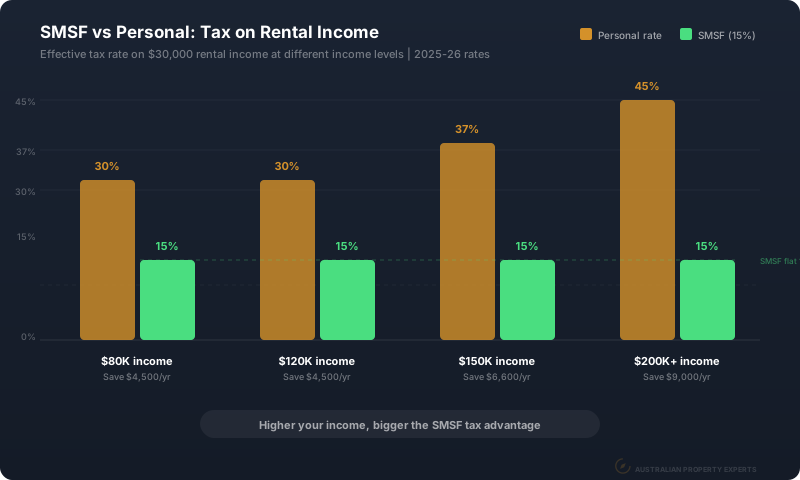
Capital gains get a discount too. If the SMSF holds the property for more than 12 months before selling, it gets a one-third CGT discount. That brings the effective rate to 10%. Outside super you get a 50% discount today. You still pay at your marginal rate, though. For someone earning $200,000+, the SMSF route means 10% CGT versus an effective 22.5% outside super.
One thing to factor in is the 2026 federal budget. Those measures are now law. They replace the 50% CGT discount for individuals, trusts and partnerships with cost base indexation and a 30% minimum rate. The change covers gains that accrue after 1 July 2027. Super funds are not on that list. The SMSF rate stays at 10%. For a high-income investor on a fast-growing property, the personal effective rate rises well above today’s 22.5%. We have modelled who pays more.
In the pension phase (when you’re drawing an income stream in retirement), the tax rate drops to 0%. That means no income tax on rent and no CGT on a sale, which is a big benefit if the numbers work.
SMSF-owned properties can also claim depreciation under the same Division 40 and Division 43 rules that apply outside super. The deductions reduce the fund’s taxable income at the 15% rate, so each dollar of depreciation saves 15 cents in tax. Less impactful than for a high-income individual, but still worth claiming. We covered this in our depreciation guide.
The real costs
The tax numbers look good in isolation. But SMSF property investment comes with costs that eat into those advantages.
Calculate stamp duty for SMSF property purchases across all states.
Use the calculator →
Setup costs: a one-off cost to establish the fund, trust deed, corporate trustee (if applicable) and ATO registration.
Annual running costs: the ATO’s 2023-24 SMSF data puts the median fund’s management and admin expenses at $3,309 a year. The average is $5,164. The independent audit (legally required) and the ATO supervisory levy ($259) come on top, plus ASIC fees if using a corporate trustee. Larger funds sit higher, with a median of $4,582 for funds holding $2 million to $5 million.
Borrowing costs: new residential LRBAs ended on 10 August 2026. Loan rates now matter only for grandfathered residential loans, which can still be refinanced, and for business real property. SMSF lending is a specialist market. Compare the rate against a standard investment loan before you commit.
Funding the purchase: a residential purchase inside super must now be paid for outright from the fund’s existing balance, including stamp duty and costs. That puts residential property out of reach for smaller funds unless the price point suits the balance. Business real property can still be bought with an LRBA. The lender will set its own deposit and fund balance rules.
Liquidity constraints: your fund needs enough cash flow to cover any loan repayments, rates, insurance, management fees and maintenance, all from within the super fund. You can’t just top up from your personal bank account whenever there’s a shortfall. Contributions are capped at $32,500 concessional and $130,000 non-concessional per year (2026-27 figures, ATO). If the property sits vacant for a few months, the fund needs reserves to absorb that.
The ATO’s median for a fund of $500,000 to $1 million was $3,140 a year in management and admin alone in 2023-24. The audit and levy sit on top, before you count the normal holding costs every property investor pays. That overhead needs to be justified by the tax savings.
Division 296: changes from July 2026
This is the big legislative change that affects high-balance SMSFs.
Division 296 became law when the Treasury Laws Amendment (Building a Stronger and Fairer Super System) Act 2026 received Royal Assent on 13 March 2026. It applies from 1 July 2026. It adds tax on superannuation earnings for members with a total super balance above $3 million.
The tiers for 2026-27 are:
- Up to $3 million: Standard SMSF tax rules apply (15% on income, 10% effective CGT)
- Above $3 million: An extra 15% on the share of earnings linked to the balance above $3 million
- Above $10 million: A further 10% on the share of earnings linked to the balance above $10 million
Both thresholds are indexed to CPI ($150,000 increments for the $3M threshold, $500,000 for the $10M), so inflation won’t gradually drag more members in over time. LRBA amounts are disregarded when the ATO works out your balance for Division 296.
One detail matters for property investors. For an SMSF, the earnings figure is an adjusted version of the fund’s taxable income, as the ATO explains. A capital gain on a property is therefore counted when it is realised, generally on sale.
There is transitional relief available. An SMSF can elect to reset the cost base of its assets to market value at 30 June 2026. That way, growth before the tax started is not caught. The election covers every CGT asset the fund held at that date. It cannot be revoked. It must be made by the due date of the fund’s 2026-27 annual return.
For most property investors reading this, the $3 million threshold won’t apply. But if you’re building a substantial portfolio partly through super, it’s worth understanding where the goalposts are.
The rules you cannot break
The ATO doesn’t take SMSF compliance lightly. Trustees can be personally fined between 5 and 60 penalty units per breach. A borrowing breach sits at the top of that scale. In serious cases, trustees can be permanently disqualified.
The most common property-related breaches:
Sole purpose test violations. A member or related party using the property in any way, even briefly, is a breach. No “just staying for a weekend while it’s between tenants.”
Incorrect valuations. The ATO requires market-based valuations for SMSF assets, particularly property. Using purchase price instead of current market value in your fund’s accounts is a compliance risk.
Prohibited borrowing. Any borrowing that doesn’t meet LRBA requirements triggers a breach. That includes a new LRBA over residential property that isn’t business real property. Using borrowed funds to improve (not just maintain) the property counts too.
Late lodgements. Not lodging annual returns on time is a breach in its own right. It can also lead to deeper scrutiny of the fund’s investments.
If you’re running an SMSF with property, the compliance burden is real and ongoing. It isn’t something you set and forget.
When SMSF property makes sense
SMSF property investment works when the numbers add up for your fund. A seminar pitch or an attractive headline tax rate is no substitute for that maths.
It generally makes sense when:
- Your super balance can cover the full purchase price, purchase costs, and a liquidity buffer, since residential property inside super must now be bought outright
- You’re on a high marginal tax rate (37% or 45%) where the 15% SMSF rate delivers a genuine advantage over holding property personally
- You have a long time horizon before retirement, because the real payoff comes in pension phase at 0% tax
- You already have properties outside super and want to diversify the tax treatment of your portfolio
- You’re comfortable with the compliance obligations and costs of running an SMSF
It generally doesn’t make sense when:
- Your super balance is low and you haven’t checked whether running costs erode the tax benefit (the ATO median was $3,309 a year in management and admin in 2023-24)
- You’re within 5 to 10 years of retirement, because you may not have enough time for the tax advantages to outweigh the setup and running costs
- You’re buying your first investment property, where the flexibility and lower costs of buying outside super are almost always a better starting point
- You plan to borrow and then renovate, because LRBA rules prevent structural improvements while the loan is outstanding
- Your fund’s cash flow is tight, since you can’t just inject personal money to cover shortfalls beyond the contribution caps
For most investors building their first or second property, buy outside super first. Build your portfolio where you have full control, can borrow, can renovate, can access equity easily, and aren’t paying fund overheads every year. SMSF property is a tool for later in a portfolio. Whichever side of super you buy on, see what a buyers agent costs to run the search.
Speak to an SMSF specialist before you buy
SMSF property investment pulls in property, super law, tax and lending all at once. It’s not something to figure out from a blog post or a free seminar.
Before you go down this path, you need an SMSF specialist accountant and a financial adviser who understands property. You only need a broker if you are buying business real property or refinancing an existing loan. New residential borrowing inside super ended on 10 August 2026. Get the structure right before you look at property.
For the evergreen pillar guide, see our SMSF property investment page.
This is general information only and not financial advice. SMSF rules are complex and penalties for non-compliance are significant. Speak to a qualified SMSF specialist, financial adviser, and accountant before making any decisions about property investment through superannuation.
See how we source and vet properties for investors.
If you’re building a property portfolio and want to understand where SMSF fits into your strategy, book a free discovery call.