
The RBA lifted the cash rate to 4.35% on 5 May 2026, the third hike of the year. That reversed all three 2025 cuts, and the Board then held at 4.35% in June and August. For property investors, borrowing capacity moves more than the cash rate does. Capacity decides what you can buy.
The three hikes cut about 6.5% off what a fixed repayment budget can borrow. On the average new investor loan of $708,000, that is about $46,000.
How banks calculate your number
Three numbers do almost all the work.
Your assessed loan rate. The bank starts with the actual product rate, then adds APRA’s serviceability buffer of 3 percentage points. The average variable rate on new investment loans was 6.4% in July 2026 (RBA table F6). Add the buffer and the assessment rate is about 9.4%. Every dollar you borrow is tested at that higher rate.
Your debt-to-income (DTI) ratio. From 1 February 2026, APRA limits each bank’s new lending at a DTI of six times income or more to 20% of new loans (APRA). The limit applies to investor and owner-occupier lending separately, measured each quarter. APRA said the pick-up in high-DTI lending was driven by investors, so investors feel it first. Loans for new dwellings and owner-occupier bridging loans are exempt.
Your existing commitments. Other loans, credit card limits, HECS, dependants and existing rental income all change the income the bank counts. Banks assess cards at the full limit, whatever the balance. APRA expects a haircut of at least 20% on rental income for vacancy and costs. Some lenders shade it harder.
Put these three together and you have your real ceiling. The cash rate moves the assessed loan rate, which moves capacity. The DTI limit puts high earners with big portfolios into a capped share of each bank’s lending.
What each 0.25% hike actually costs you
Hold your monthly repayment budget fixed and each 0.25% hike cuts the loan it supports by about 2.2%. The three 2026 hikes together cut it by about 6.5%.
The working, for a 30-year principal and interest loan:
- Capacity = monthly budget x [1 minus (1 + r/12)^-360] / (r/12), where r is the assessment rate.
- Before February, a variable investor rate of about 5.65% plus the 3% buffer gave an 8.65% assessment rate.
- At 8.65%, a $708,000 limit implies a monthly budget of $5,519.
- At 9.40% (6.40% plus 3%), that same $5,519 supports $662,136. The loss is $45,864, or 6.5%.
The $708,000 figure is the average new investor loan in the June quarter 2026 (ABS Lending Indicators). The $1.2 million row is the couple on $200,000 in the next section, at six times income.
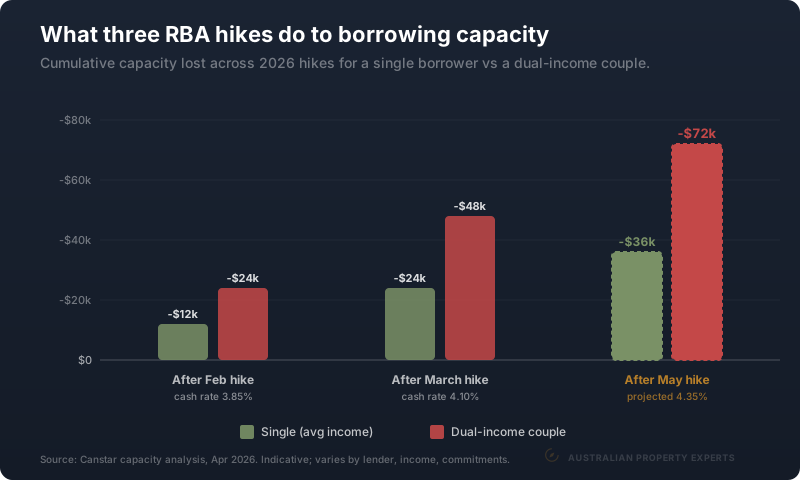
| Borrowing limit before February | After Feb hike (3.85%) | After March hike (4.10%) | After May hike (4.35%) |
|---|---|---|---|
| $708,000 (average new investor loan) | -$16,000 | -$31,000 | -$46,000 |
| $1,200,000 (couple on $200,000 at 6x) | -$27,000 | -$53,000 | -$78,000 |
That is about $78,000 less capacity for that couple in three months. For a buyer who pre-approved before February, those numbers explain why the property they were chasing may now be out of reach without more deposit.
Where most investors run into a wall
The cash rate is the headline. The DTI limit is the quieter constraint, and it bites earlier than most investors realise. We have mapped where it stops a portfolio, and the eight levers that move it, in the serviceability wall.
Take a couple on $200,000 combined gross income. Six times $200,000 is $1.2 million of total debt. If they already have an owner-occupier mortgage of $700,000, $1.2 million less $700,000 leaves $500,000 before they reach 6x. Any investment loan past that point lands in the bank’s capped 20% share of high-DTI lending. A growing portfolio can hit that line before it hits a rate ceiling.
Some lenders will assess investment property rental income inside the DTI calculation, which extends the runway. Others will not. Lender choice now matters as much as the rate itself.
Lifting your capacity from here
A few things still move the needle.
Refresh your pre-approval often. The RBA Board meets eight times a year, and each decision can move your number. A pre-approval from before February is almost certainly stale. A six-week-old number is usually still in the right ballpark.
Choose your lender deliberately. Lender policies on rental income shading, casual income, bonuses, share dividends and trust distributions vary widely. Two lenders looking at the same applicant can produce very different capacity numbers. A good broker shops the policy fit as well as the rate.
Reduce stated commitments where possible. Banks assess credit cards at the limit, so cancel cards you do not use. Pay down high-interest consumer debt before applying. APRA’s guidance gives 3% of the limit a month as an example assessment. On a $10,000 limit that is $300 a month, which at 9.4% over 30 years would support about $36,000 of loan.
Know what interest-only loans do to capacity. Interest-only lowers your actual repayments, which helps cash flow. It does not lift borrowing capacity. APRA expects banks to assess interest-only loans on principal and interest over the term left after the interest-only period. A $500,000 loan at 9.4% is assessed at $4,168 a month over 30 years. With five years interest-only, it is assessed over 25 years at $4,334 a month. Talk to your broker and accountant about the trade-off.
Avoid lender cross-collateralisation. Each property securing each loan independently keeps your structure flexible and your capacity portable. Cross-securitised structures lock you into a single lender and reduce future options.
Stay below the 6x DTI line where possible. Once you cross 6x, you are competing for a capped share of each lender’s book. APRA notes a lender near its limit may offer a smaller loan or defer the application. A purchase that takes you from 5.8x to 6.2x might be the wrong purchase right now, even if the property itself stacks up.
What we are doing for clients
A few patterns in how we work through the squeeze.
We are checking pre-approvals at the broker before going under contract. A 48-hour broker check before exchange is low-cost insurance against a finance fall-through.
We are pushing harder on yield. Sydney houses return a 2.9% gross yield on Cotality’s August 2026 figures. Against a 6.4% average investor loan rate, that leaves a large monthly shortfall to fund. We screen for growth and yield together.
We are buying in the affordable corridors. Cotality’s August 2026 index shows higher-value housing still recording larger falls amid serviceability constraints. The gap has narrowed as lower-priced homes also start to fall. That is what borrowing-capacity compression looks like. Our April 2026 update tracked how it started.
We are pacing the portfolio. A purchase a year through a tightening cycle beats two purchases now that max out capacity and lock you out of the next opportunity. Compounding only works if you can keep buying. If you want that pacing managed for you, here’s whether a buyers agent is worth it.
What this means for your next purchase
Borrowing capacity in 2026 is being squeezed from two sides. The RBA has moved rates up, which compresses the serviceability number on every loan. APRA’s DTI limit, live since February, caps how much high-DTI lending each bank can write. Investors who treat their capacity number as a static figure are getting caught short. Investors who treat it as a moving target, refresh often and pick their lender deliberately are still buying.
If you want a current read on your specific capacity number across two or three lender scenarios, talk to your broker before you talk to anyone else. That is the call that decides what comes next.
This is general information only and not financial or lending advice. Borrowing capacity numbers are indicative and depend on your specific lender, income mix, and existing commitments. Speak to a qualified mortgage broker for a current assessment.
See how we find properties that work at today’s rates.
If you want a strategy that maps your capacity to the right markets, book a free discovery call.


.jpg)