
Investment property tax deductions reduce your taxable income. The more you claim legitimately, the less tax you pay. But the ATO has specific rules about what qualifies, and getting it wrong can mean penalties, interest, and amended returns.
Here’s every deduction available to Australian property investors, what you can’t claim, and the mistakes that attract ATO attention.
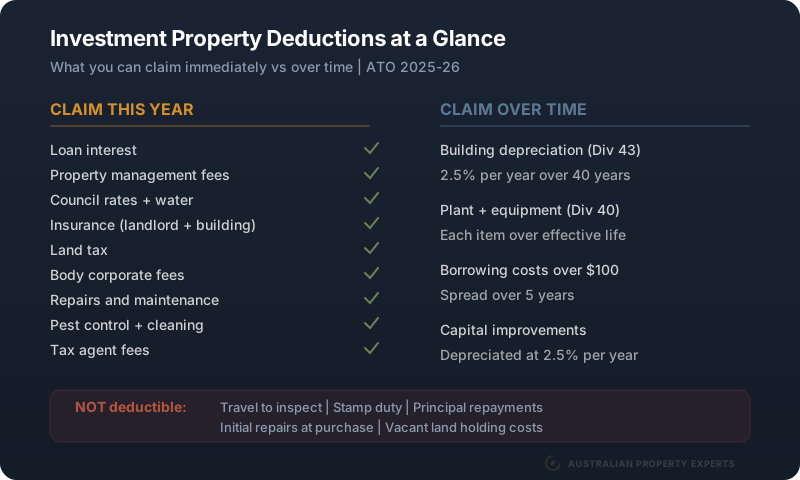
Immediate Deductions
These are expenses you can claim in full in the financial year you incur them.
Loan interest. The biggest deduction for most investors. Every dollar of interest on a loan used to purchase or improve your investment property is deductible. On an interest-only loan, 100% of your repayment is deductible. On a P&I loan, only the interest portion qualifies, and it shrinks each year.
Property management fees. Management fees (5.8% to 8.7% of rent depending on the state), letting fees for finding tenants, lease renewal fees, and advertising for tenants. All deductible. What each one should actually cost is in our property management fees breakdown.
Council rates. Your quarterly council rates are fully deductible for the period the property is rented or genuinely available for rent.
Water charges. Water rates and usage charges are deductible. If the tenant pays usage directly, you can only claim the base rate.
Insurance. Landlord insurance, building insurance, and public liability insurance. All deductible in the year you pay.
Land tax. Deductible as an operating expense. Use our land tax calculator to estimate your liability.
Body corporate fees. Strata levies, including both administration and sinking fund contributions, are deductible. For more on how these affect your returns, see our body corporate fees guide.
Repairs and maintenance. Fixing something that’s broken or worn to restore it to its original condition. Replacing a cracked window, patching a wall, fixing a leaking tap, repainting a faded room. These are immediately deductible.
Pest control. Termite treatments, pest inspections, and ongoing pest management.
Cleaning. End-of-lease cleaning, regular cleaning during vacancy, and garden maintenance while the property is between tenants.
Legal expenses (some). Costs for evicting a non-paying tenant or pursuing unpaid rent. Legal costs for purchasing the property are NOT immediately deductible (they’re added to your cost base).
Stationery and phone. The portion of your phone, internet, and stationery costs that relate to managing the rental property.
Tax agent fees. The portion of your tax return preparation that relates to your rental income.
See how your deductions reduce your after-tax holding costs. Model different scenarios with actual tax rates.
Use the calculator →
Capital Deductions
These expenses are claimed over multiple years, not in a lump sum.
Depreciation, Division 43 (building). The building structure itself depreciates at 2.5% per year over 40 years. For a building constructed after 15 September 1987, you can claim 2.5% of the original construction cost annually. On a $300,000 build cost, that’s $7,500 per year. For a deeper look at how this works, see our depreciation schedules guide.
Depreciation, Division 40 (plant and equipment). Fixtures, fittings, and appliances inside the property: carpet, blinds, hot water systems, air conditioning, ovens, dishwashers. Each item depreciates over its ATO-determined effective life. For properties purchased after 9 May 2017, only new plant and equipment can be claimed by subsequent owners, not items already in the property at purchase.
Borrowing costs. Loan establishment fees, valuation fees, title search fees, mortgage registration. If the total exceeds $100, these are spread over 5 years (or the loan term, whichever is shorter). Under $100 is claimed immediately.
Capital improvements. Renovations, extensions, or structural changes to the property. These aren’t immediately deductible. Instead, they’re added to the building’s depreciable base and claimed at 2.5% per year under Division 43.
What You Can’t Claim
Travel to inspect the property. Since 1 July 2017, individual investors cannot claim travel costs to inspect their rental property. No flights, accommodation, car expenses, or meals. The only exception is if you’re in the business of property investing (most individuals are not). This is one of the most commonly overclaimed deductions and the ATO actively monitors it.
Initial repairs at purchase. If you buy a property and fix existing issues before renting it out, those costs are capital improvements, not repairs. Replacing a kitchen that was already worn when you bought the property is not a repair. It’s an improvement and must be depreciated over time.
Private use portion. If you use the property for personal purposes for any part of the year, you must apportion your deductions. Holiday homes listed on Airbnb but used personally for some weeks cannot claim 100% of expenses.
Acquisition costs. Stamp duty, conveyancing fees, and legal costs of purchasing the property are not deductible. They’re added to your cost base for capital gains tax purposes. Our capital gains tax calculator factors these in when you eventually sell.
Principal loan repayments. Only interest is deductible. The principal portion of a P&I loan repayment is not a tax deduction.
Holding costs on vacant land. Holding costs for vacant land (interest, rates, land tax) have been denied since 1 July 2019 unless you’re running a business on the land or it’s used in a primary production business.
Common ATO Red Flags
The ATO has flagged rental property deductions as a priority area. In 2021-22, rental property owners claimed over $48 billion in deductions. The ATO reviews approximately 300,000 rental property returns every year.
Interest after refinancing. If you refinance your investment loan and draw down extra for personal use (car, holiday, home renovation), only the interest on the original investment portion is deductible. The ATO matches loan records with bank data.
Repairs vs improvements. Replacing a few broken tiles is a repair. Retiling the entire bathroom is an improvement. The distinction matters because repairs are immediately deductible while improvements must be depreciated. The ATO’s test: did you restore the item to its original condition, or did you improve it beyond that?
Claiming for periods not rented. Your property must be genuinely available for rent to claim deductions. Setting an unrealistically high rent to discourage tenants while claiming deductions doesn’t work. The ATO considers whether the property was advertised, whether you rejected reasonable tenants, and whether the asking rent was at market rate.
Paying a contractor with no ABN. The no-ABN withholding rules (47% on payments over $75) apply to payers carrying on an enterprise, which most private landlords are not. If you hold property through a business or trust, ask your accountant before paying a tradesperson who will not give you an ABN.
Getting Your Records Right
Good records are the difference between claiming everything you’re entitled to and leaving money on the table, or worse, having claims denied on audit.
Keep receipts for everything. Every expense related to the property needs a receipt or statement. Bank statements alone aren’t always sufficient. The ATO expects itemised invoices for larger expenses.
Get a depreciation schedule. A quantity surveyor inspection typically costs $600 to $800 and identifies thousands in annual deductions. It’s one of the highest-return investments you can make as a property investor. The cost of the schedule itself is also deductible.
Separate your loan accounts. If you refinance or redraw, keep investment funds completely separate from personal funds. Mixed-purpose loans create apportionment headaches and audit risk.
Use a property-specialist accountant. A general accountant who does one or two rental returns a year will miss deductions that a property-specialist finds routinely. The difference in claimed deductions typically far exceeds the fee difference. The same logic applies to buying; here’s what a specialist buyers agent costs.
For more EOFY-specific strategies, including timing your deductions and prepaying expenses before 30 June, see our tax tips guide.
When you eventually sell, those deductions interact with the gain: how much capital gains tax you pay on an investment property.
This is general information only and not tax advice. Tax outcomes depend on your individual circumstances. Always consult a qualified tax professional before making decisions about your investment property deductions.
See how we buy investment properties for clients.
If you want help structuring your next investment property purchase for maximum tax efficiency, book a free discovery call.