Body corporate fees are the one cost that makes unit investing a different exercise to house investing. They come out of the rent before you see it, they rise on a schedule nobody consults you about, and if you buy without reading the strata report first they will quietly rearrange your cash flow projections.
Body corporate, strata, owners corp
Every state has its own name for the same legal entity. It is a body corporate in Queensland, Tasmania and the NT. An owners corporation in Victoria, NSW and the ACT. A strata or community corporation in South Australia. A strata company in WA.
Same structure, same job, different letterhead. This post uses “body corporate” for all of them.
What the fees actually pay for
Buy a unit, townhouse or apartment in a strata scheme and you become a member of the body corporate whether you wanted to be or not. Your levies fund everything outside the walls of your own lot, split across two pots.
The administration fund covers the running costs. Building insurance is by far the largest line in it, followed by common area cleaning and gardening, lifts, fire systems and security, the body corporate manager’s own fee, and the power and water for common areas.
The sinking fund is the one to look at. It pays for the big irregular jobs: the roof, waterproofing, repainting, replacing lifts and hot water systems and intercoms, structural work, and whatever the ten-year plan says is coming.
A healthy scheme puts at least 25 to 30% of total levies into the sinking fund. Anything meaningfully below that means the maintenance is not being skipped, only postponed, and you will meet it later as a special levy.
What body corporate fees cost
The range is enormous, driven mostly by what the building has in it.
| Property Type | Annual Fees |
|---|---|
| Townhouse (small complex, no pool) | $1,500 - $3,000 |
| Standard unit (walk-up, no lift) | $2,500 - $4,500 |
| Mid-rise apartment (lift, basic amenities) | $4,000 - $7,000 |
| High-rise apartment (gym, pool, concierge) | $7,000 - $15,000+ |
Put that against a real property. A $5,000 annual levy on a $450,000 unit renting at $400 a week takes more than a full percentage point off your net yield before you have paid rates, insurance or a property manager.
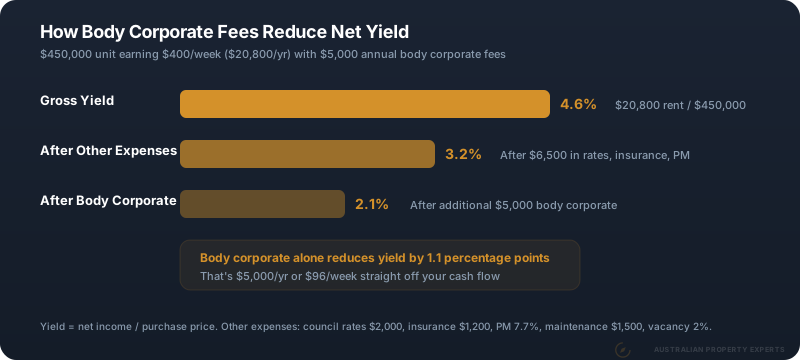
Factor in body corporate fees, vacancy, management costs, and all expenses to see your true net yield.
Use the calculator →
What pushes a levy up is predictable enough. Every amenity is a maintenance contract, so a pool, a gym, a sauna or a rooftop terrace all show up on the invoice. Older buildings cost more to repair and more to insure. A small complex spreads the same bills across fewer owners. Inner-city service costs run higher. And high-rise buildings carry lifts, fire systems and facade maintenance that a walk-up simply does not have.
One warning about new stock. Developer-sold apartments routinely launch with levies set low enough to make the investment numbers work on the brochure. Three to five years in, once the sinking fund has to face what the building actually needs, those levies can double. Ask for the trajectory, not this year’s figure.
A house and a unit, same rent
Two properties, both renting at $420 a week, or $21,840 a year.
The house costs $500,000. No body corporate. Council rates, insurance and maintenance run about $5,500 a year, so it nets around 3.3%.
The unit costs $400,000. Body corporate takes $5,500. Rates and its share of insurance add about $2,000. Net yield: roughly 3.6%.
On gross yield the unit wins comfortably, 5.5% against 4.4%. After the levies the gap almost disappears, and the house still has land underneath it, room to renovate, and no committee that can vote you a special levy. That is the main reason we lean toward houses over units for investment clients.
None of which makes units unbuyable. The right one, in the right location, with levies you have actually verified, can be a strong cash flow property. The difference is whether you knew the number before settlement or found it out after.
Red flags in the strata report
Order a strata report on any strata property before you go unconditional. It runs $200 to $350 and it is the only place the scheme’s finances and its politics are both written down.
Start with the sinking fund balance and hold it against the building’s age. A twenty-year-old block sitting on $50,000 with no capital works plan is not a saving, it is a bill with no date on it yet. Then look at the special levy history. One levy for a genuine emergency is ordinary. A pattern of them says the scheme has been underfunded for years.
Check how the fees have moved. Three to five percent a year is just insurance and labour doing what they do. A 20% jump in a single year needs an explanation, and the minutes should contain one.
Then read the minutes themselves, two years of them. They will tell you more than the financials. You are looking for litigation, with owners or builders or neighbours, because it drags on and it costs. You are looking for unpaid levies, which mean either owners in financial trouble or a manager who does not chase. You are looking for a ten-year capital works plan, and its absence is its own answer. And you are looking at how the committee behaves: the same argument in four consecutive meetings, or a quorum they cannot make, tells you who will be handling the next $200,000 decision.
When high fees are worth paying
A high levy is not automatically a bad one.
A well-run building charging $8,000 a year with a full sinking fund, a professional manager and nothing deferred is a better buy than a neglected one charging $3,000 with a facade repair coming that nobody has budgeted for.
High fees make sense when the lift or pool or gym is genuinely lifting the rent, when the insurance is high for a reason you can name (coastal, flood-prone, high-rise), when the sinking fund is full and the ten-year plan is real, and when you can walk the common areas and see the money.
They are a problem when the amenities sit unused but still get serviced, when levies have climbed sharply and nothing about the building has improved, when the sinking fund is still thin despite years of high levies, or when the management company’s own fee looks out of proportion to a building this size.
Run the real number through the cash flow calculator. If the property still works after the levy, the levy is fine.
What to check before you sign
- Order the strata report. It is not optional at $200 to $350.
- Weigh the sinking fund balance against the building’s age and condition.
- Read the last two years of meeting minutes end to end.
- Ask the manager directly what special levies are planned or being discussed.
- Compare the levy to similar buildings nearby. Well above average and well below average are both worth a question.
- Check the insurance policy. Underinsurance is a growing problem in flood and cyclone areas.
- Put the levy into your yield calculation. The after-everything number, not the gross.
That checklist is part of due diligence on every unit purchase we run. Here is whether that help is worth paying for.
If you are buying your first investment property and it is a unit, this is the cost you are most likely to underestimate. Get the number before you sign, not after.
This is general information only and not financial advice. Speak to a qualified professional before making investment decisions.
See how we assess and buy investment properties for clients.
If you want help analysing unit investments and strata costs in any Australian market, book a free discovery call.