Maybe you’ve been thinking about buying an investment property for years. Maybe you started looking last week. Either way, the gap between “I should invest” and “I’ve bought my first property” is where most people get stuck.
This guide is a practical starting point, covering the things that actually matter when you’re buying your first investment property.
Why property works in Australia
Property works in Australia for two structural reasons.
Borrowing power. You can borrow 80-90% of the purchase price. A 10-20% deposit gives you control of an asset worth five to ten times your cash contribution. If that asset grows by 5% in a year, your return on the cash you put in is 25-50%. No other mainstream asset class lets you borrow at that ratio as an everyday investor.
Compounding growth. Australian dwelling values rose 66.5% over the ten years to August 2026, about 5.2% a year compounded (Cotality). That compounds. A $500,000 property growing at 5.2% a year is worth about $830,000 in ten years ($500,000 x 1.052^10). In twenty it is worth about $1.38 million ($500,000 x 1.052^20). The longer you hold, the harder compounding works for you.
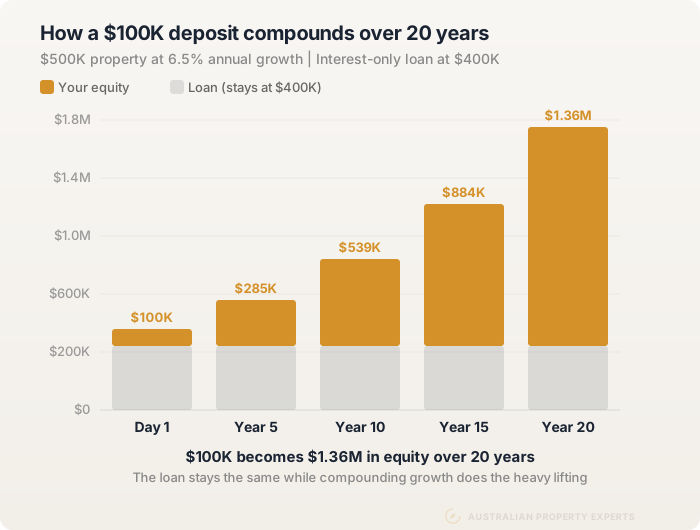
That said, these are averages. Values can fall. National values were 3.6% below their March 2026 peak at the end of August. Individual properties in individual suburbs can do much better or much worse. The suburb you choose, the property you buy, and the price you pay all matter more than most people realise.
How much you need to get started
The numbers depend on your state, your loan structure and the property price. But here’s a rough guide for a $500,000 investment property.
- Deposit: 10-20% ($50,000 to $100,000). A 20% deposit avoids Lenders Mortgage Insurance (LMI), but many investors start with 10-15%. At 10% the loan is $450,000, and one lender’s published table charges 1.873% at that size. That is about $8,429 of LMI ($450,000 x 1.873%), plus state duty on the premium. At 15% it drops to about $4,118 ($425,000 x 0.969%). Our LMI calculator shows what the premium costs at each deposit size.
- Stamp duty: Varies by state. Budget $20,000 to $37,000 on a $700,000 property depending on where you buy. The ACT is lowest, then QLD, and VIC is highest. See our stamp duty by state guide for the full breakdown.
Calculate exact stamp duty for any property price across all Australian states. Includes bracket breakdowns and first home buyer concessions.
Use the calculator →
- Legal/conveyancing fees: $1,500 to $3,000.
- Building and pest inspection: $500 to $800.
- Loan application and valuation fees: $500 to $1,000.
- Worked examples below: we allow $3,500 for these three items together.
- Buffer: At least 3-6 months of holding costs in reserve for vacancies, repairs, or rate rises.
All up, you’re typically looking at $73,000 to $129,000 in cash to purchase a $500,000 investment property. That’s before your buffer. It depends on your deposit size and state.
- Lowest, 10% deposit in the ACT: $50,000 deposit + $11,400 duty + $8,429 LMI + $3,500 other costs = $73,329.
- Highest, 20% deposit in Victoria: $100,000 deposit + $25,070 duty + $3,500 other costs = $128,570.
Stamp duty figures come from our stamp duty calculator at general investor rates. If that sounds like a lot, it is. But remember the borrowing power point above. That $73,000 to $129,000 gives you control of a $500,000 asset.
The three numbers that matter
When evaluating any investment property, these are the numbers to focus on.
1. Rental yield
This is the annual rent as a percentage of the purchase price. A $500,000 property renting for $450 per week ($23,400/year) has a gross yield of 4.7%. Yield tells you how much cash flow the property generates. Higher yield means lower out-of-pocket costs each month. For a first property, anything above 4.5% gross is a reasonable starting point. Below 3.5% and the holding costs will be significant. For a deeper look at how yield and growth work together, see our guide to capital growth vs rental yield.
2. Capital growth potential
This is harder to measure because it’s forward-looking. But you can assess it through historical suburb growth rates, supply constraints (limited land, heritage overlays, established areas), population growth, infrastructure investment and proximity to employment centres. Use actual data, not hotspot articles or selling agent forecasts.
3. Vacancy rate
The percentage of rental properties sitting empty in a given area. Below 2% is tight (good for investors). Above 4% is loose (harder to find tenants, downward pressure on rents). A high-yield property in an area with 6% vacancy is a different proposition to a high-yield property in an area with 1.5% vacancy. The vacancy rate tells you how reliable that yield actually is.
Common beginner mistakes
These are the ones we see most often, and they’re also the most expensive.
Buying emotionally
Investment properties aren’t homes. You don’t need to love the kitchen or imagine yourself living there. The only question is: does this property deliver strong returns for the price?
The most common emotional mistake is buying close to home because it feels comfortable. Your best investment might be in a suburb you’ve never visited, in a state you’ve never lived in. The numbers don’t care about your postcode.
Not running the numbers
ATO data shows 54.7% of individuals with rental income recorded a net rental loss in 2023-24. That is 1,276,669 of 2,332,653 people (ATO taxation statistics). More than half were cash-flow negative.
Some of that is deliberate negative gearing strategy. The rules have changed for new purchases. Losses on established dwellings bought after 7.30pm on 12 May 2026 carry forward from 2027-28 against rental income and gains, not salary. Speak to your accountant about how negative gearing applies to your tax situation.
But a lot of it is investors who didn’t model the holding costs before they bought. Loan repayments, council rates, insurance, property management, maintenance, vacancy allowance, water rates, strata fees. These add up fast. Run the numbers before you make an offer rather than after. If the property doesn’t stack up on a spreadsheet, it won’t stack up in reality.
Model the full cash flow on any investment property before you buy. Income, expenses, loan costs, and net position.
Use the calculator →
Choosing the wrong location
This is the most consequential decision you’ll make. The difference between a suburb that grows at 7% per year and one that grows at 2% is hundreds of thousands of dollars over a decade. Location research means looking at population growth, employment diversity, infrastructure investment, supply pipelines, school catchments and historical price performance. In our experience, it takes 10-20 hours per week to do well. That’s not an exaggeration. Serious suburb analysis requires pulling data from multiple sources and cross-referencing it.
Skipping due diligence
Professional building and pest inspections regularly catch issues that would cost thousands to repair. Termite damage to structural timber is one of the most expensive. Never skip an inspection to save $500, which is a gamble with terrible odds rather than a saving. Read our complete building and pest inspection guide for what to look for, what it costs, and when to walk away.
Trying to time the market
Every year, someone tells you the market is about to crash. Every year, someone else tells you it’s about to boom. Both are usually wrong, or at least wrong about the timing.
The investors who build real wealth buy well-researched properties at fair prices and hold them for 10-20 years. They don’t wait for the perfect moment because there’s no such thing. We’ve put the data behind that in what past fear markets did next: the forecasts, the troughs, and who ended up paying more.
How to choose a location
Location selection is the single most important skill in property investment. Here’s a simplified framework.
Population growth. More people means more demand for housing. Look for areas with consistent population growth driven by employment and lifestyle, not just one-off events.
Employment diversity. Single-industry towns are risky. If the mine closes or the factory shuts down, property values collapse. Look for areas with diverse employment across multiple sectors.
Infrastructure investment. New transport links, hospital upgrades, university expansions. These drive demand and signal government confidence in the area’s future.
Limited supply. Areas where new housing is constrained (established suburbs, geographic barriers, planning restrictions) tend to see stronger price growth. Demand there can’t be easily met by new construction.
Rental demand. Look for low vacancy rates and strong rental growth. The tenant demographic should match the property type (young professionals, families, students, retirees).
These matter as a set, cross-referenced against the data, rather than any one of them on its own.
When to get help
A full investment property search, from strategy to settlement, can easily take 100+ hours of work. Suburb research, property sourcing, inspections, negotiation, due diligence, coordination with solicitors and lenders. Some people have the time and inclination for that. Many don’t.
Plenty of first-time investors sell within a few years. The most common reasons are buying in the wrong location, overpaying, or underestimating holding costs. All of these are avoidable with better research and guidance upfront.
Buyers agents exist for this reason. Not to sell you a property (that’s the real estate agent’s job). But to help you buy the right property, at the right price, in the right location for your goals. The negotiation savings alone can cover the cost of the service.
Where to from here
Property investment is straightforward in principle. Buy a good property in a good location, at a fair price, and hold it for a long time. The compounding does the heavy lifting. In practice, every step of that sentence requires research, analysis and discipline. The investors who build serious portfolios are the ones who treat it like a business decision, not a gut feel.
Your first property sets the trajectory for everything that follows. Get it right, and it becomes the foundation of a portfolio. Get it wrong, and you may stay with the 71.6% of individual investors who hold just one rental property, per 2023-24 ATO taxation statistics. If you’re priced out of buying a home in your city, rentvesting might be the smarter way in. The rent vs buy calculator puts numbers on that choice.
This article provides general guidance only and is not financial, tax, or legal advice. Always consult a qualified professional before making investment decisions.
See how we help investors buy their first property.
If you’re thinking about your first investment property, book a free discovery call.


.jpg)