Buyers Agent Burnie
Up 15.2% in the year to August 2026, the strongest growth of any regional market in Tasmania. A $5 billion undersea power cable is being built to a converter station at Heybridge, a few kilometres east of town, and houses still change hands around $455,000 in Acton.
Investment Property Specialists
Cotality's September 2026 index put the Burnie-Ulverstone region at a $578,979 median and 15.2% annual growth, ahead of Launceston and Devonport, and it did that while national home values fell for a fifth straight month. Burnie is also the market most people get wrong, because the figure they look up is for a 1.4 square kilometre pocket of 693 people that sells eleven houses a year. The city's roughly 20,400 residents live in Acton, Park Grove, Montello, Upper Burnie, Shorewell Park, Romaine and a dozen other localities. Reading them at that level is most of the job here.
In a market this thin, how fast a property would sell again matters as much as what it rents for, so we test both before anything reaches your shortlist. Australian Property Experts works for investors only, on one flat fee, and takes nothing from developers or selling agents. Peter Ly founded it, holds 17+ investment properties in his own name, and has bought 250+ for clients across every state. If Tasmania is new to you, our guide to regional property markets in 2026 is a good place to start.
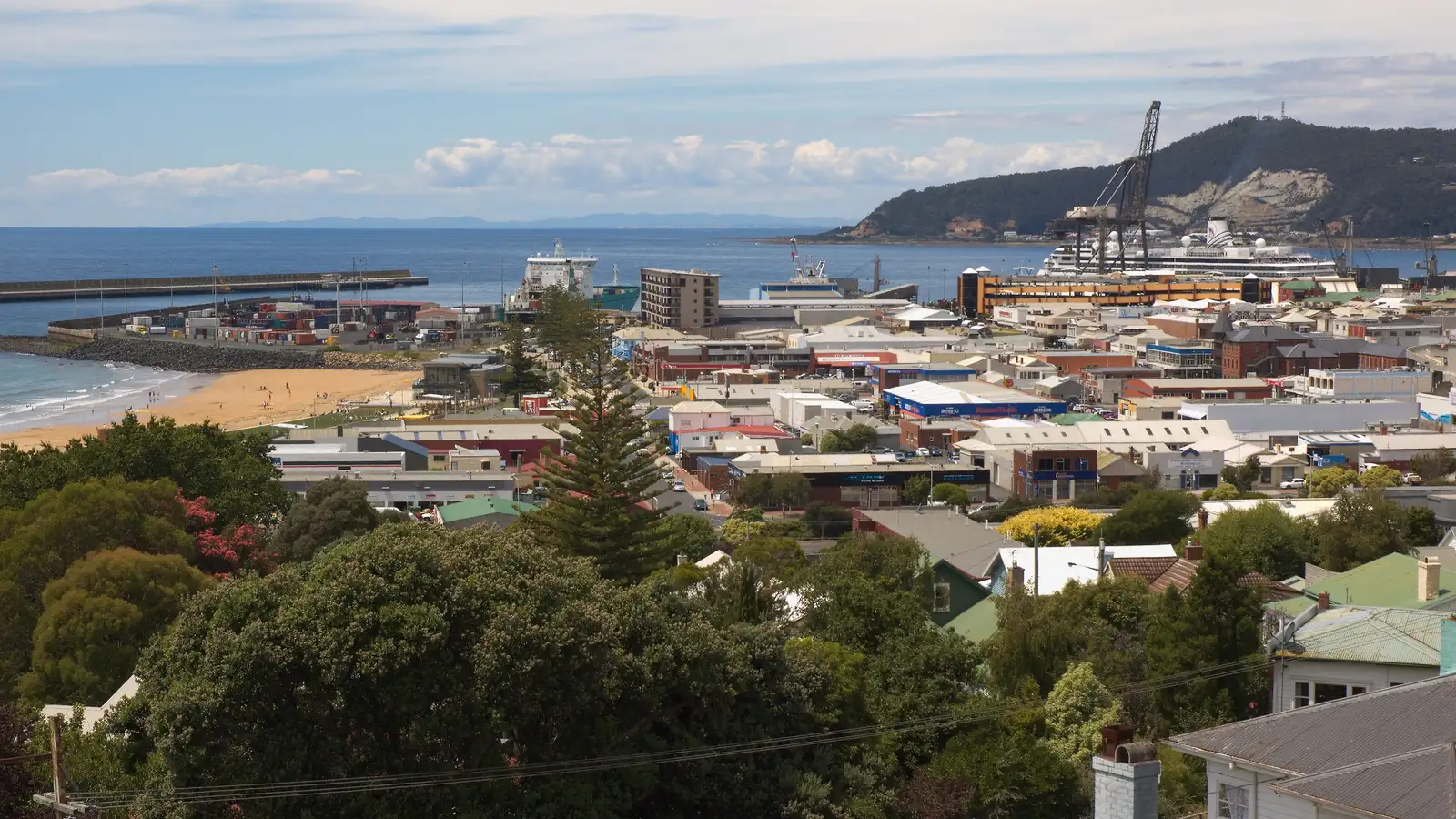
Burnie is the commercial centre of Tasmania's north-west coast, a city of about 20,400 people whose port handles roughly a third of the state's freight by tonnage, more than any other port in Tasmania. Its economy runs on the port, health, education, food manufacturing and mining, and it is about to spend four years as the landing point for the biggest energy project in the state's history. It is also a market where the published data is unusually easy to misread.
Here's what we bring to a Burnie purchase:
Search "Burnie median house price" and you get $540,000 built on eleven sales in a CBD pocket of 693 people. Cotality's own reliability threshold is twenty sales, so that figure does not clear the bar its publisher sets. We work off the Burnie-Ulverstone region for the market call and off the seven Burnie localities that do clear twenty sales for the property call. Acton alone sold 55 houses in twelve months, five times the locality everyone quotes.
Hillcrest computes 5.08% on a $461,000 median and $450 a week. Acton computes 5.03% at $455,000 and $440. Upper Burnie sits at 4.98%. Those are gross figures worked out from the median and the rent shown beside them, not copied from a yield column. The published columns on the major portals do not reconcile to their own medians and rents. We check the arithmetic on every suburb before it goes in front of a client.
SQM Research recorded 17 vacancies in postcode 7320 in July 2026, a rate of 0.67%. That is up from 0.24% in March, so the direction is worth watching, but it is still comfortably under 1%. UTAS also bought the Wellers Inn in June 2026 for student accommodation ready for Semester 1 2027, which takes more beds out of the private rental pool.
Plenty of Burnie articles still quote a $1.2 billion mine expansion. Grange Resources booked a $690.7 million non-cash impairment in its half year to 30 June 2026 and disclosed that its major shareholder would not provide financial support to the project at this stage. Meanwhile the $86.5 million courts complex started piling in August 2026 and Marinus Link reached a final investment decision in August 2025. We buy against the things that have contracts and concrete, not announcements.
Most Burnie investors we work with are in Melbourne or Sydney. We inspect, we run the numbers, we negotiate, and we hold the purchase together to settlement, so a north-west Tasmanian purchase costs you a few phone calls rather than flights and a weekend.
The localities below all cleared twenty house sales in the twelve months to May 2026, which is Cotality's own threshold for a figure it will stand behind. Every yield is that locality's median weekly rent multiplied by 52 and divided by its median price. Days on market is the locality's own figure, and it matters more here than in most markets.
The busiest house market in the Burnie LGA and the one we look at first. It combines the deepest trading with a yield above 5% and an eighteen day sale time, which is a rare set of three in north-west Tasmania.
Thirteen days on market is the quickest of any Burnie locality clearing twenty sales. Buying where stock moves in a fortnight means you are competing, so we tend to work Montello off-market rather than through the portals.
Three kilometres south of the centre, close to the hospital precinct, and priced between the affordable pockets and Park Grove. Thirty-eight days to sell is slower than Acton, so we buy here on price rather than on pace.
Hillcrest computes the strongest gross house yield in Burnie. It also takes fifty days to sell, the slowest on this list, so we only buy here at a price that pays for the wait.
Park Grove is the dearest sizeable locality in Burnie and the second busiest at 48 sales. The yield drops to 4.08% at that price. Romaine holds up better at 4.72% and sells in 24 days, and the new 18-unit social housing build on Atkins Drive started there in June 2026.
The wider Cotality region takes in all four, and every one trades more deeply than Burnie's centre. Somerset is the pick on our numbers, selling in seventeen days at 4.70%. Ulverstone is the busiest of the four at 107 sales.
Two localities we will not quote figures for: Wivenhoe publishes no house median, rent or growth at all, and Havenview publishes a median but no house rent, so no yield can be worked out for either. We would rather say that than fill the gap with an estimate.
How It Works
We've refined this across 250+ purchases. In Burnie the first two steps carry more weight than usual, because picking the right locality inside the city decides most of the outcome.
A quick conversation about your goals, budget, timeline and how much risk you want to carry. We'll tell you straight whether Burnie suits what you're trying to do, or whether Devonport, Launceston or somewhere on the mainland is the better fit.
We work through your borrowing position and what the purchase has to do for you, then map it against the Burnie localities by yield, turnover and days on market. You see the arithmetic behind every suburb we put forward.
Burnie had 142 listings in August 2026 and 27 of them had been sitting more than 180 days. Sorting the genuinely overlooked from the justifiably unsold is the work. We search the portals and our off-market network across the north-west coast.
On every shortlisted property we arrange building and pest inspections, comparable sales analysis, and rental appraisals. In a market this thin the comparable sales work takes longer, because there are fewer of them and they need reading carefully.
Long days on market cut both ways, and on a property that has been listed six months you are the one with room to move. We use it.
We coordinate your solicitor, broker and property manager through to settlement, and introduce you to a property manager based on the north-west coast.
Typical timeline: 6 to 12 weeks from engagement to settlement, depending on finance and how quickly the right property comes up.
Burnie's nearest big-city market is across Bass Strait, and Melbourne buyers make up most of our north-west Tasmanian work. $455,000 buys a house here. Two hours from the Melbourne CBD it buys very little.
You want the rent to carry most of the holding cost from settlement. Hillcrest and Acton are the two we point you at, and we'll model the cash flow on your actual rate and deposit before you commit.
You hold three to ten properties on the mainland and you want Tasmanian exposure at a price that still works. You know what you're doing and you want someone on the ground who can move quickly when the right thing comes up.
A smaller deposit goes further here than in almost any mainland market. We'll also be direct about what makes Burnie harder than a capital city, because the parts that catch first-time buyers out are the exit and the depth of the tenant pool, not the buying.
New residential borrowing inside an SMSF was prohibited from 10 August 2026, so a fund purchase now has to be funded from cash the fund already holds. That rules the strategy out for some buyers entirely. We work with specialist SMSF lawyers and would rather walk through it with you before you go any further.
Getting to Burnie means a flight to Devonport or Launceston and a drive, or the overnight ferry. Doing that repeatedly to inspect houses costs you weekends you won't get back. We do the travelling.
Your Buyers Agent
Founder & Principal Buyers Agent
Peter spent almost a decade in banking and finance before turning a deep interest in property and data into Australian Property Experts. That analytical background shapes everything we do.
If Peter wouldn't buy it himself, he won't recommend it to a client. His own portfolio spans houses, townhouses and units across multiple states, so the strategy he brings to your purchase comes from real experience rather than theory.
What Peter likes is that the growth arrived while the national market was falling, and it did not need a boom price to do it. The rent here still covers a real share of the holding cost, which is not true of most markets that have run this hard.
What he weighs against it is the employment base. One mine, one port, one hospital and a university campus is a narrow spread for a city this size. The higher-yielding pockets also take fifty days to sell, so you do not get out quickly if you need to. He would buy Burnie for a five to ten year hold, at a price that pays for both.
Based in Sydney, buying Australia-wide. We service Burnie investors remotely, with on-ground inspections and coordination from contract through to settlement.
We charge a clear flat fee based on the scope and complexity of your purchase. No percentage-based fees and no hidden charges.
Flat Fee Pricing
Strategy session, property search on and off-market, due diligence, negotiation and settlement coordination for a single residential investment property in Burnie or the wider north-west coast.
Flat Fee Pricing
SMSF, family trusts, company structures, or properties needing development approval or subdivision analysis. The fee reflects the extra due diligence and specialist coordination involved.
Custom Pricing
Buying 2 to 5 or more investment properties across Tasmania? We offer volume pricing. Talk to us about the portfolio rather than the first purchase.
Why flat fees? Percentage-based fees create a conflict of interest: the more you pay for a property, the more the buyers agent earns. A flat fee means we're incentivised to negotiate the best price rather than push you toward a dearer property.
All four markets below come from one source on one date, Cotality's Home Value Index for September 2026, with values at 31 August 2026. They are median valuations across houses and units combined, which is why they differ from the suburb medians further up this page. Comparing markets on one consistent basis matters more than using the flattering number for each.
| Market | Median value | 12-month change |
|---|---|---|
| Burnie-Ulverstone | $578,979 | +15.2% |
| Launceston | $672,071 | +14.9% |
| Devonport | $617,147 | +12.5% |
| Greater Hobart | $752,397 | +8.1% |
Our read: Burnie suits an investor buying for yield and a five to ten year hold, who can accept that selling may take a couple of months rather than a fortnight. If a fast exit matters more to you than the entry price, Devonport is the better call, and if you want a bigger and more diversified economy, Launceston is the better call. We'd rather tell you that on a 15 minute call than sell you the wrong market.
Weighing up Burnie against other markets? We're an investment property buyers agent working across every Australian state, and the brief gets built around the numbers rather than the postcode. See our client case studies for what that looks like in practice, or the buyers agent fees guide for pricing.
Background reading for any Burnie investor before booking a call.
Get Started
A 15 minute call to understand your goals, your budget, and whether Burnie is the right market for what you're trying to build.
A buyers agent is licensed to search, assess and negotiate property on behalf of the person buying it. The agent selling the house works for the owner and is paid to lift the price. We are hired by you and paid to hold it down.
A buyers agent handles the search, the assessment, the negotiation and the paperwork that follows, so the only thing you do is decide.
You get an experienced negotiator on your side of the table and a shortlist built from data rather than from whatever happened to be advertised that weekend.
On the numbers it has had a strong run. Cotality's September 2026 Home Value Index, with values at 31 August 2026, puts the Burnie-Ulverstone region at a $578,979 median and 15.2% annual growth. That is the strongest of the regional Tasmanian markets in that table, ahead of Launceston at 14.9% and Devonport at 12.5%. House yields still compute above 5% in Acton and Hillcrest, and vacancy in postcode 7320 was 0.67% in July 2026 on SQM Research figures. Marinus Link is under construction, with its converter station at Heybridge a few kilometres east of Burnie. The counterweight is liquidity and a narrow employment base, both covered further up this page.
On Cotality's index to 31 August 2026, Burnie-Ulverstone grew faster than both. It ran 15.2% against Launceston's 14.9% and Devonport's 12.5%, and it is the cheapest of the three on that measure, at a $578,979 median against $672,071 and $617,147. Devonport is the more liquid market, with about 429 house sales across its localities in twelve months against Burnie's 335, and more buyers active at any given moment. Launceston is the bigger and more diversified economy, and its north-side suburbs reach higher yields than Burnie's best. If a fast exit matters most, Devonport. If you want the strongest recent regional growth on the lowest regional median, Burnie.
We buy investment property and nothing else, and most clients come back for a second and third purchase. Every brief is built from your own numbers. Our agent relationships run across every state, so we are never stuck recommending the one market we know. We also offer project management of renovation work.
We start with a strategy session to understand your needs and investment goals. From there, we use our network and market knowledge to find suitable properties. Once we identify the right one, we handle due diligence, negotiate terms, and manage the purchase, keeping you informed every step of the way.
Regional medians and 12-month growth: Cotality Home Value Index, September 2026 report, index results at 31 August 2026 (median valuations, houses and units combined). Locality medians, sales volumes and days on market: Cotality via Your Investment Property, 12 months to May 2026, with the median weekly rent published alongside them. Every gross yield on this page is that locality's median weekly rent multiplied by 52 and divided by its median price, worked out by us rather than taken from a published yield column, because those columns do not reconcile to the medians and rents shown beside them. Vacancy rates, listing counts and listing age: SQM Research, postcode 7320, July and August 2026. Ten-year growth: HtAG, Burnie City Council, based on typical (automated valuation) prices rather than sale medians. Population: ABS Regional Population, estimated resident population for the Burnie local government area, rounded. Marinus Link cost, financing and timing: Marinus Link and ABC News, following the final investment decision of August 2025. Burnie Courts Complex value and construction dates: Burnie City Council. Grange Resources impairment and shareholder funding position: the company's half-year report to 30 June 2026 and its ASX announcement of 13 May 2026. First home buyer duty exemption dates: State Revenue Office Tasmania. Localities with fewer than 20 annual sales fall below Cotality's own reliability threshold and we have flagged them where they appear. Figures are current as at 3 September 2026 and are general information, not personal financial guidance.