
Every property investor hits this question: do you buy for capital growth or rental yield?
Get the answer wrong for your situation and you’ll stall at one property. In the latest ATO taxation statistics, for 2023-24, 71.6% of individual property investors own just one investment property. Another 18.8% own two. The figure has sat between 71% and 72% in every year since 2018-19. A first purchase that doesn’t match your financial position is one way to end up in that group.
The choice determines whether you build wealth or tread water. If you’re new to property investing, our beginner’s guide covers the fundamentals.
What capital growth actually means
Capital growth is the increase in your property’s value over time. A property bought for $500,000 that’s worth $700,000 five years later has delivered $200,000 in capital growth, or roughly 7% per year compounded.
Growth-focused buyers usually target established suburbs with strong fundamentals: proximity to the CBD, good school catchments, infrastructure investment, limited new supply, and consistent population growth.
The trade-off is lower rental yield. Premium suburbs can yield 2% or less. Mosman houses compute to 2.26% and Toorak to 1.62%. The rent doesn’t cover your holding costs, so you top up from your own pocket each month. Nor is the growth guaranteed. Mosman’s median fell 9.3% in the year to June 2026.
What rental yield actually means
Rental yield is the annual rental income as a percentage of the property’s value. A property worth $400,000 renting for $400 per week ($20,800/year) has a gross yield of 5.2%. Whether 5.2% is any good depends entirely on the loan behind it, which we set out in what is a good rental yield.
High-yield properties are typically in regional centres, outer suburbs, or mining towns. Areas where purchase prices are lower relative to rents.
The usual trade-off is weaker capital growth, though not always. Armadale in Perth computes to a 4.84% house yield. Its median rose 115% over the ten years to June 2026. A property returning 7% yield but only growing at 2-3% per year generates cash flow today but builds less equity over time.
The compounding maths
This is where the numbers tell the real story.
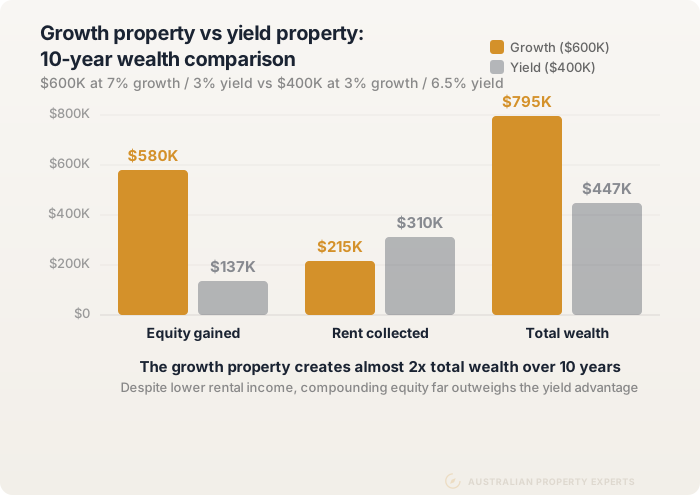
Growth-focused property:
- Purchase price: $600,000
- Growth rate: 7% per year
- Yield: 3%
- After 10 years: worth approximately $1,180,000
- Equity gained: ~$580,000
- Total rent collected: ~$215,000 (assuming modest rental increases)
Yield-focused property:
- Purchase price: $400,000
- Growth rate: 3% per year
- Yield: 6.5%
- After 10 years: worth approximately $537,000
- Equity gained: ~$137,000
- Total rent collected: ~$310,000 (assuming modest rental increases)
The 7% growth rate is an assumption. It is a generous one. Cotality has national dwelling values up 5.2% a year over the past decade.
On these assumptions the growth property generated over four times more equity. The yield property generated better cash flow year-to-year. Neither is wrong. But they serve very different purposes in a portfolio. You can see the hold-time effect in real numbers across 19 investor purchases. There, the same state and the same buyer produced wildly different growth depending purely on how long the property had been held.
Calculate gross and net rental yield for any property. Full expense breakdown and ROI metrics included.
Use the calculator →
Over 20 years, the gap in equity widens significantly. Compounding growth on a higher base value is the engine that builds serious wealth in property. But you have to be able to hold the property for those 20 years. That’s where yield comes in.
When to prioritise growth
Growth should be the focus when:
- You have strong income and can comfortably cover the shortfall between rent and expenses.
- You’re early in your investment journey and have time on your side. Growth compounds. The earlier you buy, the longer it works for you.
- You’re building equity to leverage for your next purchase. Growth properties give you the equity to borrow against for property two, three, and beyond.
- Your goal is long-term wealth rather than immediate income replacement.
Most investors under 45 with stable professional incomes should lean toward growth as the primary driver, without ignoring yield entirely.
Lean toward growth, but read the numbers at both ends. Melbourne’s blue chip units yielding up to 6.19% have gone backwards over five years, so a high yield on its own is no protection. On the Sunshine Coast, Buderim’s median house is $1,402,500 and Maroochydore’s is $1,250,000. Both compute to yields of about 3.5%. You are buying the growth and funding the gap out of your own income every month.
When to prioritise yield
Yield becomes more important when:
- Your borrowing capacity is tight. High-yield properties reduce the cash top-up required each month, which means the bank sees less risk and will lend you more.
- You already own growth assets and need to balance the portfolio with cash flow to sustain your holding costs.
- You’re approaching retirement and want passive income rather than equity you can’t easily access.
- You’re scaling a portfolio. After two or three growth properties, the cumulative holding costs can strain even a good income. A yield property can offset those costs and free up capacity for the next purchase.
Why the best portfolios use both
The question is rarely growth or yield, because a portfolio that keeps scaling needs both of them working together.
A well-structured portfolio might look like this:
- Property 1: Growth-focused house in an established capital city suburb. This is your equity engine.
- Property 2: Balanced property with moderate growth and solid yield. Helps with cash flow while still building value.
- Property 3: Higher-yield property that offsets the holding costs of properties 1 and 2, freeing up borrowing capacity for the next purchase.
Each property has a specific job. Growth properties build equity. Yield properties fund the portfolio. Balanced properties do a bit of both.
One way to get stuck at one property is to buy a moderate-growth, moderate-yield property. It didn’t build enough equity for a second purchase. It didn’t generate enough cash flow to make the owner comfortable holding it long-term. It sat in the middle and did neither job well.
The mistake that costs the most
ATO data shows 54.2% of individual investors recorded a net rental loss in 2023-24, up from 49.4% the year before. More than half.
Some of that is deliberate negative gearing. Some of it comes from investors who never modelled the numbers before buying. They bought on emotion, on a hot tip, or on a selling agent’s promise of growth that never materialised.
What costs the most is skipping the numbers. That means going in without stress-testing the holding costs, or without working out whether the property is a growth play, a yield play, or an expensive compromise.
Getting the balance right
Capital growth builds wealth over time. Rental yield sustains your portfolio while it grows. The best strategy depends on where you are financially, how many properties you own, and what you’re trying to achieve.
Your strategy should come from your own numbers, your borrowing capacity and your long-term plan. Gut feel, whatever your mate bought and whichever suburb made the news last week are poor guides. A good buyers agent can help with this. We cover whether one is worth it.
Both growth and yield feed into the portfolio maths for retirement. Growth builds the equity you’ll eventually unlock. Yield keeps you holding long enough to capture it.
This is general information only and not financial or tax advice. Speak to your accountant or financial adviser about how these strategies apply to your situation.
For what that yield gap costs in dollars each week, see our model of what an investment property costs you per week across all eight capitals.
See how we find properties with both growth and yield.
If you want help mapping out a strategy that matches your financial position, book a free discovery call.


.jpg)