Ask what a good rental yield is and almost everyone lands on 5%, or somewhere between 5 and 6%. Those numbers were set when money cost about half what it costs today, and they have been repeated ever since without anyone checking them against a current loan. What counts as good for you depends on what you are borrowing and what the place costs to run, so it shifts whenever rates or your deposit shift.
How to calculate rental yield
Gross rental yield is the annual rent divided by the purchase price.
A property renting at $600 a week earns $31,200 a year, and on a $650,000 purchase that works out to a gross yield of 4.8%. Weekly rent times 52, divided by the price, times 100, and our rental yield calculator will run it on your own numbers.
Every listing and every market report quotes the gross figure, which makes it handy for comparing one market against another. It also ignores every cost except the purchase price, so on its own it will not tell you much about whether you can afford to hold the place.
Gross yield vs net yield
Net yield takes the running costs out of the rent first.
Property management averages about 7.5% of rent collected nationally and a fair bit more in some states. Then there are council rates, water, landlord insurance, repairs, and the weeks the place sits empty between tenants. Across a portfolio those tend to land somewhere around 25% to 30% of gross rent on a typical property, and none of that has touched the interest yet.
So the $600-a-week property grossing 4.8% is netting closer to 3.4% by the time the bills are paid. Strata shifts it again, which we cover in the body corporate fees breakdown, and for working out whether you can carry a property the net figure is the one to start from.
What counts as a good rental yield
The comparison that settles it is your yield against your interest bill, which is the part the rules of thumb leave out.
The RBA’s lenders’ rates series puts the average new variable investor loan at 6.41% for July 2026. Borrow 80% of the price at that rate and interest alone costs you 5.13% of the purchase price every year.
That leaves two different bars, and it is worth knowing which one you are talking about:
- Rent covers the interest. You need a 5.13% gross yield at an 80% loan. We modelled this capital by capital in what an investment property costs per week, where the bar came out at 5.04% on a slightly lower 6.3% rate.
- Rent covers interest and the running costs. Take 30% off the rent first and the bar climbs to 7.33%.
The higher one is the figure to plan around, since the running costs turn up whether you budgeted for them or not.
The yield your loan actually needs
The bar is set by your deposit more than by the market. Same rate, same costs, different loan size:
| Your loan (LVR) | Yield to cover interest | Yield to cover everything |
|---|---|---|
| 90% | 5.77% | 8.24% |
| 80% | 5.13% | 7.33% |
| 70% | 4.49% | 6.41% |
| 60% | 3.85% | 5.49% |
| 50% | 3.21% | 4.58% |
Assumes a 6.41% interest rate and running costs at 30% of gross rent.
Drop from an 80% loan to a 60% loan and the bar falls from 7.33% to 5.49% without anything about the property changing. A 4.6% yield that looks poor on a big loan is comfortable on a small one, which is why the question has no single answer and why anyone who quotes you a number without asking about your deposit is guessing.
What Australian markets yield now
Against a 7.33% bar, this is where the country sits. These are Cotality’s gross yields for August 2026.
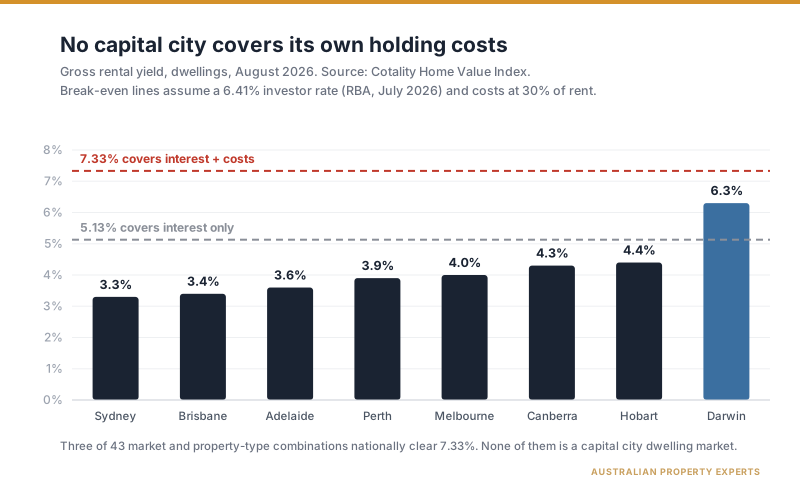
The national gross yield is 3.8%, its highest since September 2019, because rents kept climbing while values fell. Even after that run it sits 3.5 percentage points below the bar.
Across the 43 market and property-type combinations in that table, covering every capital and every rest-of-state region split by house and unit, three clear 7.33%: regional Northern Territory houses at 8.0%, regional Western Australia units at 7.9%, and Darwin units at 7.4%. Six get over the lower interest-only bar.
Cotality puts it plainly enough. Gross yields across the larger capitals “remain well below the level required to achieve a neutral cash flow position for most investors”, and research director Tim Lawless noted yields “would need to rise substantially before rental income offsets holding costs, particularly while interest rates remain elevated”.
Why the 5% rule of thumb is dated
The 5% figure made sense when investors were borrowing at 3%. Interest then cost 2.4% of the price on an 80% loan, so a 5% gross yield covered it twice over with enough left for the rates notice.
At 6.41% the same 5% yield falls short of the interest on its own. Nobody retired the rule when rates doubled, which is how investors end up buying what they were told was a good yield and finding it costs them $300 a week.
How to lift the yield you can get
Three levers move it, and only one of them is the property.
Your deposit. More equity going in means a lower bar to clear, and it is the one variable in the table above you can change today.
Property type. Units out-yield houses in every capital and every region in the country, 4.6% against 3.5% nationally, with Melbourne units running 5.1% against 3.5% for houses. The gap is real, though units carry strata costs and weaker land content, so the house or unit decision comes down to more than yield.
Market selection. The spread runs from Sydney at 3.3% up to Darwin at 6.3%, a wider swing than anything else on this list, and part of why we buy across every state rather than in one. Affordable markets tend to carry the stronger yield and the lower entry price together.
Chasing the highest number on the board is its own mistake. A 9% yield in a single-industry town with thin sale volumes is a different asset to a 5% yield in a growing regional centre, and the yield figure alone will not tell you which one compounds, which is why the growth and yield question is better answered together.
Picking a yield you can hold
A good rental yield is the one that gets you over your own bar with enough margin that a vacancy or a rate rise does not force a sale. At an 80% loan today that bar is 7.33% and almost nothing in Australia clears it, so most investors are buying a shortfall deliberately and funding it from salary while growth does the work. There is nothing wrong with that as a strategy, provided somebody told you the number before you signed.
Work out your own bar before you start looking at listings, because it rules out most of the market in about a minute.
This is general information only and not financial advice. Speak to a qualified professional before making investment decisions.
If you want to know which markets clear your bar on your deposit, book a free discovery call.