There is no flat rate of capital gains tax on an investment property. Your profit is added to your income and taxed at your marginal rate. Get the timing right and it’s halved. The number that lands on your assessment turns on two rules most sellers only meet afterwards.
The calculation below uses real figures, along with both of the rules that move it.
How capital gains tax is calculated
The tax applies to the gain rather than to your sale price. The gain is what you sold for minus what the property cost you. Your cost base is the purchase price plus what it cost to acquire and improve the property. That covers stamp duty, legal fees, building and pest inspections and any capital improvements. Selling costs such as agent commission come off your sale proceeds. Your capital gain is what is left after both.
Capital losses from other assets come off the gain first. If you owned the property for at least 12 months and you are an Australian resident for tax purposes, you then reduce what is left by 50%. What is left is added to your taxable income for the year of sale and taxed at your marginal rate.
That last part is where estimates go wrong. The gain stacks on top of your salary. A large one can push you into a higher bracket than you normally sit in.
A worked example on a $890,000 sale
Take a property bought in 2019 for $520,000 and sold in 2026 for $890,000.
Buying costs were $22,000 in stamp duty, legals and inspections. During the hold, $35,000 went into a new kitchen and bathroom. That counts as a capital improvement. Selling costs were $21,000 in agent commission and legal fees.
Cost base: $520,000 plus $22,000 plus $35,000, so $577,000.
Now the part almost everyone misses. Over seven years the schedule claimed $38,000 in Division 43 capital works deductions. The ATO is direct about this: capital works deductions cannot be included in the cost base. Capital works you could claim come off your cost base at sale, whether or not you actually claimed them. The ATO lists two narrow exceptions, one of them for assets bought by 13 May 1997.
Adjusted cost base: $539,000.
Net proceeds after selling costs: $869,000. Capital gain: $330,000. Apply the 50% discount and $165,000 is added to taxable income.
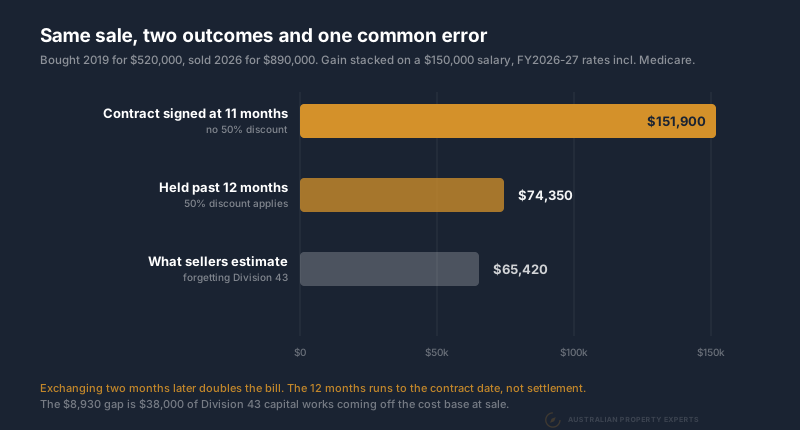
On a $150,000 salary, that $165,000 stacks on top. Most of it lands in the top bracket. Run across the FY2026-27 rates with the Medicare levy, the extra tax is about $74,350. That is an effective 45% on the discounted gain.
Division 43 comes back, Division 40 does not
Had you ignored the capital works add-back, you would have calculated a $292,000 gain, a $146,000 taxable amount and about $65,420 in tax. The real figure is $74,350. That $8,930 gap is the capital works deductions already banked over seven years being squared up at sale.
Only the Division 43 column does this. Division 40 plant and equipment, the carpet, blinds and appliances, sits outside CGT entirely. The ATO says CGT does not apply to depreciating assets used solely for taxable purposes, including items in a rental property. Those are squared up as balancing adjustments through assessable income instead. Applying the cost base rule to a whole schedule overstates the gain.
The contract date that costs you half
The 50% discount needs 12 months of ownership. What catches people is the moment the clock stops. The ATO counts the CGT event. For property, that is the date of the contract, not settlement. You also exclude the day you bought and the day of the CGT event when counting the 12 months.
A seller who signs a contract at 11 months and settles at 13 months has owned it for 11 months as far as the discount is concerned. On the sale above, that means $330,000 taxed instead of $165,000. The tax is roughly $151,900 instead of $74,350.
Same property, same price, roughly double the tax, decided by a signature date. Anyone near the 12 month mark has a reason to check the exchange date with their accountant before signing.
What changes on 1 July 2027
The 50% discount is legislated to end. Under Act No. 49 of 2026, assented 26 June 2026, it is replaced from 1 July 2027. In its place is indexation of your cost base for inflation, plus a minimum 30% tax on the gain for resident individuals. It applies to assets held by individuals, trusts and partnerships.
Investors in new-build property can choose at sale between the 50% discount and the new regime. What counts as a new build is still only a draft. The ATO has also confirmed the changes announced in the 2026-27 Budget do not apply to Tax Time 2026.
The 7:30pm 12 May 2026 cut-off grandfathers negative gearing, not the discount. Every asset a resident individual or a trust holds through 30 June 2027 is treated as sold just before 1 July 2027 and bought back on that date. Growth up to 30 June 2027 keeps the 50% discount whenever you eventually sell. Growth after that date is taxed under the new method. Owning before the Budget protects your deductions, not your discount. Who is affected is set out in our 2027 negative gearing and CGT playbook. The sell-or-hold arithmetic sits in should you sell before July 2027.
Four things that move the number
The 12 month test runs contract to contract. It is worth half the tax, and it turns on exchange dates rather than settlement dates.
Keep every receipt from the purchase. Stamp duty, conveyancing, building and pest, and buyers agent fees on the acquisition all sit in the cost base. Lost the settlement statement? The stamp duty calculator will get you close enough to sense-check what you paid. Receipts you cannot find are costs you cannot add to the cost base.
Capital improvements count, repairs do not. A new kitchen adds to the cost base. Fixing a leaking tap was already deductible against rent.
The gain is assessed in the year the contract is signed. Where income differs between financial years, the exchange date decides which year’s brackets apply.
None of this is a substitute for your accountant, and structure matters too, since a property held in a trust or an SMSF is taxed differently again.
Capital gains tax on inherited property
Capital gains tax on an inherited property is paid when you sell it, not when you inherit it. What you pay depends on when the person who died bought it and how they used it.
If they bought it before 20 September 1985, your cost base is its market value on the day they died. If they bought it later, you generally take over their cost base, so their growth becomes part of your gain. Their home is the exception. Where it was their main residence just before they died and was not earning income, your cost base resets to market value at the date of death. That reset does not apply if you owned it with them as joint tenants.
The gain can be fully exempt. It needs two things. First, they bought it before 20 September 1985, or it was their home and not rented out when they died. Second, the sale settles within two years of the death. You can rent it out in the meantime. The ATO gives an automatic extension of up to 18 months when set conditions are met. Otherwise you have to ask the ATO. It only extends the deadline for exceptional circumstances outside your control.
The two-year limit does not apply if, from the death until the sale, the property is the home of their spouse at the time of death (unless the two had permanently separated), someone the will lets live there, or you. It cannot earn any income in that time. Otherwise you may only get a partial exemption, worked out by days. For the 50% discount, your 12 months start on the day they bought it if that was after 20 September 1985, or on the date of death if they bought before then. The exemptions generally do not apply where the person who died had been a foreign resident for more than six years. They also generally do not apply if you are a foreign resident when you sell. The full conditions are on the ATO’s inherited property and CGT page. Talk to your accountant before you list an inherited property.
Run your own numbers
Our capital gains tax calculator runs this on your own figures. It puts the 2027 rules beside the current discount. It also stacks the gain across the brackets the same way the example above does.
The two numbers worth checking before you sell anything are the Division 43 capital works on your depreciation schedule and the date you plan to exchange. They move the result more than the sale price does. For the levers that bring the number down, see how to reduce capital gains tax on an investment property.
This is general information only and not financial advice. Speak to a qualified professional before making investment decisions.
If you’re weighing whether to sell an investment property or hold it and buy the next one, book a free discovery call.
Sources
- CGT discount rules, 12 month ownership test and the contract-date CGT event: ATO, CGT discount, last updated 29 June 2026
- Capital works deductions and the cost base: ATO, Cost base adjustments for capital works, last updated 22 June 2026
- 2027 changes: Treasury Laws Amendment (Tax Reform No. 1) Act 2026, No. 49 of 2026, assented 26 June 2026
- Depreciating assets outside CGT: ATO, List of CGT assets and exemptions
- Inherited property: ATO, Inherited property and CGT, last updated 22 June 2026, and the ATO pages on the cost base of inherited assets and extensions to the 2-year period
- Tax rates: ATO, Tax rates for Australian residents, 2026-27 year
- Worked example figures are illustrative. Tax is calculated by stacking the gain on a $150,000 salary across the FY2026-27 marginal rates including the 2% Medicare levy, not by applying a single flat rate