Should you sell your investment property before July 2027, while the 50% CGT discount still exists? Plenty of investors are asking. One national news headline put it as “could it spark a rush to sell?” For most people the answer is no. The reason is written into the legislation itself. This guide covers how the deadline works, what selling would cost you and the smaller group of investors who should think about it.
What changes on 1 July 2027
From 1 July 2027, the 50% CGT discount is replaced for individuals and trusts (Act No. 49 of 2026). Gains are instead worked out on a cost base indexed for inflation. Resident individuals then face a 30% minimum tax on what remains. New builds can keep the 50% discount instead. We covered the full reform in our guide to the negative gearing changes. The worked strategy sits in our 2027 investor playbook.
The fear driving the sell-before-the-deadline question is simple. If the discount disappears in under a year, shouldn’t you cash out while it still applies? That misses how the new law treats gains you have already made.
Gains before July 2027 keep the discount
The Act treats a property you hold across 1 July 2027 as sold just before that date and bought back on it. The gain on that deemed sale waits until you actually sell (s112-155 and s112-160). Treasury’s factsheet is explicit about what that means. Assets held across the date “will be treated under current arrangements on gains made prior to this date, and under the new arrangements for gains made after this date”. In other words, every dollar of growth your property has already earned keeps the 50% discount, no matter when you eventually sell. That earlier gain also sits outside the 30% minimum tax (s119-5).
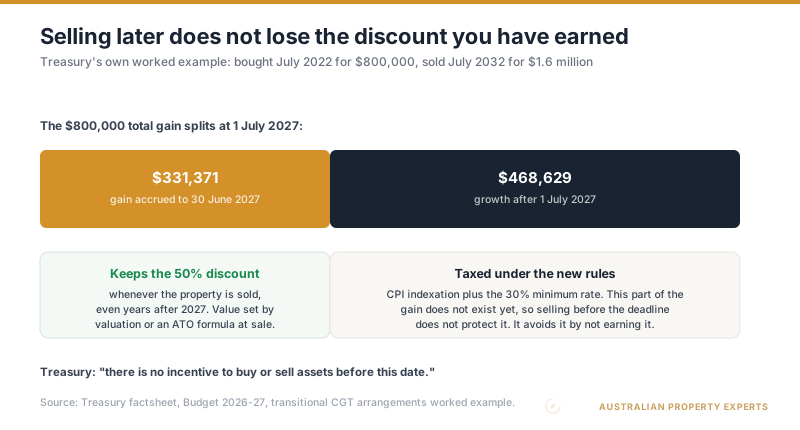
Treasury’s own worked example makes it concrete. A property bought in July 2022 for $800,000 and sold in July 2032 for $1.6 million has made an $800,000 gain. The $331,371 that accrued before 1 July 2027 still gets the 50% discount at the 2032 sale. Only the $468,629 of growth after the date falls under indexation and the minimum tax.
The Act does not make you lock in a value in 2027 either. The deemed sale price is the market value just before 1 July 2027. You can instead choose an apportioning method the Minister will set. That choice waits until you lodge the return for the year you sell (s112-155(3) and (4)). Getting a valuation around the date is still worth considering. Corrs Chambers Westgarth points out that relying on market value can be hard years later without one. But nobody loses the discount by holding.
Treasury even states the conclusion for us: “there is no incentive to buy or sell assets before this date.”
So the deadline only changes the tax on growth that has not happened yet, and selling has real costs.
What a sale would cost you
Selling one property to buy another is one of the most expensive moves in property. On an $850,000 sale and a similar repurchase in Queensland, the exit-and-re-entry bill runs to roughly $53,000 before you pay a dollar of CGT.
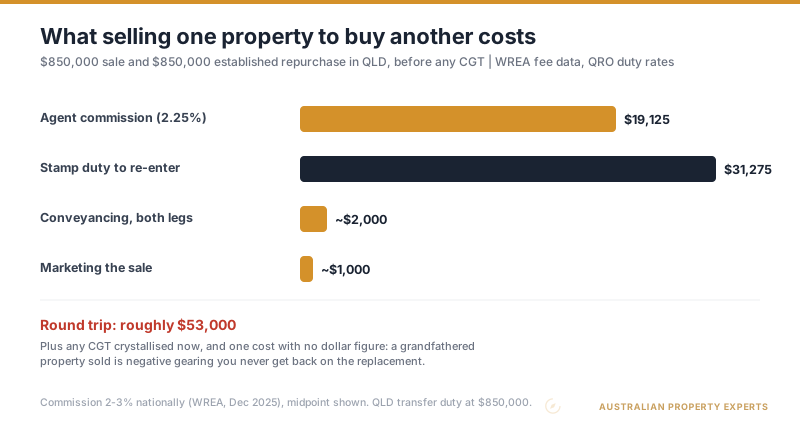
Agent commissions run 2% to 3% nationally. Stamp duty on the way back in is $31,275 at that price in Queensland (check your state with our stamp duty calculator). Conveyancing and marketing add a few thousand more. Selling also crystallises your CGT now instead of deferring it, which hands the tax office money that would otherwise keep compounding for you.
Two more costs sit outside that $53,000. The first is timing. Sydney values were 7.1% below their February peak at the end of August. Auction clearance rates have held below 50% (Cotality). A seller today is selling into the softest market in years. The second is bigger and mostly invisible. If you signed the contract on your property before 7:30pm on 12 May 2026, it is grandfathered. The Treasury factsheet says such properties can be negatively geared “until sold”. Sell it, and any established property you buy to replace it falls under the new rules. From 2027-28, its rental losses carry forward against residential rental income and gains instead of your salary (s26-155).
Who should genuinely think about selling
None of this means nobody should sell before mid-2027. The maths points that way for a few groups.
Investors who were selling anyway. Say a property has underperformed for years on growth and yield, and you would sell it regardless. Selling before 1 July 2027 keeps the whole gain under the current rules and skips the valuation-and-apportionment exercise entirely. The deadline is a scheduling nudge for a decision you had already made, not a reason to make it.
Sellers expecting a low-income year. The new 30% minimum tax only bites for people whose tax on the gain would otherwise work out below 30%. One example is someone selling a large gain after retiring. The test compares 30% of the gain with the basic income tax on it, leaving out the Medicare levy. It has no 12-month holding test (s119-10). The Act exempts anyone who receives certain payments at any time in the income year. The list includes the Age Pension, JobSeeker, Disability Support Pension, Carer Payment, Youth Allowance and Family Tax Benefit (Act No. 49 of 2026, s119-15). If you will not receive one of those payments but your tax on the gain would sit below 30%, realising before the deadline can genuinely save tax. This is exactly the situation to model with an accountant.
Portfolio rebalancers with a clear next step. If the equity in a tired asset would work harder somewhere else, check that the numbers survive the $53,000-style round trip plus CGT. If they do, the current rules make this financial year the cleanest window to do it. Run both sides through our capital gains tax calculator, which models the old regime, the new one and the transition split.
One timing note if you do sell. The Act keeps the current rules for a CGT event that happens before 1 July 2027. For a sale, the ATO says that event happens on the contract date, not at settlement. So a sale contracted in June 2027 falls under the current rules even if it settles later. Confirm your dates with your accountant before you rely on them.
Four questions before you decide
- Would you sell this property on its fundamentals alone? If the answer is no, a tax deadline that grandfathers your existing gains is not a reason to start.
- What does the split actually cost you? Model your property in the CGT calculator with a sale now versus a sale in five and ten years. The difference is usually smaller than the headlines suggest, because the pre-2027 gain is protected either way.
- Have you priced the full round trip? Commission, stamp duty, conveyancing, the CGT you bring forward, and the grandfathered negative gearing you give up.
- Is the equity better released than realised? A loan split against your equity funds the next purchase without selling anything, and keeps the grandfathered property working.
Tax deadlines make poor sell signals
The 2027 changes are real and they matter for what you buy next. But the legislation was deliberately built so that holding through the date costs you nothing on the gains you have already made. Treasury said so in plain words. Pitcher Partners described the wider shift in July. “The direction of policy is clear: less reliance on tax-driven strategies and greater focus on sustainable income and housing supply.” Sell or hold based on the property itself, and treat the date as a minor factor. Whichever way you go, reducing the tax on the sale is a separate job and worth doing first.
Sources
- Treasury Laws Amendment (Tax Reform No. 1) Act 2026, Act No. 49 of 2026
- Tax explainers: negative gearing and capital gains tax - Treasury factsheet, Budget 2026-27
- Capital gains tax and negative gearing amendments - Corrs Chambers Westgarth
- Federal Budget 2026-27: capital gains tax - William Buck
- How capital gains tax changes from 1 July 2027 - Westcourt
- A major tax deadline is coming next year - SBS News
- Australians weigh impact of tax changes - SBS News
- Home Value Index, September 2026 (data to 31 August 2026) - Cotality
- CGT events - Australian Taxation Office
- How much do real estate agents charge? - Which Real Estate Agent
- Queensland transfer duty rates - Queensland Revenue Office
- Budget tax reforms raise risk of ill-advised investment decisions - PIPA via MPA
- Positive gearing in a post-Budget 2026 landscape - Pitcher Partners
For the mechanics of the calculation itself, see how much capital gains tax you pay on an investment property.
If you are buying rather than selling, the same reform lands differently. We have modelled who pays more and who pays less under the new rules. The answer turns mostly on how fast the property grows.
This is general information only and not financial, tax, or credit advice. The transition rules described include elements still to be finalised in guidance, and the right decision depends on your circumstances. Speak to your accountant before selling or restructuring.
See how we find the properties worth holding through any tax change.
If you’re weighing up a sale and want the hold-versus-sell numbers run on your actual property, book a free discovery call.