The debate over the 2027 negative gearing and CGT changes is over. The Treasury Laws Amendment (Tax Reform No. 1) Bill 2026 passed Parliament on 25 June 2026 and received royal assent the next day as Act No. 49 of 2026. Both reforms start on 1 July 2027.
We covered what changed and who is grandfathered when the budget dropped. This post is the strategy layer. It works the numbers on quarantined losses and the maths of indexation versus the 50% discount. Then it covers what to do between now and July 2027.
Now law, not a proposal
Three things worth knowing about the final Act that were not in the budget papers.
The Senate amended it on the way through. The biggest addition bans new SMSF borrowing over residential property from 10 August 2026. If a fund purchase was part of your plan, our SMSF borrowing ban guide covers what still qualifies.
The 30% minimum tax got carve-outs. Age Pension, JobSeeker, DSP and other listed income support recipients are exempt from the new floor. The list is written directly into the Act rather than left to regulation.
“New dwelling” is still being defined. The carve-out for new builds hangs off a definition that is not yet law. The government announced on 18 June that it would sit in primary legislation. The draft Tax Reform No. 3 Bill, released on 4 August 2026, generally treats a property as new if bought within 24 months of its certificate of occupancy. Anyone making a large decision on the new-build exemption is relying on a draft, not law. We’ve worked the whole trade-off through in new build vs established after the Budget.
The four positions
Every investor is in exactly one of these boxes.
- Grandfathered. You owned, or had exchanged on, the property before 7:30pm on 12 May 2026. Negative gearing stays with that property for as long as you hold it. The 50% CGT discount does not. It applies to the gain accrued up to 30 June 2027, and gains from 1 July 2027 are taxed under indexation with a 30% minimum. We have modelled who that leaves better off and who it leaves worse, and the answer is not the flat tax rise most commentary assumes. Selling is what ends the concession, because whatever you buy next sits in one of the boxes below.
- Established, bought after budget night. From 1 July 2027, losses on the property no longer offset your salary. They pool against income from your other residential properties, carry forward, and can be applied against future residential capital gains. Your CGT on sale runs through the new indexation regime.
- New build, bought after budget night. Negative gearing survives in full, and at sale you choose between the 50% discount and indexation, whichever leaves you better off.
- Selling anything after 1 July 2027. Gains that accrued before 1 July 2027 keep the 50% discount. The split uses market value at that date, or a formula you can choose instead. Growth after it falls under the new rules.
What matters now is which box your next purchase lands in, and what that does to your cash flow and the tax when you sell.
Quarantining is a timing problem
Quarantining is the most misunderstood part of the reform. You still get the value of the losses back, just later and at a different rate.
Take an investor on a $120,000 salary who buys an established house after the cutoff and runs it at a $12,000 annual loss. Under the old rules, that loss came off their salary at a 32% marginal rate including Medicare. That was worth $3,840 back each year at tax time.
From 1 July 2027 that refund is gone. The $12,000 pools instead. Five years of it is $60,000 sitting in the carry-forward pool. Along the way, that pool soaks up income from any positively geared residential property in the portfolio. Whatever is left comes off residential capital gains when they sell. Applied against growth after 1 July 2027 that would have been taxed in the top bracket at 47%, a $60,000 pool is worth around $28,200 at settlement. Any gain from before that date takes the pool first. There, the 50% discount halves what each dollar saves.
So you still get the deduction later, sometimes at a higher rate than it was worth against your salary. In the meantime, you fund the holding costs yourself. A property that used to cost you $157 a week after tax now costs you $231. The difference compounds against your borrowing capacity for the next purchase. Run your own numbers through our negative gearing calculator before you commit to carrying that.
The new CGT maths, worked through
From 1 July 2027 the 50% discount is replaced for individuals, trusts and partnerships. Your cost base gets indexed by CPI, so only the real gain is taxed. A new Division 119 puts a 30% minimum rate on real gains for resident individuals. Super funds are untouched. They keep the 33.33% discount.
The same property under both regimes looks like this. Established purchase at $650,000 in July 2027, growing at 5% a year, CPI averaging 2.5%, owner on a $120,000 salary, whole gain taxed in the year of sale.
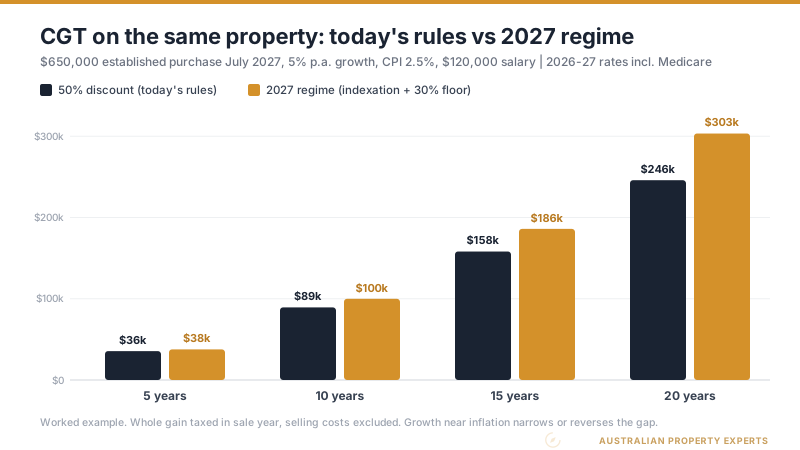
At a 10-year hold, the new regime costs roughly $10,500 more. At 20 years, about $57,000 more. The gap grows with time because indexation only shields the inflation component. The old discount halved the entire gain, inflation and real growth alike.
Growth close to inflation flips that result. Index a property that barely beats CPI and the taxable real gain shrinks toward zero, which beats a 50% discount. The new regime punishes strong growth and is gentle on weak growth.
The 30% floor works the other way. It mostly bites lower incomes. Take a retiree with little other income who sells a big gain. They would have paid low average rates on it. Now they pay at least 30% on the post-2027 real gain, unless they receive an exempt payment. On a $120,000 salary, as in the chart, your marginal rate is already at or above the floor. The floor never triggers.
Our capital gains tax calculator runs every scenario above, both regimes side by side. For property you already own, it estimates the pre-2027 portion by splitting the gain by time held. Treat that part as a guide.
Yield just got a promotion
Follow the two changes to their logical end and they say the same thing. The tax system stops subsidising deep negative cash flow on established property.
The old playbook was to buy a low-yield property in an expensive suburb and let the taxman fund a $25,000 annual loss. It stops working the moment that purchase happens after budget night. The loss still exists. The refund that made it bearable does not arrive for years.
What sidesteps quarantining entirely is a property that runs at or near neutral from day one. There is nothing to quarantine. That is a yield question. Yield has always been where affordable markets beat blue-chip suburbs. They offer stronger rental yields against the purchase price, lower vacancy and growth from a lower base. Under the new rules a property needs both growth and yield, because a low yield now costs more to carry.
The early market data points the same way. Ray White runs roughly one in four Australian auctions. It tracked investor purchases dipping to 20.7% of sales in the four weeks to 27 June, then recovering to 23.2% by mid July. Investors paused, absorbed the rules and came back. The ones coming back are buying the numbers rather than the deduction. They are doing it into the thinnest buyer competition in years. We’ve laid out what markets this fearful did next in every cycle on record.
The new-build carve-out trap
The carve-out will be marketed hard. Negative gearing plus a CGT choice sounds like the government built a runway straight to the house-and-land display village.
A tax concession won’t make up for paying too much. New builds typically carry a developer margin and thinner land content. The growth you give up on that trade routinely exceeds what the concession returns. HIA’s own data shows new home sales falling 4.6% in June, with cancellations up 50% on the month. HIA put that down to higher rates and uncertainty. There is no sign of a stampede into the exemption. And as above, the legal definition of “new dwelling” is not even settled.
If a new build stacks up on land content, price against comparable established stock, growth prospects and yield, the tax treatment is a bonus. If it only works because of the tax treatment, it isn’t a good buy. Price the property on its own merits, the way a buyers agent would.
Your runway to 1 July 2027
Where that leaves each position between now and the start date.
Grandfathered holders: the concessions are now an asset attached to your properties. Selling one both realises CGT and forfeits grandfathering on the replacement, so hold-versus-sell decisions carry more weight than they did last year. Model the exit under both regimes before you list anything. Read our full sell before July 2027 or hold breakdown first.
Buying established: nothing about the reform starts until 1 July 2027, but a purchase today is already inside the new rules when they arrive. Buy the strongest yield you can find without giving up growth. Stress-test the cash flow with no salary offset. If the numbers only work with the tax refund, keep looking.
Chasing the new-build exemption: wait for the definition to be legislated at minimum. Price the asset as though the concession did not exist.
Everyone: the CGT split at 1 July 2027 uses market value at that date unless you choose the formula. Keep your records clean now. Put your accountant across anything held in a trust, because trusts lose the 50% discount too.
Properties that pay their own way are the strategy left standing
The job of negative gearing on established property was to make weak cash flow survivable. From 1 July 2027 that prop is gone for new purchases. The CGT discount that flattered fast-growth exits is replaced by a regime that taxes real gains in full. Buying properties that pay their own way and grow from a sensible entry price was a good strategy before the Act, and the new rules favour it even more.
Sources
- Parliament of Australia: Treasury Laws Amendment (Tax Reform No. 1) Bill 2026
- Second reading speech, Treasurer Jim Chalmers, 28 May 2026
- Budget 2026-27: tax reform
- ATO: Treasury Laws Amendment (Tax Reform No. 1) Act 2026
- Federal Register of Legislation: Act No. 49 of 2026
- Treasurer: consultation on the draft Tax Reform No. 3 Bill, 4 August 2026
- Corrs Chambers Westgarth: CGT and negative gearing amendments, 3 June 2026
- Smart Property Investment: negative gearing and CGT bill passes Parliament, 25 June 2026
- The Adviser: reforms pass Senate, 25 June 2026
- AusTax.tools: what passed in the 2026 CGT reform, 2 July 2026
- Ray White investor auction data and HIA new home sales via AAP, 21 July 2026
- Prime Minister: tax reform implementation, 18 June 2026
- ABS: Consumer Price Index, Australia
This is general information only and not financial, tax, or credit advice. The worked examples use simplified assumptions and 2026-27 resident tax rates. Speak to your accountant about how the 2027 changes apply to your situation.
For what quarantining does to the weekly number rather than the tax return, see what an investment property costs you per week.
See how we find properties that pay their own way in affordable growth markets.
If you want your next purchase modelled under the 2027 rules before you commit, book a free discovery call.