
The 2026 Budget added a big tax difference to the new build vs established decision, on top of the usual questions about depreciation and tenant appeal.
From 1 July 2027, a new build you buy today keeps full negative gearing and a choice of CGT treatments. An established purchase loses the salary offset entirely. Project marketers are now selling that difference hard. This is what the carve-out is worth, what you give up to get it, and the problem few house-and-land sellers mention.
What the tax break is worth
The tax difference is real money. Take an investor on a $120,000 salary running a $15,000 first-year loss.
On a new build, that loss comes off salary at a 32% marginal rate including Medicare. That’s about $4,800 back at tax time, every negatively geared year. On an established purchase made after 7.30pm on 12 May 2026, the same loss is quarantined from 1 July 2027. It carries forward against future residential rental income or capital gains, deferred rather than destroyed. It is just not in your pocket this year.
Depreciation stacks on top. A brand-new dwelling claims both the building structure and the plant and equipment inside it. An established house bought today claims far less, because the 2017 rules block plant-and-equipment deductions on second-hand assets.
At sale, the new build picks whichever CGT regime is kinder, the old 50% discount or indexation, and sits outside the new 30% minimum tax. The established buyer gets indexation with that 30% floor and no choice.
Add it up and the new build’s tax ledger runs well ahead in the early years. If tax treatment were the whole decision, the carve-out would win, but three things count against it.
“New build” now has a draft definition, not a final one
The first reason is that the definition is still only a draft.
The Act that passed in June left the meaning of “new residential dwelling” to a ministerial instrument. On 18 June the government announced the definition would instead go into a future tranche of primary legislation, with final details “subject to consultation”.
That draft arrived on 4 August 2026 in the draft Tax Reform No. 3 Bill. Consultation closed on 21 August 2026. The draft treats a property as new where it genuinely adds to housing supply. It must also have been acquired within 24 months of a certificate of occupancy being issued. As at late September 2026 that bill has not become law. The 24 month test is still a draft and can still move. It is double the 12 months set out in the Budget. That gives builders longer to sell stock on hand.
The same tranche carries a draft method for apportioning gains on assets held on 1 July 2027 and a minimum tax exemption for genuine testamentary trusts. Carve-outs for dwellings passing on death or relationship breakdown are already law, in the Tax Reform No. 2 Act assented on 26 August 2026.
The June Act already lists what the final test may turn on. That includes whether the dwelling was built on vacant land, created through substantial renovation or built to replace a demolished home. It also covers whether you were the builder or a later purchaser.
A draft is not final law. Anyone signing a contract today specifically to capture the concession is buying a tax outcome that can still move before it is settled. If a marketer tells you a particular product “qualifies”, ask which provision they are relying on. Then check the 24 month rule against the certificate of occupancy date yourself. Treat it as a draft rather than a promise.
What you pay for the tax break
The second reason is the purchase itself. A new build is priced at land plus construction plus the developer’s and builder’s margin. By definition, you buy at or above replacement cost. Established houses in the same growth corridors routinely trade below it, under lot-plus-build in several corridors we work.
The gap shows up at the bank first. Lenders value new stock against comparable resales, not against your contract price. When those disagree, the valuation wins. In the last soft cycle, CoreLogic settlement data to June 2019 showed 62% of Sydney off-the-plan units valuing below their contract price at settlement. Those buyers paid prices that included the developer’s margin, and the valuations didn’t support it.
Then there’s time. A detached house took an average of 12.7 months to build in 2023-24, 40% longer than in 2010-11 on Master Builders’ analysis of ABS data. That is a year of interest on the land with no rent against it. An established purchase collects from the first week after settlement. Construction risk has eased but not vanished. ASIC’s July release counted 3,435 construction insolvencies in FY2025-26, the first annual fall in five years. Construction is still the largest single industry in the insolvency statistics, at roughly a quarter of all failures.
What the growth actually did
Costs and tax are only half of it. The other half is what happens to the value after you buy, and here the estate corridors have a record worth reading before you sign.
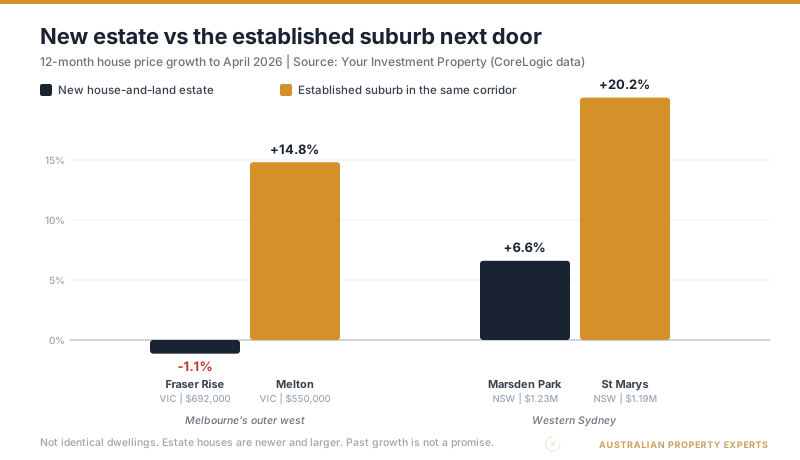
In Melbourne’s outer west, Fraser Rise houses went backwards over the year to June 2026, down 2.1% to a $685,000 median. Established Melton up the road rose 16.5%. Herron Todd White’s valuers flagged the reason in March 2023. They described an “oversupply of new housing with the development of multiple new estates throughout Tarneit, Truganina, Deanside and Fraser Rise”. Buyers who paid new-build prices in those estates back then have spent the years since waiting for the market to catch up.
Western Sydney tells a softer version of the same story. Marsden Park did grow, up 6.7% to a $1.24 million median. This is underperformance rather than a flat line. But established St Marys, in the same corridor at a similar price point, did 16.7% over the same year. That is two and a half times the growth, on older stock, at a slightly lower $1.2 million entry price.
Two caveats worth stating. These are not identical dwellings. Estate houses are newer and larger, which is part of why their medians sit higher. And this pattern is regional, not universal. In south-east Queensland right now the greenfield estates are running hot, and Yarrabilba rose 20.6% over the same period, ahead of plenty of established suburbs. Anyone telling you new estates never grow is overselling it.
What travels across all of those markets is the entry price. When you buy new, the developer’s and builder’s margins are inside your purchase price. The first few years of growth go to catching up with what you already paid. Buy established below replacement cost and there is no margin to grow through. So your growth starts from a price the market already supports.
When a new build stacks up
There are cases where the answer genuinely can be new. A build on a full-sized block in a corridor where established stock already trades at replacement cost gives up little on price. A buyer who will hold for decades, as the first purchaser, captures the concession for the entire hold. And a portfolio already heavy with quarantined losses has more use for a full salary offset than one starting fresh.
What those cases have in common is that the asset stacks up first. The tax treatment arrives as a bonus. That is the test to apply. Run the property through the same filters as any other purchase: land content, price against comparables, yield, vacancy. Only then let the concession break a tie. A purchase that only works because of the tax treatment is a bet on legislation that has not been finalised yet.
New build vs established, compared
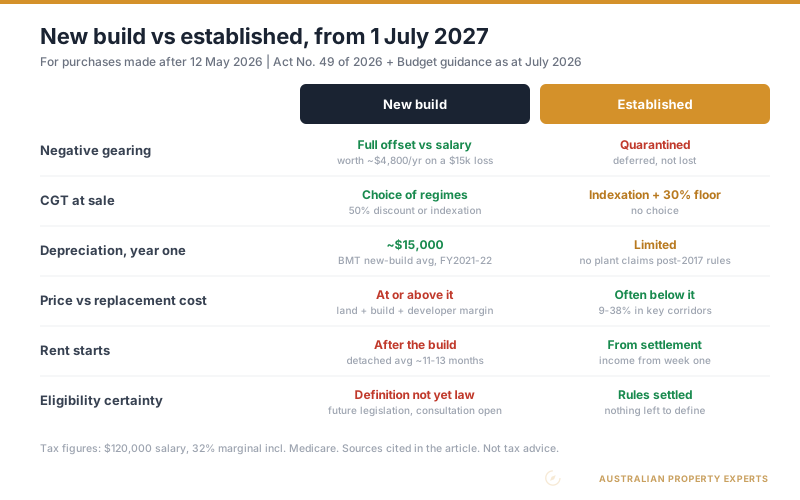
The left column is a genuine tax advantage. It sits on top of an asset priced at replacement plus margin, with eligibility rules still being written. The right column pays more tax and buys the same suburb at a discount, with nothing left to define. We keep buying established houses, because our affordable markets data shows growth comes from the land and the entry price.
Price the asset, not the concession
The 2027 rules made new builds more attractive on tax and did nothing to make them better assets. Say a specific new build survives the same scrutiny you would apply to any established purchase. Once the definition becomes law, the concession is a legitimate tiebreaker. Until then, choose the property first, then work out the structure and the tax.
Sources
- Tax reform implementation - Prime Minister’s media release, 18 June 2026
- Treasury Laws Amendment (Tax Reform No. 1) Act 2026 - Federal Register of Legislation
- Treasury Laws Amendment (Tax Reform No. 2) Act 2026 - Federal Register of Legislation
- Consultation on next tranche of tax reform legislation - Treasurer’s media release, 4 August 2026
- Tax rates for Australian residents - ATO
- Rental properties 2025: limits on second-hand depreciating assets - ATO
- CGT and negative gearing amendments - Corrs Chambers Westgarth
- What counts as a new build under the 2026 Budget - Aussie
- Federal Budget 2026-27 negative gearing - Pitcher Partners
- Off-the-plan settlement valuations, CoreLogic data to June 2019 - Smart Property Investment
- Construction insolvencies fall for the first time in five years (ASIC data) - The Good Builder
- Master Builders analysis of construction time blowouts - Real Estate Business
- Fraser Rise suburb profile - Your Investment Property
- Melton suburb profile - Your Investment Property
- Marsden Park suburb profile - Your Investment Property
- St Marys suburb profile - Your Investment Property
- Yarrabilba suburb profile - Your Investment Property
- Herron Todd White Month in Review commentary, March 2023 - via Elite Agent
This is general information only and not financial, tax, or credit advice. The “new residential dwelling” definition was not legislated at the time of writing and the treatment described may change. Speak to your accountant before structuring a purchase around the 2027 rules.
See how we vet established properties in growth corridors.
If you’re weighing a new build against an established purchase and want both run through the same data, book a free discovery call.




.jpg)