
Almost everything written about the 1 July 2027 capital gains tax reform says the same thing: investors will pay more. We ran the numbers through our own capital gains tax calculator and that is not what comes out.
For a property bought after the change, growing at the long-run national average, the new rules land within a few hundred dollars of the old ones. Grow slower than that and you pay less than you would today. Grow faster and you pay a great deal more.
The reform changes what the tax is charged on rather than raising it across the board, and that shifts who pays more and who pays less.
What actually changes on 1 July 2027
The 50% CGT discount goes. In its place, two things:
- Cost base indexation. Your purchase price and buying costs are lifted by CPI over the years you hold. You are taxed on the gain above inflation, not the whole gain.
- A 30% minimum tax rate on that indexed real gain.
The change applies to individuals, trusts and partnerships. Indexation needs at least 12 months of ownership. The 30% minimum applies to resident individuals, including gains that reach them through a trust. Companies and super funds keep their existing settings. That covers the CGT half, and the full picture, including the negative gearing changes and who is grandfathered from what, sits in our main guide.
The old system gave you half your gain tax free no matter how fast prices moved. The new one exempts inflation and nothing beyond it. That single swap drives every number below.
Growth against inflation decides it
We modelled a $1 million established purchase made in 2028, held ten years, sold by an investor on $120,000 of other income. It assumes $58,000 of buying costs and selling costs of 2.5%, taxed at the 2026-27 rates plus the 2% Medicare levy. Every figure is what our calculator produces under each set of rules.
The change in CGT payable, new rules against the old 50% discount:
| Annual growth | CPI 2.0% | CPI 2.5% | CPI 3.5% |
|---|---|---|---|
| 3.0% | -$45,652 | -$52,645 | -$52,645 |
| 5.4% | +$30,158 | -$220 | -$65,119 |
| 8.0% | +$137,136 | +$106,759 | +$41,859 |
| 10.0% | +$236,764 | +$206,386 | +$141,487 |
A minus sign means you pay less than you would have under today’s rules. At 5.4% growth and 2.5% inflation the reform is a rounding error. Nudge either number and the answer swings by tens of thousands of dollars.
Slow growth is now worth more, for tax
Look at the top row. A property growing at 3% a year costs you around $50,000 less in CGT under the new rules than the old ones.
If prices barely outrun inflation, indexation shelters nearly the whole gain. The 50% discount only ever paid you in proportion to how fast the asset ran.
Now look at the bottom row. At 10% growth the same property costs you over $200,000 more. The reform is, in effect, a tax on outperformance. The better your selection, the more of the upside the change takes.
The longer you hold, the worse it gets
Same $1 million purchase, 5.4% growth, 2.5% inflation, varying only how long it is held:
| Held for | Change in CGT |
|---|---|
| 3 years | -$14,528 |
| 5 years | -$15,933 |
| 10 years | -$220 |
| 15 years | +$32,741 |
| 20 years | +$89,783 |
| 25 years | +$180,010 |
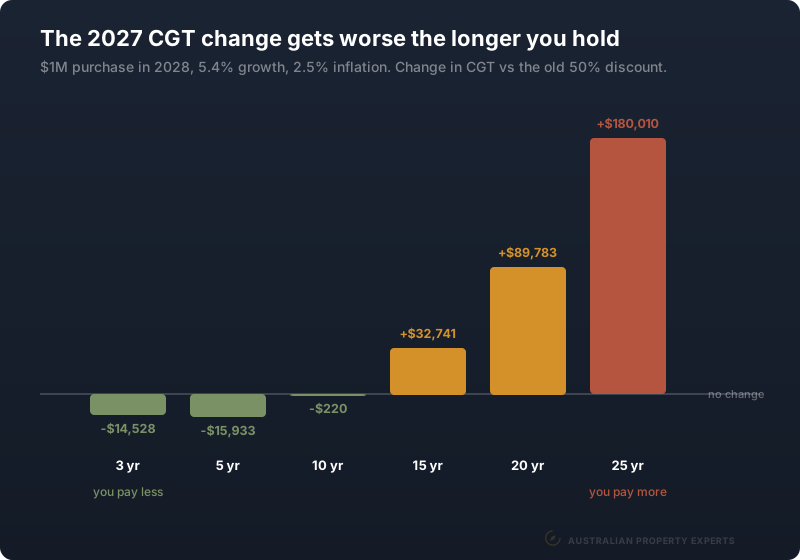
Short holds come out ahead. Somewhere around ten years it flips, and from there it gets steadily worse.
The reason is compounding. Growth compounds on the whole value. Indexation only compounds on the cost base, so the gap between them widens every year. Under the old rules a longer hold was rewarded with a bigger discount in dollar terms. Under the new ones a longer hold means a bigger share of your gain sits above inflation and gets taxed.
Buy and hold forever has long been the default play in Australian property. On tax alone, the reform argues against it.
Higher inflation now helps you
Read across the 5.4% growth row. At 2% inflation you pay $30,158 more. At 3.5% inflation you pay $65,119 less.
Higher inflation means more indexation, which means less of your gain is taxable. An investor with a long hold now has a tax reason to want inflation running warm, which hasn’t been true since indexation was replaced in 1999. It is one more reason the reform isn’t simply bad for investors.
What this does not tell you
Three limits.
These figures are for a property bought after 1 July 2027. If you already own, or you buy before the change, your gain is split at the transition date. The law treats the property as sold just before 1 July 2027 and bought back on that day. The default value for that deemed sale is market value. You can instead choose an apportionment formula set by the Minister, which is still only a draft. Which one you use materially changes the answer, so we have not put numbers on that case here.
Growth and inflation are assumptions, not forecasts. Nobody knows what either does over ten years. Look at the overall pattern in the table rather than any single cell. The faster your property grows, the more the change costs you.
This is general information only and not financial, tax, or credit advice. Your marginal rate, your ownership structure, your other income and any carried-forward losses all move the answer. Run your own numbers in the calculator, then take them to your accountant.
What we are telling clients
What makes a good investment property is the same, but the tax maths now matters for two decisions. Whether to sell an existing property before the deadline is a separate question with its own maths. We have covered it in should you sell before July 2027.
If you are buying after the change, the reform quietly rewards getting out earlier than the old rule of thumb suggested. It also takes a bigger cut of your best-performing assets. Neither is a reason to avoid buying, though both are reasons to be deliberate about the hold period rather than defaulting to forever.
Which market you buy in matters more than the tax treatment. A buyers agent in Melbourne is working with a very different growth profile to one in Perth, and the table above shows how much that changes the bill.
Sources
- Treasury Laws Amendment (Tax Reform No. 1) Act 2026, No. 49 of 2026
- ATO: individual income tax rates
- Treasurer: consultation on the draft Tax Reform No. 3 Bill and apportionment instrument, 4 August 2026
- Baker McKenzie on the CGT discount and negative gearing changes
- Pitcher Partners: CGT reform is law, what to do before 1 July 2027
- ATO: reforming negative gearing and capital gains tax
Modelling produced with our own capital gains tax calculator, where you can run your own numbers.
If you want the hold-versus-sell numbers run on your actual property and structure, book a free discovery call.