
Negative gearing reform is no longer a proposal. Announced in the 12 May 2026 federal budget, the changes to negative gearing and the capital gains tax discount passed Parliament on 25 June 2026. They received royal assent the next day. Both start on 1 July 2027.
If you own investment property, or you are planning to buy, this covers what changed, who is protected, and what it means for your strategy. What passed is narrower than the two-property cap that was rumoured. It draws its line between established homes and new builds instead.
What changes on 1 July 2027
Two reforms take effect on 1 July 2027.
Negative gearing is limited to new builds. The rule applies from the 2027-28 income year to established residential property bought after 7:30pm on 12 May 2026. Rental losses on those homes can no longer be offset against salary or other income. The losses can only be offset against residential rental income or residential capital gains. Any excess carries forward to later years. Negative gearing survives in full for new builds, although the definition of a new build is still only a draft.
The CGT discount is replaced. The flat 50% capital gains tax discount is being replaced with indexation of your cost base for inflation, plus a minimum 30% tax on the gain. Whether that costs you more or less depends on how fast your property grows. We have modelled who pays more and who pays less under the new rules. The new regime applies to assets held by individuals, trusts and partnerships. Investors in new-build property can choose, when they sell, between the current 50% discount and the new regime.
Both start 1 July 2027. Both are law: the Tax Reform No. 1 Act, Act No. 49 of 2026, assented 26 June 2026. A second Act, the Tax Reform No. 2 Act assented on 26 August 2026, carries the protection across on death and relationship breakdown. A dwelling passed to a surviving spouse or co-owner, or transferred on a relationship breakdown, keeps the grandfathered or new-build status it already had.
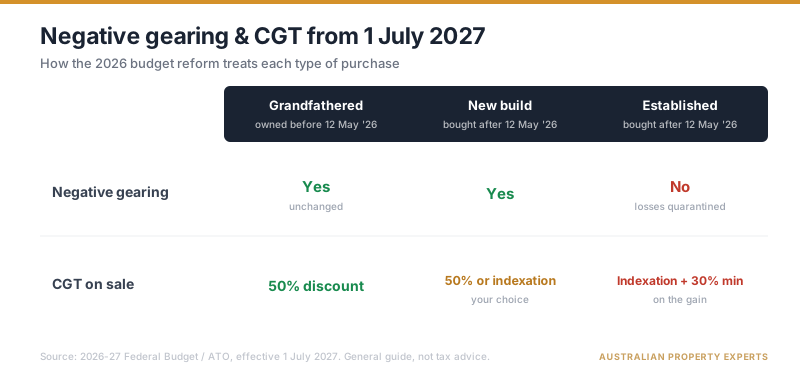
Established vs new build
The rumoured version capped how many properties you could gear. The law draws its line between established and new, and between what you already hold and what you buy next.
- Already owned it, or were under contract, before 7:30pm on 12 May 2026? Your negative gearing is grandfathered and lasts for as long as you hold the property. Your CGT discount is not. Growth up to 30 June 2027 keeps the 50%. Growth from 1 July 2027 is taxed under indexation plus the 30% floor, the same as an established purchase made today.
- Buying a new build after that? You keep negative gearing, and you choose the better of the two CGT regimes when you sell. The rules on what counts as new are still in the draft Tax Reform No. 3 Bill, so they can still change.
- Buying an established property after that? From 1 July 2027 you cannot negatively gear it against your salary, and your CGT is worked out under the new indexation-plus-30% regime.
For investors, the live questions now are established or new, and when.
How negative gearing works until 2027
Negative gearing means your investment property costs more to hold than it earns in rent. The difference, your net rental loss, is deducted against your other income, including your salary.
If you earn $120,000 and your property runs at a $15,000 annual loss, you are taxed as though you earned $105,000. At a 32% marginal rate including the Medicare levy, that is around $4,800 in tax saved. The property still costs you money each year, just less than it would without the deduction. From 1 July 2027, established homes bought after the cutoff lose this salary offset. The loss carries forward instead.
Run the numbers on any investment property. See your after-tax cost and when it turns positively geared.
Use the calculator →
Who is grandfathered, and from what
Grandfathering is the most important word in this reform for existing investors.
If you owned an investment property, or had exchanged contracts on one, before 7:30pm on 12 May 2026, negative gearing on it is untouched. You keep it for as long as you hold the property. Only selling ends it.
Capital gains tax is the part people get wrong. Grandfathered owners do not keep the 50% discount outright. The gain that accrued up to 30 June 2027 keeps the 50% discount. From 1 July 2027 onwards, the gain falls under the new indexation and 30% minimum tax regime. The Tax Reform No. 1 Act splits the gain this way. Both Baker McKenzie and Pitcher Partners set it out. Holding a pre-May-2026 property protects your negative gearing indefinitely. It only freezes the old CGT treatment on the gain made up to 30 June 2027.
The reform bites gradually, through future purchases of established homes, while existing holdings keep their negative gearing.
Do you need a 1 July 2027 valuation?
This is the part of the reform with an actual task attached to it.
Every property that an Australian resident individual or trust holds through 30 June 2027 is treated as sold just before 1 July 2027. It is then treated as bought back on that date. Nothing is really sold and no tax falls due on the day. The gain on that deemed sale waits until you actually sell. The value on the day becomes your cost base for every gain you make afterwards. That is why the number matters so much.
The law gives two ways to set that value. You only choose when you lodge the return for the year you sell. The default is market value just before 1 July 2027, which usually means a valuation. The alternative is an apportionment formula the Minister sets by legislative instrument. That formula is still a draft, released for consultation in August 2026. It costs nothing. As drafted, it appears to assume your property grew at one steady rate for the whole time you owned it.
The formula suits a property that grew at a fairly even clip. Where most of the growth came before 1 July 2027, the averaging costs you. Say you renovate in year two, or buy into a suburb that ran 20% in a single year before 2027. The formula spreads that gain evenly across your whole ownership and pushes a slice of it past the cutoff, where it loses the 50% discount. A valuation puts the gain in the year it happened. The Institute of Public Accountants has made the same point about uneven growth.
If you go the valuation route, the ATO expects a valuation that is objective and supportable, with records explaining how the value was reached. It treats a professional valuer’s report as more credible than an opinion from a non-valuer. An agent appraisal or a portal estimate carries much less weight. A retrospective valuation is allowed, but it is harder to support years later. That makes getting it done near the date the simpler path.
Whichever way you go, keep the paperwork somewhere you will still find it in twenty years. It is what proves your cost base when you eventually sell. Your accountant should be across which method suits each property you hold.
What it means for property prices
The modelling is less dramatic than the headlines.
Treasury expects a small and temporary slowing, with house prices growing around 2% less over a couple of years than they otherwise would. It expects around 75,000 additional owner-occupiers over the next decade. It puts the rent effect at less than $2 a week for a household paying the current median rent.
None of that is a crash. With national rental vacancy still tight at 1.3% in August 2026 (SQM Research), the supply picture matters more to rents than this reform does.
What the reform raises for the budget
The reform is a revenue measure. Budget Paper No. 2 estimates it raises $3.6 billion over the five years from 2025-26. Almost all of that lands late, with $1.35 billion in 2028-29 and $2.28 billion in 2029-30. The Budget says the money helps fund new tax cuts for workers.
What investors should do before 2027
Now that it is law, a few things follow in practice.
You have time. The changes start 1 July 2027. Your negative gearing and CGT position does not change before then. Properties bought before the cutoff keep negative gearing until sold.
The new-build vs established choice now carries tax weight. After the cutoff, an established purchase loses salary-offset negative gearing while a new build keeps it. That does not automatically make new builds the better investment. New builds often carry a price premium and weaker land content, which can cost you more in growth than the tax break returns. Weigh the growth and yield against the tax treatment, not the tax treatment alone.
Model your CGT before you sell. Swapping a flat 50% discount for indexation plus a 30% minimum tax changes the maths. The outcome depends on how long you hold and inflation over that time. Our capital gains tax calculator now models both regimes side by side. We’ve also answered the should you sell before July 2027 question in full.
Talk to your accountant. The specifics for your portfolio, especially anything held in a trust, need a professional to look at them.
Keep buying good properties. The fundamentals have not moved. A well-located property that grows and rents well still builds wealth. The tax treatment shifts at the margin for future established purchases. Growth, yield and compounding still do the heavy lifting.
What this means for your strategy
This is settled policy now, though it does not start until 1 July 2027. Existing investments keep their negative gearing. The investors who come out ahead will understand the established-versus-new line, use the runway before it starts, and keep buying on the numbers.
If you are buying interstate or building a portfolio, the fundamentals of due diligence and location still matter more than any single tax change.
Sources
- Treasury Laws Amendment (Tax Reform No. 1) Act 2026, No. 49 of 2026 - Federal Register of Legislation
- Treasury Laws Amendment (Tax Reform No. 2) Act 2026, No. 71 of 2026 - Federal Register of Legislation
- Treasurer: consultation on the draft Tax Reform No. 3 Bill, 4 August 2026
- ATO: reforming negative gearing and capital gains tax
- ATO: market valuation of assets
- 2026-27 Budget: tax reform
- Tax explainer: negative gearing and capital gains tax reform - Treasury, Budget 2026-27
- Budget Paper No. 2, 2026-27
- SQM Research: national vacancy rates, August 2026
- Accountants Daily: CGT apportionment measure and valuations
- Accountants Daily: tranche 2, new builds definition and apportionment
For the strategy layer with worked numbers, see our 2027 negative gearing and CGT playbook.
This is general information only and not financial or tax advice. Speak to your accountant or financial adviser about how these changes apply to your specific situation.
If you want to discuss how the 2027 changes affect your investment strategy, book a free discovery call.