NRAS ended on 30 June 2026. Since 2018, more than 36,000 dwellings that were required to rent at 20% below market have left the National Rental Affordability Scheme. The affordable end of an already-tight rental market just permanently shrank.
What Was NRAS?
The Rudd government launched NRAS in 2008 to increase affordable rental supply. Investors who built or supplied a dwelling and rented it to low-to-moderate income tenants at 20% or more below market rent received an annual government incentive in return. For the 2025-26 NRAS year, the last full year before the scheme closed, that incentive was worth $13,261 per dwelling. Of that, $9,946 came from the Commonwealth as a refundable tax offset. The other $3,315 came from the relevant state or territory (ATO, DSS).
Each allocation ran for 10 years. The Abbott government ended funding rounds for new allocations in the 2014-15 Budget. Properties started exiting from 2018. The last batch rolled off in June 2026 (DSS).
36,000 Affordable Rentals, Gone
By April 2015, 26,234 eligible dwellings had been delivered into the scheme (ANAO). Over the full life of the program, 36,564 allocations have now phased out. That is 32,963 that had ceased by 31 March 2026, plus the final 3,601 (DSS, March 2026). The bulk of exits happened between 2022 and 2024, when more than 22,000 properties left the scheme. The final 3,601 ended between April and June 2026, including 3,094 in June alone.
At April 2015, Queensland held the largest share at 10,427 allocations, or 27% of the total. NSW had 18%, Victoria 16%, Western Australia 14%, South Australia roughly 10%, ACT 6%, Tasmania 4%, and the Northern Territory 3% (ANAO).
The profile of the stock matters for investors. Of the 35,000 allocations still in the scheme in March 2020, more than half were apartments or studios. Two-thirds were two bedrooms or smaller (DSS, March 2020).
Every one of these properties was required to charge rent at 20% or more below the local market rate. That requirement no longer exists. Owners can now set full market rent, and many will.
A Market Already Running Tight
NRAS properties hitting market rent would be manageable if the rental market had slack. It doesn’t. Australia’s national residential vacancy rate was 1.3% in August 2026, with 41,039 vacant dwellings across the country (SQM Research). Every capital city except Canberra is below 2%.
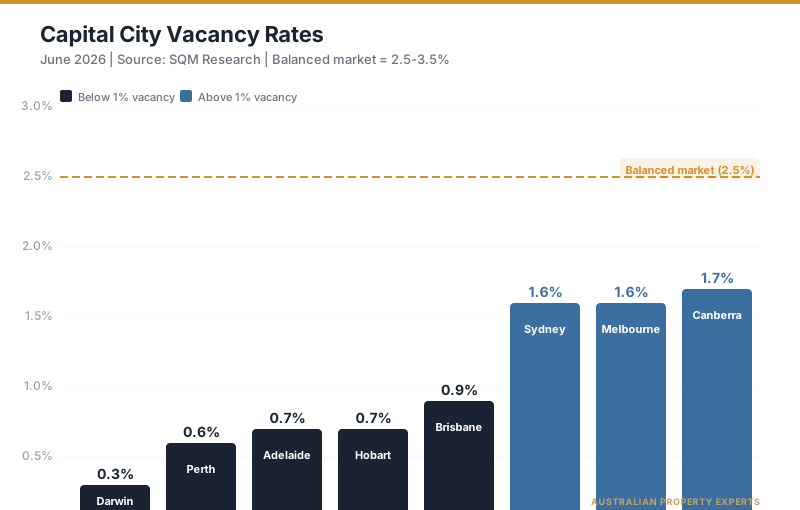
Darwin recorded 0.4%, with only 94 vacant rental properties in the entire city. Perth, Adelaide and Hobart sat at 0.6%. Brisbane was 0.9%. Sydney was at 1.7% and Melbourne 1.8%, while Canberra loosened to 2.1% (SQM Research, August 2026).
National rents grew 5.7% in the year to August 2026 (Cotality). The median advertised rent had reached $705 per week by June (Cotality). As of March, renters were already spending a record 33.1% of gross household income on rent. Over five years, rents are up 39%, leaving renters paying around $200 more per week than in 2021.
Into this market, more than 36,000 former below-market rentals have been repricing since 2018. That doesn’t add a single new dwelling to the rental pool. It just removes the discount on existing ones. The affordable end gets tighter. Tenants who were paying 20% below market either absorb the increase or compete for other affordable stock that barely exists.
Should You Buy Ex-NRAS Stock?
Some NRAS investors are selling now that the incentive has gone. The loss of $13,261 per year changes the cash flow equation. For investors who were relying on that payment to stay positive, selling makes financial sense. In 2023, Queensland’s government offered to buy homes leaving the scheme from willing sellers, starting with up to 456 through community housing partners (QLD Government). That absorbs some supply but leaves thousands of other dwellings potentially on the market.
Should you buy them? Mostly, no.
The typical NRAS property is a small apartment or studio in a medium-to-high density development. More than half were apartments or studios. Two-thirds were two bedrooms or smaller. These are exactly the type of properties that tend to underperform on capital growth. Growth comes from land value, and apartments have very little of it.
High-density apartments in areas with oversupply are a poor foundation for any portfolio. You might pick up decent yield on paper, but weak growth means you never build the equity needed to buy again. The whole point of building a portfolio is compounding equity through growth and reinvesting it. An apartment that returns 5% yield but only grows at 2% per year won’t get you there.
The rare exception would be an ex-NRAS house on a decent block in a suburb with tight supply and strong fundamentals. That profile exists but is uncommon among the former scheme stock. If you’re considering one, ask three questions. Is it a house or a unit? What’s the land component of the purchase price? And how many similar units sit in the same complex competing for the same tenants? If it’s a unit in a building with 50 others, you’re buying a commodity, not an asset that compounds.
What NRAS Ending Means for Rental Yields
The end of NRAS reinforces a trend already running hard. With rents rising and values falling, the national gross rental yield reached 3.79% in August, its highest level since September 2019 (Cotality).
Hobart recorded the strongest annual growth in advertised rents of any capital at 10.4% in the year to early September. Darwin was up 8.7% and Brisbane 7.7% (SQM Research). In the year to March, regional rents grew 6.0%, ahead of the capital cities (Cotality Q1 2026).
SQM says the smaller capitals have not yet built enough stock to give tenants relief. And the scheme that kept tens of thousands of rents below market is now gone. No like-for-like replacement has been announced. The Housing Australia Future Fund and build-to-rent tax incentives target new supply, not discounts on existing stock.
For investors focused on both growth and yield, the playbook hasn’t changed. Established houses in affordable markets with low vacancy and strong population growth remain the strongest combination. Look for older houses on decent blocks where you can renovate, add value, and hold. Skip premium blue-chip suburbs and apartments in oversupplied towers. You want a market where tenants compete for your property rather than the other way around.
NRAS ending removes one of the few remaining forces that were holding rents down at the affordable end, rather than creating a new opportunity. Rental markets remain tight by historical standards. The yield case for well-located established property stays strong.
Why NRAS Ending Matters If You’re Waiting to Buy
NRAS is done. More than 36,000 properties that were priced below market have been repricing. No new affordable rental supply is filling the gap.
If you’re sitting on equity and considering your first or next investment property, the rental market fundamentals are moving in one direction. National vacancy is at 1.3%. Rents are up 5.7% over the past year. And the pool of affordable rental stock just permanently contracted.
Waiting for the rental market to ease hasn’t worked for five years. National vacancy has edged up only from 1.2% a year ago to 1.3% (SQM Research). Cotality still describes rental markets as tight by historical standards. NRAS ending pushes the affordable end the other way. We covered why time in market matters more than timing in our guide to building a property portfolio.
If you want to talk through what the numbers look like for your situation, book a free call.
This is general information only and not financial advice. Speak to a qualified professional before making investment decisions.
Sources:
- ATO: NRAS taxation issues
- DSS: National Rental Affordability Scheme
- DSS: NRAS incentive indexation
- DSS: NRAS quarterly performance report, March 2026
- DSS: NRAS quarterly performance report, March 2020
- ANAO: Administration of NRAS
- The Conversation: NRAS has ended
- SQM Research: National vacancy rates, August 2026
- Cotality: Home Value Index, September 2026
- Cotality: Rental Review Q2 2026
- Cotality: Rental Review Q1 2026
- QLD Government: Affordable housing purchase



.jpg)