Update, 5 October 2026. On 29 September the Board lifted the cash rate to 4.60% (RBA), ending the pause this post describes. July CPI came in at 3.5%, with trimmed mean inflation steady at 3.6%. Cotality’s September report says core inflation came in higher than expected. National home values fell 0.9% in August and are 3.6% below the March peak (Cotality). SQM’s national vacancy rate held at 1.3% in August.
The RBA held the cash rate at 4.35% on 11 August 2026. Unanimous vote. The board debated whether to hike or hold. A cut was never discussed.
For investors, the bigger change is that borrowing capacity has stopped moving. Three hikes in three meetings followed by two consecutive holds. Assessment rates are stable for the first time since January. That gives buyers a number they can plan around heading into spring.
What the Board Decided
The Monetary Policy Board voted unanimously to keep the cash rate at 4.35% at the 10-11 August meeting. Governor Bullock confirmed the board discussed only two options, a hike or a hold. “The Board did not discuss cuts,” she told the media conference.
The hold was widely expected. Finder’s survey found 92% of its economists and experts predicted no change. But Bullock kept the door open. The board said it would lift the cash rate further “if upside risks materialise.” That wording is narrower than June’s “if required.” The bar for another hike has risen, but another hike is still possible.
This is the second consecutive hold after June. The cash rate has sat at 4.35% for three months. Three hikes in February, March and May added 75 basis points and fully reversed the 2025 easing cycle.
Markets are pricing roughly a 50% chance of another hike by year-end, according to the RBA. Most market economists expect no further increase, though a small number still expect one.
Inflation Below the May Forecast
The August Statement on Monetary Policy tells a clearer story than the rate decision alone.
Annual headline CPI fell to 3.8% in June, down from 4.0% in May (ABS). Trimmed mean, the RBA’s preferred underlying measure, held at 3.6%. Still above the 2-3% target band. But the trimmed mean came in below the 3.8% the RBA had forecast in its May SoMP. When the actual number lands under the central bank’s own projection, the case for tightening weakens.
The SoMP now forecasts inflation returning to the midpoint of the target by early 2028. Unemployment is expected to drift higher, reaching 4.5% by December 2026 and 4.8% by late 2028. The labour market is loosening, which takes pressure off wages and eventually prices.
The RBA also noted that the housing market has eased by more than it assumed in May. National prices were down 1.6% from their March peak when the forecasts were finalised. Weaker housing feeds into household wealth and spending, which helps slow the economy the way rate hikes are supposed to. The question is how many more months the board needs to see before cutting.
Capacity Has Stopped Shrinking
This is where the hold changes things.
The three 2026 hikes cut about 6.5% off what a fixed repayment budget can borrow. Our borrowing capacity guide covers the full mechanics. The hold means the compression has stopped. Assessment rates are no longer rising.
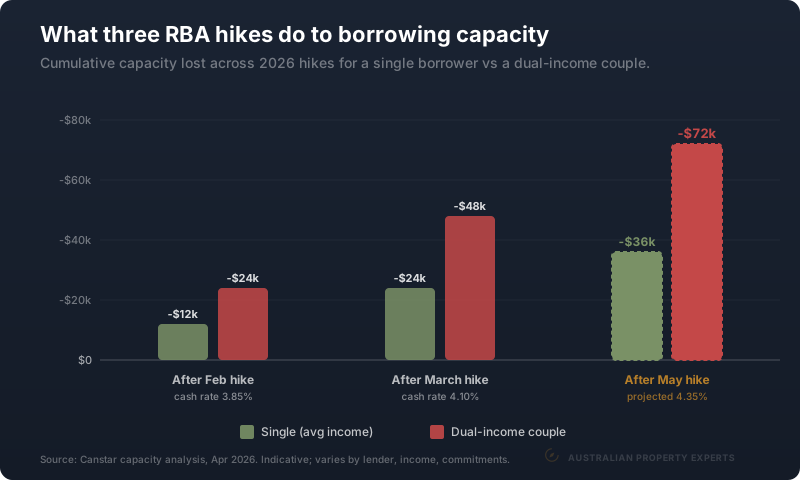
New variable investment loans averaged 6.4% in June (RBA table F6). Add APRA’s 3-percentage-point serviceability buffer and banks are testing at roughly 9.4%. That number has not moved since May. If you are on a variable rate, your repayments have not changed since the May hike.
The Right Property Group’s 2026 Investor Sentiment Report found that 52% of investor respondents ranked borrowing capacity as their single biggest challenge. That put it ahead of cash flow, market uncertainty and finding a suitable property. A further 43% said their borrowing power had declined over the past year. Capacity is the constraint shaping every purchase decision in this cycle.
The hold does not restore what the hikes took. The RBA’s August forecasts assume a cash rate of around 4.4% to 4.5% through 2027, based on market pricing. No cut is priced in over that horizon.
What matters now is that investors can plan around a stable number. A moving target is harder to buy into than a fixed one, even when the fixed one is higher than you want. Get your pre-approval refreshed this month. The next RBA decision is 29 September. Between now and then, your capacity figure holds.
Where Prices Sit in August
National dwelling values fell 0.7% in July, the steepest monthly drop since December 2022. Sydney led at -1.4%, Melbourne followed at -1.2%. The full city-by-city breakdown is in our August market update.
Premium suburbs are falling first because their buyers borrow at maximum capacity. Upper-quartile values fell 3.2% nationally over the three months to July, while the lower quartile rose 0.3% (Cotality). Affordable markets are holding up because their buyers are less stretched.
National rental vacancy held at 1.3% in July (SQM Research), with Brisbane, Perth, Adelaide, Darwin and Hobart all below 1%. Rents keep climbing in tight markets. Falling values plus rising rents means improving yields.
The Setup Heading Into Spring
Rates are stable until at least 29 September. Pre-approvals issued this month will not go stale mid-search. Auction clearance rates have sat below 50% since late May, and capital city listings are 5.7% above the five-year average (Cotality). That shifts negotiating power toward buyers.
That means less competition at inspections, longer negotiations and more pre-market stock coming through.
The 2027 negative gearing and CGT changes add a structural dimension. They cover established dwellings bought after 7.30pm on 12 May 2026. From 1 July 2027, rental losses on those properties can only be carried forward against residential rental income and gains. So an established purchase made today already sits inside the new loss rules. Separately, the 50% CGT discount for individuals is replaced by indexation plus a 30% minimum tax from 1 July 2027. Gains made up to 30 June 2027 keep the discount. Whether you support the policy or not, it shapes buying timing.
When rate cuts do arrive, borrowing capacity recovers, sidelined buyers return and vendor leverage fades. Buyers who act in the soft part of the cycle are positioned for that recovery.
If the question is whether to buy now or wait, the data still favours buying well and holding for the long term.
What to Watch Next
July CPI came in at 3.5% on 26 August. Annual headline inflation fell from 3.8% in June to 3.5% in July (ABS). The trimmed mean held at 3.6%. Housing was still the largest contributor at 5.0%. Headline inflation is easing, but the underlying measure has not moved.
RBA decision on 29 September. A third consecutive hold would extend the pause. A hike would squeeze capacity again.
SQM August vacancy data, due mid-September. National vacancy at 1.3% is tight by any historical measure. If it drifts higher while values fall, rental pressure eases at the margin. If it holds, yields keep firming.
After Three Hikes and Two Holds
Three hikes from February to May. Two holds since. Headline inflation softening. Unemployment rising. Housing prices falling faster than the RBA expected. No cut is on the table this year.
Capacity has stabilised, prices are softer and competition is thinner, but this mix is temporary. It resolves either when rate cuts bring buyers back or when another hike compresses capacity further.
This is general information only and not financial advice. Speak to a qualified professional before making investment decisions.
If you want to know what your borrowing capacity buys in the markets the data supports, book a free discovery call.
Sources:
- RBA Monetary Policy Decision, August 2026
- RBA Media Conference, 11 August 2026
- Statement on Monetary Policy, August 2026
- RBA Minutes, 10-11 August 2026
- ABS Consumer Price Index, June 2026
- ABS Consumer Price Index, July 2026
- RBA Table F6, Housing Lending Rates
- Finder RBA Cash Rate Survey
- Right Property Group Investor Sentiment Report
- SQM Research, National Vacancy Rates, July 2026
- SQM Research, National Vacancy Rates, August 2026
- Cotality Home Value Index, September 2026