
Update, 26 September 2026: The cash rate is still 4.35%. The RBA held it at its 16 June and 11 August meetings, both by unanimous vote. The August statement left a further increase on the table if upside risks to inflation materialise. The next decision is due on 29 September (RBA cash rate table). The analysis below is as published on 5 May.
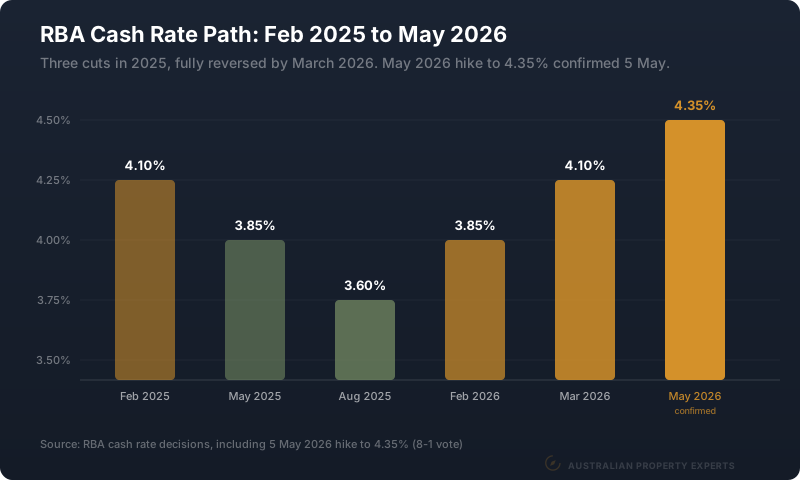
The RBA rate hike on 5 May 2026 took the cash rate to 4.35%, a 25 basis point increase and the third consecutive hike in 2026. The vote was 8-1, up from March’s 5-4 split. The Board warned that higher fuel prices are likely to have “second-round effects” on prices for goods and services more broadly (RBA statement).
This is the kind of cycle that produces some of the best buying conditions of the decade. High rates are temporary. The cost of an extra 25 basis points on your repayments is a few thousand dollars a year. Sitting out the cycle can cost far more. Competition thins, motivated vendors get more flexible, and the capital growth goes to whoever keeps buying.
The decision in detail
The Monetary Policy Board lifted the cash rate from 4.10% to 4.35%. That matches the November 2023 peak, the highest level Australian rates have been since 2011. The post-meeting statement framed the move around inflation persistence, capacity pressures, and the Middle East conflict feeding into fuel prices.
Three numbers from the day:
- 8-1 vote. Materially firmer than March’s 5-4. Hawks have the upper hand on the board.
- Headline inflation peak forecast of 4.8% in the June quarter, in the baseline where the Middle East conflict is resolved soon. That is from the Statement on Monetary Policy released the same afternoon. The February SoMP had headline inflation peaking at 4.2%.
- No forward guidance. The Board did not signal a pause. The statement said it “will do what it considers necessary” to deliver price stability and full employment.
If you assumed the Board would deliver this hike and then sit on its hands, today’s statement read more hawkish than that. The May SoMP forecasts assume a market path with the cash rate 60 basis points higher by the end of 2026. The cycle still turns. Cash rates do not stay at peaks for years. The 2022-2023 hike cycle peaked at 4.35% in November 2023. The first cut came 15 months later in February 2025, and three cuts followed over the next six months. Plan for the same shape.
What it does to your repayments
Banks passed the full 25bp through after the March hike. The RBA’s indicator rate for discounted investor variable loans moved from 6.63% in February to 6.88% in March (RBA table F5). Expect the same response in the next week or two, taking that rate to roughly 7.13%.
What that looks like in dollars on an interest-only investment loan:
| Loan size | Old rate (6.88%) | New rate (7.13%) | Extra per month | Extra per year |
|---|---|---|---|---|
| $500,000 | $2,867 | $2,971 | $104 | $1,250 |
| $750,000 | $4,300 | $4,456 | $156 | $1,875 |
| $1,000,000 | $5,733 | $5,942 | $208 | $2,500 |
For an investor carrying $2 million to $3 million of debt across two or three properties, this single hike adds roughly $420 to $625 a month. Across the three 2026 hikes combined, the same investor is paying roughly $1,250 to $1,875 a month more than in January.
On $2 million of debt, the three hikes add about $15,000 a year in interest. The rate hike is real. But it is a small cost of doing business next to the growth that comes from owning the asset through a full cycle. Rents are also rising to absorb part of the hit. Cotality’s national rents were up 5.7% in the year to March (Rental Review Q1 2026).
What it does to borrowing capacity
This is the part that hits hardest if you are still buying.
Each 25bp move trims borrowing capacity, because lenders test every applicant at the loan rate plus a buffer. Stack the three 2026 hikes (Feb, March, May) together and the rate you are assessed at is 75 basis points higher than in January.
APRA’s serviceability buffer of 3 percentage points sits on top of the loan rate. A 7.13% loan rate means an assessment rate of around 10.13%. That is the number setting your borrowing limit. APRA’s debt-to-income limit has applied since 1 February (APRA). Banks can write no more than 20% of new lending at a DTI of six times income or more. That adds another constraint for investors carrying multiple loans. The full mechanics are in our borrowing capacity 2026 guide.
Any pre-approval issued before today is now stale. Most brokers will refresh the assessment within 24 to 48 hours of a cash rate move. Get yours updated before going under contract on anything.
What it does to property prices
Counter-intuitively, capital city home values still rose 0.2% in April, after two hikes this year. The supply story has been winning the tug of war with the rate story for most of the cycle. Vacancy is still tight, at 1.2% nationally in April and under 1% in Perth, Brisbane and Adelaide (SQM Research).
Cotality’s April data shows higher rates starting to bite at the top of the market first (Housing Chart Pack, May 2026). Sydney and Melbourne are five months into the early phases of decline. Growth is slowing across the mid-sized capitals. Premium markets tend to soften before affordable markets do, because buyers there are more often borrowing at the edge of capacity. We covered this in detail in why the top end is falling first.
The affordable end is different. For investors targeting it in Perth, Adelaide, regional Queensland and parts of Victoria and Tasmania, the rate cycle is barely a headwind. Buyers in those markets are usually not maxed out on borrowing. Supply is genuinely tight, and rents are still growing.
The contrarian opportunity sits in this gap. Property news is dominated by panic headlines. A lot of would-be buyers will sit out the next six months waiting for “more clarity” or for “the bottom” of the cycle. That is when the buying gets best. There is less competition at open homes, vendors are more open to negotiation and auction battles are fewer. More pre-market and off-market opportunities surface because agents know buyers have the upper hand. The investors who built real portfolios through the last two hike cycles bought hard during the fear, not after it.
What investors should do this week
A few practical actions, in rough order of urgency.
Refresh your pre-approval. Borrowing capacity has now reset twice in three months. If your pre-approval is more than four weeks old, the number on the letter is no longer the number a lender will write today.
Run your numbers at the new rate. Model your existing portfolio at around 7.13% interest-only or the equivalent P&I number. If cash flow is tight, look at fixed-portion splits, IO extensions, or rate shopping with your broker. Not every solution suits every situation; this is a broker-and-accountant conversation.
Don’t panic-fix. Locking in fixed after a run of hikes often means paying for protection you end up not needing. The RBA’s indicator three-year fixed rate for investors was 6.83% in April. If 4.35% proves to be the peak, that rate would be above market once cuts arrive. Split structures still make sense for risk management; wholesale rushes to fixed at the top usually do not. The full trade-off sits in our interest only vs P&I post.
Keep buying. The drivers at the affordable end (vacancy under 1% in several capitals, rental growth, tight supply) have not changed because the cash rate moved 25bp. Trying to time the bottom of a rate cycle has cost more investors more money than buying through one ever has. Our case studies page shows the kind of buying we mean. Our May 2026 RBA preview walks through how we are screening properties differently in this environment.
Watch the next two weeks closely. The Federal Budget lands on Tuesday 12 May. Any change to negative gearing or CGT would be a second policy shock on top of today’s monetary one. Our budget preview covers the scenarios in play.
What to watch into June
The June meeting is on Monday 15 June and Tuesday 16 June, with the decision out on the Tuesday (RBA meeting schedule). Three pieces of data will set up that meeting.
The April CPI is out on 27 May. If the headline number softens, the case for a pause grows. If it stays at or above March’s 4.6% (ABS), the case for more hikes gets more credible.
April labour force data drops on 21 May. The unemployment rate was 4.3% in both February and March. A material loosening of the labour market would also tilt the Board toward a pause.
The May SoMP forecasts matter too. They have trimmed mean inflation above 3% until mid-2027. If the data runs hotter than that path, the Board will keep going.
The read
Three hikes in three meetings, a vote that has firmed up rather than softened, and a Board that is not signalling a pause. The path of least resistance from here is at least one more hike unless inflation breaks meaningfully lower in the next two prints.
But zoom out. Cash rates do not stay at peaks. The last cycle peaked at 4.35% in November 2023 and the RBA delivered three cuts between February and August 2025. This peak will turn the same way eventually. The fundamentals of the affordable end of the Australian market have not weakened because the cash rate moved. Vacancy is under 1% in Perth, Brisbane and Adelaide, and national rents are up 5.7% on a year ago.
The question for investors is how aggressive to be while everyone else sits the cycle out. Less competition at open homes, more flexible vendors, fewer auction wars, more pre-market opportunities. The investors who built serious portfolios through 2022-2024 bought hard during the fear. Same shape, same opportunity, this cycle.
This is general information only and not financial advice. Interest rates and lending criteria change frequently. Speak to a qualified mortgage broker about your specific borrowing situation.
See how we find properties for investors in a higher-rate market.
If you want a second set of eyes on your portfolio strategy after today’s hike, book a free discovery call.




.jpg)