
This post was written before the budget. Here is what actually happened.
The budget landed on 12 May 2026 and the measures are now law, in the Treasury Laws Amendment (Tax Reform No. 1) Act 2026, which received Royal Assent on 26 June 2026 and takes effect on 1 July 2027. The speculation below about a two-property cap and a reduced discount percentage is not what the government did.
What passed: the 50% CGT discount is replaced for individuals, trusts and partnerships with CPI indexation of the cost base plus a 30% minimum tax on the real gain. Negative gearing on established residential property acquired after 7.30pm on 12 May 2026 is quarantined from 1 July 2027, so losses offset other residential income and future residential capital gains instead of your salary. New builds keep negative gearing and can choose the better of the discount or indexation.
For the current position, read the 2027 investor playbook, or run your own numbers in the CGT calculator and the investment structure calculator.
Originally published 6 April 2026 and updated 4 May 2026 with the signals available before budget night. Kept as a record of what was expected.
The 2026-27 federal budget will be handed down by Treasurer Jim Chalmers at 7:30pm AEST on Tuesday 12 May 2026. For property investors, this is shaping up to be the most consequential budget in over a decade.
Treasury has been modelling changes to negative gearing and the capital gains tax discount. The RBA decides on rates the day before the budget. Inflation has re-accelerated. And the government is under pressure to show progress on its 1.2 million homes target. All of it lands inside one week.
Here is what is actually confirmed, what Chalmers has said, what is still speculation, and what investors should be doing this week.
What Chalmers has actually said
The Treasurer has been deliberately careful in his language. There is a sharp line between what he has confirmed and what commentators have inferred.
Confirmed: In February 2026, Chalmers said Labor was modelling changes to negative gearing and the CGT discount. On the CommBank View podcast he described “working through longer-term tax issues including negative gearing and capital gains tax”, but added the government had “not yet signed up to a particular model.”
Most recent: On 30 April 2026, on Channel Seven’s Sunrise, Chalmers framed the budget around intergenerational fairness, saying: “There are some issues of intergenerational fairness that we’re very focused on, and one of those issues is whether or not young people can get a toehold in the housing market.” He then added a revenue caveat: “Even if we went down the path that has been speculated about… people shouldn’t expect there to be this huge amount of new revenue show up over the course of the next few years in the budget.”
Albanese, pre-election: During the last campaign, the Prime Minister was asked directly whether negative gearing was off the table. His answer was: “Yeah, it’s off the table.” If Tuesday’s budget includes a change, that promise is being broken.
That gap between what was promised and what is now being modelled is the political backdrop to everything that follows.
What is on the table
Three property-related policy areas are in play. Two are tax, one is supply.
Negative gearing
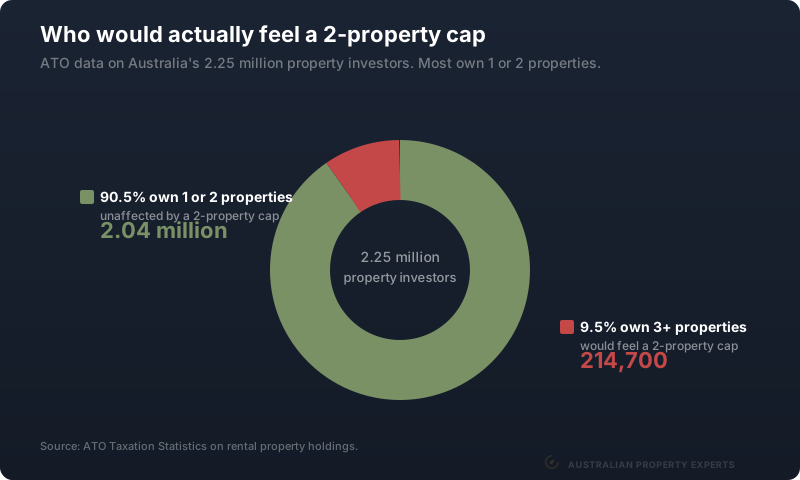
The Treasury model that has had the most public airing is a cap that would limit negative gearing deductions to a maximum of two investment properties per person. Properties beyond the cap would have their rental losses quarantined, meaning they could only be offset against future rental income from those properties, not your salary or wages.
The more aggressive scenarios floated by commentators in late April include a full abolition of negative gearing for new investments, with grandfathering for existing holdings. Chalmers has not confirmed this version, but he has not ruled it out either.
The political map matters here. The Coalition will not support any wind-back. The Greens will support a wind-back but want it harder, with concessions limited to a single existing property. To pass anything in the Senate, the government needs the Greens. That makes a softer cap politically harder than a tougher one, not easier.
We cover this in detail in our negative gearing changes breakdown. The key context number: ATO data shows about 214,700 investors own three or more properties, roughly 9.5% of all property investors. The vast majority of investors are below any cap that has been seriously discussed.
CGT discount
Two scenarios are being talked about.
The Treasury modelled scenario lowers the CGT discount from 50% to 33% on residential investment property only, leaving shares and other assets at 50%. Under the current rules, if you sell after holding for more than a year, you pay tax on half the capital gain. Under the modelled change, you pay tax on two-thirds.
The more aggressive scenario, raised by some economists and commentators in the past fortnight, replaces the CGT discount with indexation across all assets. That treatment removes the inflation component of a gain from tax altogether but loses the flat 50% concession. Whether residential property comes out ahead or behind under indexation depends on the holding period and the inflation path.
Existing holdings are highly likely to be grandfathered under either scenario. That has been the consistent signal from Treasury. Properties already owned would keep their current tax treatment. New rules would apply to future purchases.
Here is what the modelled 50% to 33% change looks like in dollar terms at the 37% marginal rate, on three different capital-gain scenarios.
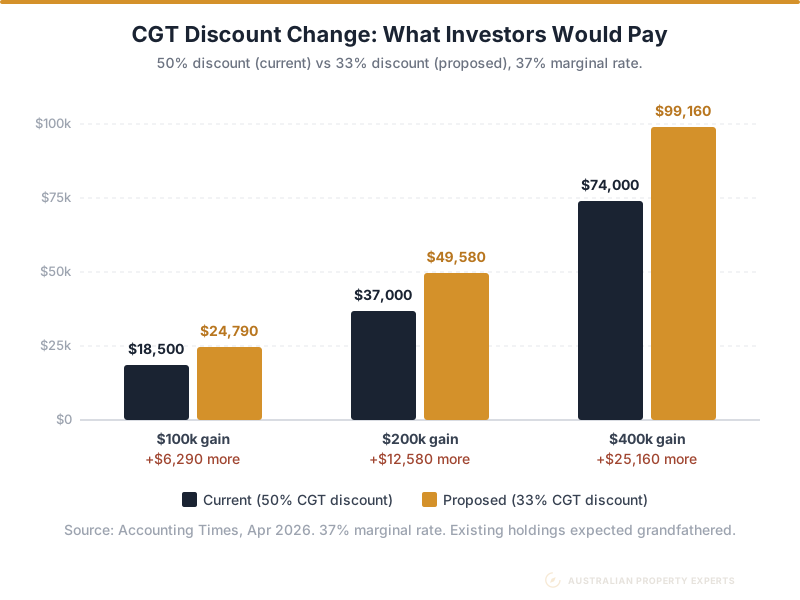
| Capital gain | Current tax (50% discount, 37% rate) | Modelled tax (33% discount, 37% rate) | Extra tax |
|---|---|---|---|
| $100,000 | $18,500 | $24,790 | $6,290 |
| $200,000 | $37,000 | $49,580 | $12,580 |
| $400,000 | $74,000 | $99,160 | $25,160 |
You can model your own position with our capital gains tax calculator.
Housing supply
The supply side is where the budget will probably move most decisively, because it is bipartisan-adjacent and not blocked in the Senate.
Help to Buy. The shared equity scheme launched in December 2025. As of 23 April 2026, Housing Australia reports 2,356 places approved (278 settlements, 2,078 progressing) out of an annual cap of 10,000. The government contributes up to 40% of the purchase price for new homes and 30% for existing. It is for owner-occupiers, not investors, but it shifts demand at the lower price points investors compete in.
Housing Accord shortfall. The 1.2 million homes over five years target is materially behind. Treasury and ABS data through the first 15 months show 81,000 fewer homes built than required, a 27% miss. Building approvals fell 10.5% in March 2026 alone, to 17,300 dwellings. The annual run-rate needed to hit target is closer to 240,000.
Foreign buyer ban. The ban on foreign purchases of established dwellings remains in place. The budget may extend or strengthen it.
Housing Australia Future Fund. Round 3 has been launched to fund 21,350 new social and affordable homes. It does not address the broader market but signals direction.
The supply numbers matter for tax discussion because the political case for changing negative gearing rests on whether the change improves housing affordability without making the supply problem worse. Most independent estimates put the price impact of combined CGT + negative gearing reform at 1% to 4% lower than baseline. Most also flag a risk to new construction.
The economic backdrop
The budget arrives into a hostile macro setting.
Inflation has re-accelerated. The March quarter CPI print, released 29 April, came in at 4.6% headline annual, up from 3.7% in February. Trimmed mean was 3.3% annual, with the quarterly read at 0.8%. Both well above the RBA’s 2-3% band.
The RBA is hiking. The cash rate sits at 4.10% after back-to-back hikes in February and March 2026. The RBA decides again on Tuesday 5 May, the day before the budget, with markets pricing an 86% probability of a 25 basis point hike to 4.35%. The full implications are in our May 2026 RBA decision and CPI breakdown.
Property prices are still rising despite all of it. The national median dwelling value sits around $933,000 on the most recent Cotality numbers, with regional markets outpacing capitals year to date. Sydney and Melbourne are now in slight retreat. Perth and the mid-sized capitals are still climbing. That split is covered in our latest property market update.
The takeaway: the supply imbalance is overriding higher rates in most markets. Tax changes can do something to demand. They cannot do anything to supply.
What it could mean for you
You own one or two properties
Under the modelled two-property cap, you are unaffected. Your deductions stay as they are. Under the more aggressive Greens-style proposal (one property cap), you would feel a change on the second property. Under the full abolition for new investments scenario, anything you buy after the commencement date would not benefit from negative gearing.
The CGT change only affects you if you sell after 1 July 2027. Existing holdings were not grandfathered outright, which was the expectation at the time of writing. Growth up to 30 June 2027 keeps the 50% discount and growth after it is indexed. If you are building a portfolio, the timing of your next purchase still matters.
You own three or more properties
The two-property cap would affect deductions on your third and subsequent properties. Run the numbers on what quarantined losses would mean for cash flow. For many investors the impact is manageable, especially where those properties are close to neutrally or positively geared. For investors leaning hard on negative gearing on multiple properties, the impact compounds.
You are planning to buy in 2026
Do not rush. Do not wait indefinitely either. If changes are announced Tuesday, there will be a commencement date. The historical pattern is for tax measures to commence 1 July or later in the financial year. The window between announcement and commencement is when timing decisions matter most.
The fundamentals have not moved. Growth, yield and location quality determine long-term returns. Tax treatment is one input.
You are considering selling
If selling within the next few years was already part of your plan, the CGT change could cost you real money. The reduced discount percentage speculated about here is not what happened. The discount was replaced with indexation plus a 30% minimum tax, and growth up to 30 June 2027 keeps the 50% discount through a transition split rather than existing holdings being grandfathered outright. The CGT calculator runs both regimes on your own numbers.
What the industry is saying
The Housing Industry Association’s modelling estimates combined CGT and negative gearing changes could reduce new housing starts by approximately 46,000 dwellings over five years and cost more than 4,300 construction jobs.
The Grattan Institute estimates combined reforms would lower property prices by only 1% to 2% with minimal rental impact.
The Property Council argues that reducing investor incentives will push some landlords to sell, tightening rental supply in a market where the Cotality national vacancy rate sits around 1.6%.
Both sides have a defensible case. The practical outcome will depend heavily on the specific design and the transition rules.
What to do this week
Review your portfolio numbers. Count properties. Identify which ones run at a loss. Calculate how much of that loss you currently deduct against your income. If you own three or more, model the quarantined-loss scenario.
Talk to your accountant before Tuesday, not after. A good accountant can model your specific exposure under each scenario and flag transactions worth doing or pausing this week.
Do not panic-buy or panic-sell. Major reform announcements always trigger a rush of emotional decisions. The investors who do best are the ones who already did the analysis and act calmly when the details are confirmed. If you want a second set of eyes before acting, here’s whether a buyers agent is worth it.
Watch the data, not the headlines. The markets that are performing best right now are being driven by population growth, undersupply, and infrastructure. Those fundamentals do not change because of a budget announcement. Tax treatment changes the after-tax return. It does not change which suburbs are growing.
Mind your EOFY position. With 30 June approaching there are tax strategies worth considering before year end, regardless of what the budget delivers.
We will update this Tuesday night
Budget night is Tuesday 12 May 2026. We will publish the actual measures and what they mean for your investment strategy within hours of the speech. If you want a clean read of what changed and how to act, that update is the one to watch.
Until then, the best work you can do this week is preparation. Know your numbers, understand your exposure, and have a plan for each scenario. That is what separates investors who keep moving from investors who freeze.
This is general information only and not financial or tax advice. Speak to your accountant or financial adviser about how the 2027 changes apply to your specific situation.
See how we find investment properties that stack up either way.
If you want to talk through how the budget might affect your portfolio, book a free discovery call.