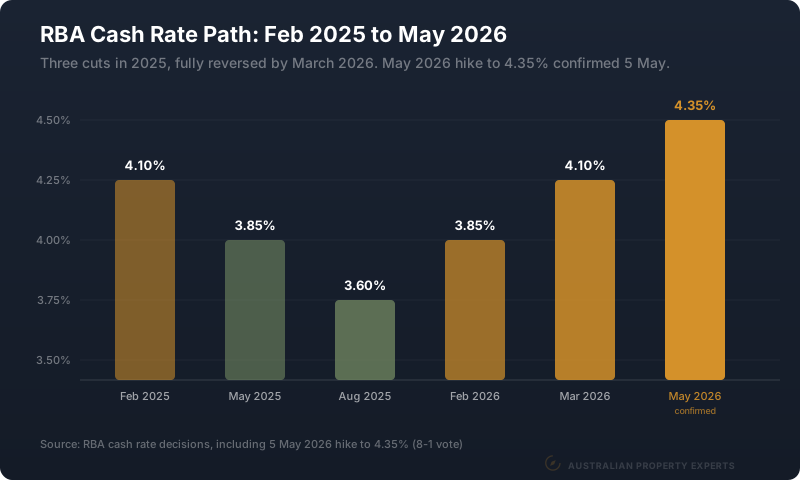
Update, 26 September 2026. The cash rate is still 4.35%. After the May hike, the RBA held at its 16 June and 11 August meetings, both by unanimous vote. Westpac’s call for June and August hikes did not happen. The next decision is due on 29 September. Headline inflation peaked at 4.6% in March and eased to 3.5% in the 12 months to July. Trimmed mean inflation has drifted up to 3.6% (ABS, July 2026). The average new variable investor loan was 6.4% in July (RBA F6). National home values are now 3.6% below their March peak, and the national median is $912,885 (Cotality, 31 August 2026). The preview below is unchanged apart from corrections to figures that were wrong at the time.
Update 5 May 2026, 2:30pm AEST. The RBA hiked the cash rate by 25 basis points to 4.35%, the third consecutive hike in 2026. The vote was 8-1, much firmer than March’s 5-4 split. The Board’s statement warned that higher fuel prices were likely to have “second-round effects” on prices. The Statement on Monetary Policy forecast headline inflation to peak at 4.8% in the June quarter, assuming the Middle East conflict is resolved shortly. Full follow-up analysis is in RBA hikes to 4.35%: what the May decision means for investors. The original preview below remains useful context on how the print and the May decision came together.
The March CPI print landed on 29 April. Headline inflation came in at 4.6% year-on-year, up from 3.7% in February. The RBA’s preferred underlying measure, trimmed mean, was 3.3% annual. On the quarterly measure it rose 0.8% in the March quarter. Both are still above the 2-3% target band.
The RBA Monetary Policy Board meets 4-5 May, with the decision announced Tuesday 5 May at 2:30pm AEST. Straight after the CPI print, markets priced around a 70% chance of a 25 basis point hike to 4.35%. CBA and NAB both expect a hike. Westpac is calling three more hikes through to August.
The CPI print, in one minute
The headline number jumped almost a full percentage point in a single month. Annual CPI moved from 3.7% in February to 4.6% in March. Prices rose 1.1% in March alone, and 1.4% over the March quarter.
The biggest contributors were Housing (+6.5% annual), Transport (+8.9%) and Food and non-alcoholic beverages (+3.1%). Transport is being driven by fuel, with automotive fuel up 24.2% over the year and a record 32.8% in March alone. Housing is mostly electricity (+25.4%, as government rebates ran out), new dwellings (+4.5%) and rents (+3.7%).
Trimmed mean, which strips out the most volatile items, was 3.3% annual. That sounds closer to target. The quarterly trimmed mean still rose 0.8%, after 0.9% in the December quarter, which runs at more than 3% a year.
So inflation is more than a fuel story. The base of the basket is still running too hot for the RBA to relax.
Why the May hike is almost a done deal
The RBA already hiked twice in 2026, taking the cash rate from 3.60% in August 2025 back to 4.10% in March. Two of the three 2025 cuts have already been reversed.
Three things make a third 2026 hike very likely:
Inflation is moving the wrong way. February to March took headline inflation from 3.7% to 4.6%. That is a big jump, and it strengthens the case for the hawks on the board.
Underlying inflation is still sticky. Trimmed mean has not dropped below 3% in any of the last three readings. The RBA cannot declare victory until that number is comfortably back inside the band.
Markets and major banks are aligned. Markets priced around a 70% chance of a 25 point hike after the CPI print. CBA and NAB both forecast 4.35%. Westpac is the most hawkish, calling for hikes in May, June and August to take the rate to 4.85%.
If the RBA holds, it would be the surprise. The base case is 4.35% by Tuesday afternoon.
What 4.35% does to your numbers
For an investor on a variable rate, the rule of thumb is direct. Cash rate moves pass through to your rate, give or take lender margin and timing.
RBA lending data put the average rate on new variable investor loans at about 6.1% in March. A 25 point hike pushes that towards 6.35%. On a $750,000 interest-only investment loan, that is roughly $156 more per month, or about $1,875 a year. On a $1,000,000 loan, it is closer to $208 per month, or about $2,500 a year.
Borrowing capacity moves more than most investors expect. Each 0.25% hike trims about 2.2% off what a fixed repayment budget can borrow. On a $1 million limit, that is about $22,000. Stack three 2026 hikes together and the same budget borrows about $65,000 less than it did in January. We covered the full mechanics, including the new APRA DTI cap, in our borrowing capacity 2026 breakdown.
Banks assess serviceability at your loan rate plus a 3% APRA buffer. A 6.35% loan rate means an assessment rate of around 9.35%. That is the real number setting your borrowing limit.
If you have a pre-approval from before February 2026, it is almost certainly stale. Refresh it.
What this does to property prices
This is the part that surprises most investors. Despite two hikes already in 2026, national dwelling values are still up 9.8% year-on-year. The supply story is winning the tug of war with the rate story.
SQM Research national vacancy was 1.2% in April, and Perth, Brisbane and Adelaide were all below 1%. The National Housing Supply and Affordability Council’s 30 April report expects about 980,000 new homes over the Housing Accord period. That leaves Australia around 220,000 homes short of the 1.2 million target.
Rate hikes can soften demand. They cannot manufacture supply. So the markets where the supply imbalance is sharpest, and where buyers are not maxed out on borrowing in the first place, hold up better through hiking cycles.
That is a structural argument for affordable markets over blue chip in this part of the cycle. A buyer in Davoren Park or Logan or Mount Druitt is not borrowing at the edge of their capacity. A buyer in Mosman or Toorak is. When borrowing power tightens, the top end gets hit first and hardest. The April 2026 Cotality release confirmed this pattern in real time, with Sydney and Melbourne both falling 0.6% while Perth gained 2.1%.
For investors who have already bought, rents are still rising, up 5.7% nationally over the 12 months to April on Cotality’s index. That partially offsets higher holding costs, especially if you are sitting on a 2024 lease about to roll.
What we are doing for clients right now
A few things have changed in the last fortnight, and a few have not.
We are still buying. The supply-demand fundamentals in our preferred markets have not flipped. If anything, the squeeze is tighter. Trying to time the bottom of a rate cycle has historically cost more than buying through it. The purchases on our case studies page show what buying through a cycle looks like.
We are pushing harder on yield. In a higher-rate environment, cash flow matters more. Properties that were marginal at the 5.7% investor rates of late 2025 are tighter at 6.35%. We are screening more aggressively for yield without sacrificing growth fundamentals. The growth versus yield balance tilts when rates move.
We are talking to brokers earlier. Borrowing capacity now resets with each RBA meeting. Pre-approvals are getting refreshed mid-search. Investors who do not check in with their broker before going under contract are getting caught short.
We are leaning into interest-only structures where it makes sense. Cash flow preservation matters when holding costs rise. The trade-offs are real, so this is not for everyone. Talk to your broker and accountant.
We are not chasing fixed rates. Fixing locks in today’s elevated rate. If the RBA finishes its hiking cycle later in 2026, you would be paying above market for years. Split structures still make sense for risk management. A wholesale rush to fixed near a rate peak is a risky bet.
What we were watching
The decision drops at 2:30pm AEST on Tuesday 5 May. Two things matter beyond the rate itself:
The vote split. March was 5-4. If May is also split, the hiking cycle is not on autopilot, and a pause in June or July becomes more plausible. A unanimous hike signals more to come.
The Statement on Monetary Policy released the same day. The RBA’s revised inflation and growth forecasts will tell you whether they expect to hike again. If the SoMP forecasts have inflation back in band by mid-2027, this is likely the last hike. If it is later, Westpac’s call gets more credible.
The federal budget then drops 12 May. Fiscal policy can either reinforce or work against the RBA. We covered the budget preview here. We will update once the actual measures land.
The read
The CPI print and the May hike confirm a story that started in February. Inflation is sticky. The RBA is responding. Borrowing capacity is compressing. Property prices in supply-constrained, affordable markets are rising anyway.
For investors with a five to ten year horizon, one question matters most. Are you buying in markets where the fundamentals do the heavy lifting, wherever the cash rate sits in any given month? That is what we are focused on, and that is the call that matters.
Sources: ABS CPI, March 2026, RBA decision, 5 May 2026, CommBank on the March CPI, Westpac IQ, SQM Research vacancy and NHSAC State of the Housing System 2026.
This is general information only and not financial advice. Interest rates and lending criteria change frequently. Speak to a qualified mortgage broker about your specific borrowing situation, and your accountant about your tax position.
See how we buy for investors through rate cycles.
If you want a second set of eyes on your portfolio strategy, book a free discovery call.