
Update, 26 September 2026. The slowdown in this post became a broad downturn. Cotality’s national index fell 0.9% in August, its fifth monthly fall in a row, and Cotality now dates the national peak to March. National values are 3.6% below that peak. The national median is $912,885, up 2.7% over the year (Cotality HVI, data to 31 August 2026). Sydney fell 1.4% in August and is down 4.6% over the year. Perth is still up 15.6% on the year but fell 0.8% in August. Darwin was the only capital to rise in August. Gross yields have lifted as values fell, to 3.8% nationally and 6.3% in Darwin. The RBA hiked to 4.35% on 5 May and held in June and August. The figures below are as they stood at the end of April.
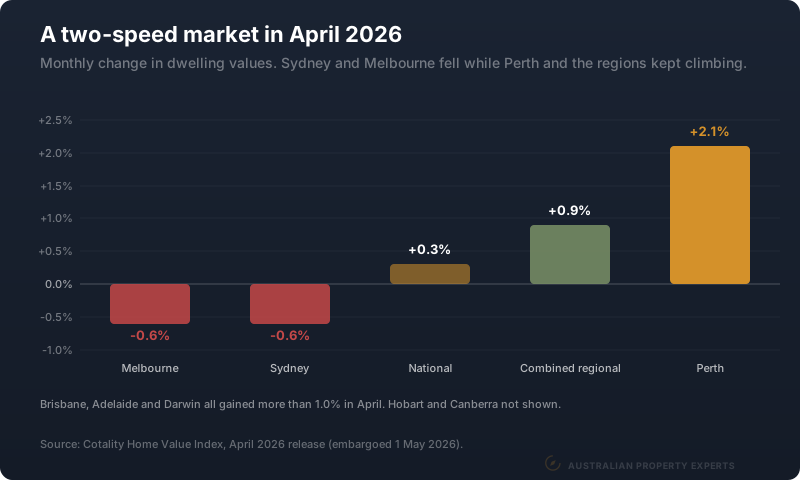
Sydney is down. Melbourne is down. Perth added more than $21,000 to its median dwelling value in a single month. The latest Australian property market data shows the slowest national growth in over a year. The headline number hides four very different markets running at once, and the split is sharpening fast.
The Cotality Home Value Index for April 2026, released Friday 1 May, showed national dwelling values up 0.3% for the month. That is the slowest pace since January 2025. For investors, the more useful signal sits underneath that headline. The top end of the market is now falling first, and the data shows where the cycle is likely to turn next.
What April actually showed
The headline rise was the smallest in more than twelve months. Four things drove it:
- Sydney values fell 0.6% for the month and now sit 1.0% below their November 2025 peak. The median dwelling value is now around $1.29 million.
- Melbourne values fell 0.6% as well, putting the city 1.9% below its November 2025 cyclical high and 2.3% below the long-running March 2022 peak.
- Perth led the country again, up 2.1% for the month. The Perth median is now $1.04 million, sitting at 80% of the Sydney benchmark. A year ago it was about 67%.
- Brisbane, Adelaide and Darwin all posted monthly gains above 1%, with listings still well below typical levels for this time of year.
The combined regional markets gained 0.9% for April, the smallest regional rise in nine months. Year to date though, the regions are still outpacing the capitals 4.2% to 1.8%.
Sydney and Melbourne are retreating
Both cities are now five months past their November peaks. The slowdown began before the RBA’s back-to-back February and March hikes. Those hikes have added to the pressure.
Borrowing capacity has tightened more than most buyers expect. Each 0.25% hike trims about 2.2% off what a fixed repayment budget can borrow, or about $22,000 on a $1 million limit. Two hikes are already through the system in 2026. A third looks very likely on Tuesday 5 May. The buyer pool at the top end of Sydney is thinning.
Listings tell the same story. Sydney advertised stock now sits 9.4% above its five-year average. Melbourne is 2.2% above. When more vendors compete for a smaller buyer pool, prices ease. Capital city auction clearance rates have held below 55% since the last week of March.
The lower quartile is the real story
This is the data point most reports skipped past. Through the first four months of 2026:
- Sydney’s lower quartile house values are up 2.9%.
- Sydney’s upper quartile house values are down 3.3%.
That is a six percentage point spread inside the same city in four months. Affordable Sydney is still rising while premium Sydney falls. Every capital city is recording stronger growth in its lower quartile, and Sydney has the widest gap.
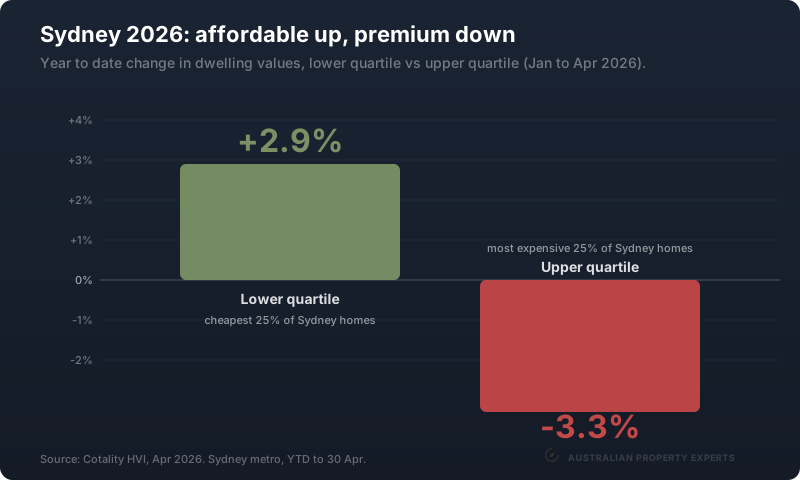
When borrowing capacity compresses, the top end gets hit first because those buyers are already stretched. The lower quartile, where buyers are not borrowing at the absolute edge, holds up. Often it strengthens as demand shifts down the price spectrum.
The case for affordable markets over blue chip was already strong at the long-run level. April just added a four-month live case study, in the largest property market in the country.
Where the cycle is still climbing
The mid-sized capitals are running on a different clock. Listings are scarce, buyer competition is sharp, and prices keep climbing despite higher rates.
Perth added 2.1% in April alone. The median dwelling is now $1.04 million, and values are up 26.0% over the year. Inventory is still tight, with advertised listings well below typical levels for the time of year.
Brisbane and Adelaide both gained more than 1%. Brisbane is up 19.7% over the year and Adelaide 12.2%. Both still have listings below typical levels.
Darwin posted another month above 1% and is now at a fresh record high after a decade of underperformance. Darwin has been the year’s quiet outlier. It has the highest gross rental yield of any capital at around 6.0% on Cotality numbers. The national average is 3.6% and Sydney’s is 3.1%.
These markets have run hard for several years already, so the runway is shorter than it was. Even so, the growth-versus-yield calculus still works in their favour through 2026 for investors who screen carefully.
The yield gap between the capitals
If you are buying for cash flow, the spread between cities is wide on Cotality’s numbers. Darwin’s gross yield is almost double Sydney’s:
- Darwin: around 6.0% gross
- Melbourne: around 3.8% gross
- Perth: around 3.6% gross
- Adelaide: around 3.4% gross
- Brisbane: around 3.3% gross
- Sydney: around 3.1% gross
A $1.6 million Sydney house at Cotality’s 2.7% average house yield grosses about $43,000 in rent. RBA data put new variable investor loans at about 6.1% in March. At that rate, interest alone on an 80% loan of $1.28 million is about $78,000 a year. Council rates, insurance, repairs and management come on top.
Yields matter even more in a tightening rate environment. Rates do not care whether your yield is 3% or 6%. They eat fixed dollars. The lower your yield, the deeper the bite.
Where the data points investors next
A few things have shifted in the last month, and a few have not.
We are leaning further into the lower-priced corridors. The lower quartile data is now the clearest signal in the market. Buyers in the $500,000 to $850,000 range are in the part of the market that is still rising, especially in growth corridors with infrastructure tailwinds. That is the same corridor logic behind the purchases on our case studies page.
We are weighting yield more heavily in screening. A 3.1% yield property in a Sydney premium suburb was a marginal investment at the 5.7% investor rates of late 2025. At 6.1% and rising, it is bleeding cash with no growth catalyst attached.
We are not rushing into Sydney or Melbourne premium. The slide from the November peak is not a buying signal yet.
We are watching Darwin closely. A market at fresh highs after a decade of underperformance is worth paying attention to. The fundamentals are real. If you buy here, do it with eyes open and a yield safety margin.
What April means for investors
Sydney and Melbourne’s premium suburbs are now retreating under the weight of higher rates and worsening affordability. Affordable submarkets in those same cities are still rising. The mid-sized capitals are pushing fresh records. The regional rise has moderated but remains clearly ahead of the capitals on the year.
For investors with a five-to-ten year horizon, the call is unchanged. Buy where the data points, even when the postcode looks less impressive on paper. The April release just made that call easier to defend.
All capital growth, rent and yield figures are from the Cotality Home Value Index April 2026 release, embargoed 1 May 2026. Investor loan rates are from RBA table F6. For the current picture, see our August 2026 market update.
This is general information only and not financial advice. Property markets change quickly. Speak to a qualified mortgage broker about your borrowing position and your accountant about your tax circumstances before investing.
See how we buy in the corridors that are still moving.
If you want a strategy that maps your portfolio to the parts of the market that are still moving, book a free discovery call.



.jpg)