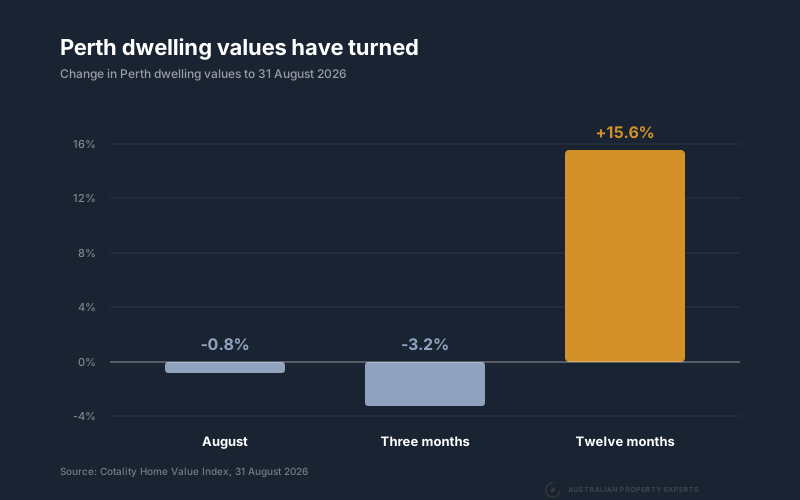
Perth was the strongest capital city market in Australia over the year to August 2026, with dwelling values up 15.6%. The run has turned since. Values fell 3.2% over the three months to August. Vacancy, while still tight, is off its lows.
Perth has clearly run. Investors need to know whether the numbers still work at today’s prices.
Where Perth sits right now
On Cotality’s Home Value Index at 31 August 2026, Perth’s median dwelling value is $999,987, up 15.6% over the year. Houses sit at $1,043,478 and units at $733,223.
The run has stalled. Perth fell 0.8% in August and 3.2% over the quarter. Cotality also revised July from +0.1% to -1.3%. The annual number is still the strongest of any capital, but the last three months are not.
For a transaction-based cross-check, REIWA’s release of 22 September 2026 put Perth’s median house sale price at $980,000 for the June quarter. That was down 2.0% on the March quarter and up 18.7% on a year earlier. Other dwellings sat at $700,000. REIWA’s Perth metro data has median weekly rents of $750 for houses and $700 for units to August 2026. REIWA measures the middle of what actually sold. Cotality models the value of the whole stock, so the two do not line up.
Cotality has Perth’s peak in April 2026, the month our April market update covered. Values are 3.2% below that peak now, though over five years they are still up 79.7%. Both sources tell the same story. Prices are well up on last year and slipping now.
Other data points worth anchoring on:
- Vacancy rate: 0.61% (SQM Research, August 2026), or 1,192 vacant rentals across the metro. That is up from 0.51% in March
- Days on market: a median of 24 days for the September 2026 quarter so far, up from 9 in the March quarter (REIWA)
- Listings: 7,755 homes for sale in the week to 20 September 2026, 164.8% more than a year earlier (REIWA)
- Annual growth: houses 15.6%, units 16.0% (Cotality)
Units have slightly outpaced houses on growth in this leg of the cycle, which is unusual. It reflects just how stretched house prices have become. With the median house above $1.04 million on Cotality’s index, buyers at the lower end start hunting units and townhouses instead. That substitution effect is showing up in the numbers.
Sales volumes have also dropped. Cotality names Perth among the capitals where estimated sales are down more than 20% on a year ago. REIWA members reported 635 sales in the week to 20 September. With fewer buyers and more stock, homes now take longer to sell, which explains the 24-day median.
What drove the last cycle
Three things, stacked on top of each other.
The resources sector ran hot through this cycle. Iron ore held up, LNG expanded, and critical minerals investment kept flowing in.
Interstate migration followed the jobs. WA posted a net gain of 10,314 residents from other states in the year to March 2026, on ABS figures. WA’s population grew 2.1% over that year, the fastest of any state or territory. Greater Perth grew 2.4% in 2024-25, the highest rate of any capital city (ABS).
And supply never caught up. Construction costs, labour shortages and a slow approval pipeline kept new builds well below what the population growth required. For-sale stock was scarce too, with REIWA counting just 1,564 listings in the December 2025 quarter. That shortage is what pushed prices up. It has now reversed on the listings side, even if new building is still short.
Bank forecasts for 2026
The bank forecasts made at the start of the year have been overtaken by four rate rises and the falls since.
What the forecasters say now is cautious. Cotality says the housing market is likely to remain under downward pressure over the coming months.
Where Perth goes from here comes down to two things. One is rates. The cash rate is 4.60% after four rises in 2026. The other is how much of the migration plus supply shortage is already priced in. If rates stay high, values could keep falling. If demand holds up, population growth could keep outpacing a building industry that can’t catch up.
Infrastructure and jobs backdrop
METRONET is effectively done. The Yanchep Line opened in July 2024 and the Ellenbrook Line in December 2024. Perth’s first east-west rail connection, the Thornlie-Cockburn Line, opened in June 2025. The program wrapped with the new Midland Station, opened on 22 February 2026. That capped roughly 72 kilometres of new rail and 23 new stations (METRONET).
For investors, that means most of the transport uplift in the growth corridors has already happened. The suburbs along the Ellenbrook, Yanchep and Thornlie-Cockburn lines have largely priced it in. Buying now for a “METRONET story” is late. Ellenbrook’s full arc, from oversupply casualty to $825,000 median, is worked through in our land supply post.
What’s still coming:
- Perth Airport: a $5 billion redevelopment bringing the terminals together, with a major contract awarded in June 2026
- Resources pipeline: the WA Government pointed to a strong resources project pipeline for WA jobs in September 2026
- Alkimos Seawater Desalination Plant: under construction, with first water planned for 2028 (Water Corporation)
- Westport (Kwinana): long-term container port relocation, still years from completion but relevant for southern corridor land values
The job creation backdrop matters more than any single project. When migration, wages, and resource investment all point the same direction, rental demand and owner-occupier demand both hold up.
Perth investor risks in 2026
The bull case is loud, so the risks are worth saying out loud too.
Affordability ceiling is closer than it looks. Perth houses sit at $980,000 on REIWA’s June quarter median, and above $1.04 million on Cotality’s index. That is no longer an affordable market. REIWA says WA housing affordability is at a record low. First-home buyers using the expanded federal guarantee scheme can still stretch into mid-ring suburbs. But a solid house under $500,000 in a commutable suburb is now hard to find.
Yield compression on houses. Cotality has Perth houses on a 3.8% gross yield, against 5.0% for units. Perth rents rose 56% over five years, the biggest rise of any capital, but values rose 79.7%. For investors modelling cash flow, Perth houses no longer stand out the way they did in 2023.
Reliance on one industry. Perth is heavily tied to resources. When iron ore or lithium turns, it flows through to jobs, migration, and rental demand fast. The project pipeline looks solid for now, but that dependence is still a risk.
Rate sensitivity at the margin. The RBA cash rate sits at 4.60% after four rises in 2026. It is thinning out the buyer pool, and sales have already dropped. If the RBA goes again, Perth’s mid-ring may be the next segment to slide.
What we still buy in Perth
Affordable houses in the outer north and south, on land that gives the property somewhere to go. That means a decent block for a future granny flat or subdivision, and older established stock we can put a cosmetic renovation through. It also means yields at the top of the metro range, which narrow the holding cost at current rates.
What we avoid: new builds in greenfield estates (oversupply risk and no equity uplift on settlement) and off-the-plan apartments (developer risk, no cosmetic reno lever). We also skip the inner ring, where yields are too low for an investment purchase.
The outer-ring rule is simple. The property needs to make sense on yield today and on growth over the next five years. It also needs to give you a reno lever or land lever if the market flattens. Without those three, you’re betting on capital growth alone in a market that’s already run hard. That’s a worse bet in 2026 than it was in 2023.
For the breakdown of specific suburbs still working in the current cycle, see our Perth suburb guide. And if you want to understand why affordable markets continue to outperform premium postcodes in this environment, read affordable vs blue chip.
What this means for the rest of 2026
Perth still has the strongest annual growth of any capital, but it’s in a different phase of the cycle to where it was in 2023. Values have fallen 3.2% from their April peak, and Cotality expects downward pressure over the coming months. House rents are still up 8.1% over the year, so yields have started to lift off their lows. New building will not catch up with demand in 2026.
If you’re buying in Perth now, entry price and block quality matter more than they did two years ago. The easy gains are behind us. The structural tailwinds are still there, but margin for error is thinner.
If Perth is outside your budget, regional markets across the eastern states offer alternative entry points with their own tailwinds. If Perth fits and you want someone buying there regularly who knows which streets still work, see our Perth buyers agent page. The case studies page shows what those purchases look like.
Figures refreshed 26 September 2026. Perth metro values, yields and rent growth are Cotality’s Home Value Index at 31 August 2026. REIWA sales and rent medians cover the June quarter and the 12 months to August 2026; listings are for the week to 20 September 2026. Vacancy is SQM Research, August 2026.
This is general information only and not financial advice. Speak to a qualified professional before making investment decisions.
See how we find high-yield properties in markets like Perth.
If you’re weighing up Perth for your next investment, book a free discovery call.