The Adelaide property market in 2026 looks very different to the one investors first noticed in 2020. Median house values have pushed close to $1 million, vacancy is sitting at 0.8%, and the city has just come off a five-year run where dwelling values climbed close to 80%.
The question for 2026 isn’t whether Adelaide has been a good market. It has. The question is what’s left in the tank.
Where Adelaide sits right now
Adelaide’s median dwelling value is $944,909 on Cotality’s Home Value Index released 3 August 2026, covering July, up 10.5% over the year. The quarter was flat at +0.1% and July slipped 0.2%, so the run has levelled off rather than reversed the way Sydney and Melbourne have.
For the earlier detail: in January 2026 Cotality had Adelaide’s median house value at $972,435, the combined dwelling median at $937,021 and the median unit at $684,698, with houses up 1.3% for the month, 4.8% for the quarter and 9.7% over the year, and units up 12.3% year-on-year.
SQM Research has Adelaide’s vacancy rate at 0.8% as of March 2026. That’s been the number, give or take a tenth, for most of the past 18 months. Balanced is 3%. Adelaide is running at roughly a quarter of that.
Days on market sit around 31 for houses, with limited vendor discounting. Gross dwelling yield is around 3.5% on the Cotality measure, with units meaningfully stronger than houses. In the outer north, yields on established houses still push into the high 4s and low 5s.
The 5-year run, and why it happened
Cotality’s trough-to-peak measure has Adelaide dwelling values up roughly 79% over five years. Few capital cities have matched that run, and none have done it on the kind of affordability base Adelaide started with.
Three things drove it.
Relative affordability. In 2020 Adelaide’s median was under $500k while Sydney and Melbourne were already stretched. Interstate buyers priced out of the east coast looked west to Perth and south to Adelaide, and the numbers worked.
Defence, space and health jobs. Lot Fourteen brought the Australian Space Agency, SmartSat CRC, the Australian Institute for Machine Learning and more than 1,500 workers across 150+ businesses into the CBD. Osborne shipyards anchor the $368 billion AUKUS submarine program. Defence SA, BAE Systems, and the broader defence supply chain have underwritten a wave of stable, high-paid employment.
Supply that didn’t keep up. SA has not built at the rate population growth and household formation required. Greater Adelaide added 18,600 residents in 2024-25 (ABS), net overseas migration is strong, and approvals have lagged. The result is the vacancy rate you see now.
Bank forecasts for 2026
The four major banks expect Adelaide dwelling prices to keep rising in 2026, though the spread is wide:
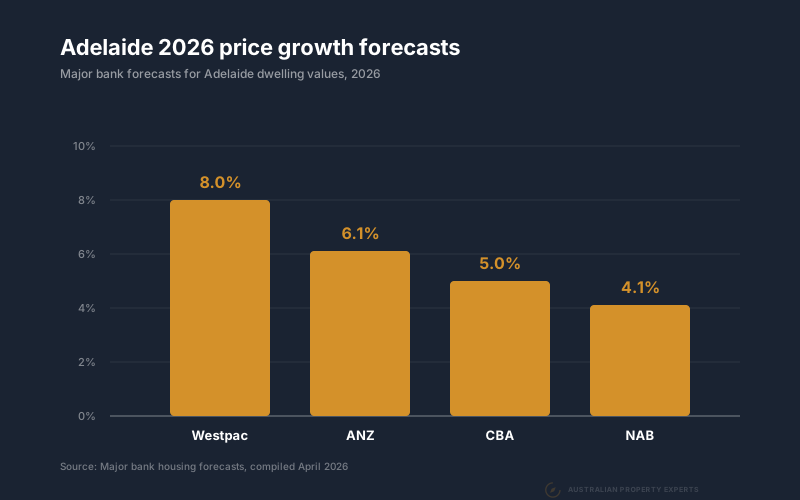
- Westpac: +8%
- ANZ: +6.1%
- CBA: +5%
- NAB: +4.1%
Even NAB, the most conservative, is calling positive growth. The direction is unanimous. The debate is pace.
Those forecasts factor in the RBA’s back-to-back February and March 2026 hikes, which cooled sentiment across most capital cities but have so far left Adelaide’s fundamentals intact. Tight supply, steady population inflow, and an unusual concentration of government-backed job growth are the reasons.
Infrastructure and jobs backdrop
Adelaide’s infrastructure pipeline is the largest in the state’s history and it’s concentrated in places that matter for housing demand.
North-South Corridor, Torrens to Darlington. The $15.4 billion T2D project is the final 10.5km of the 78km non-stop South Road motorway. Tunnel boring is scheduled to start in the second half of 2026. When finished it removes 21 sets of traffic lights between the CBD and the southern suburbs. The federal and state governments are each committing $7.7 billion. Drive-time changes on this scale reprice entire corridors.
New Women’s and Children’s Hospital. The $3.2 billion WCH is under construction next to the Royal Adelaide Hospital. The eight-storey carpark is three-quarters complete. Main hospital construction ramps up this year, targeting completion by 2031. The health precinct around the RAH is already one of the largest employment concentrations in SA.
Lot Fourteen and the Riverbank. Lot Fourteen is on track to host 6,000+ high-skilled workers in space, defence, cyber and creative industries. Festival Plaza is a $1 billion+ public-private redevelopment anchored by SkyCity and Walker Corporation, with $213 million from the state. These aren’t speculative projects. They’re funded, under construction, or already open.
Defence and space. The AUKUS submarine program at Osborne, the Australian Space Agency HQ at Lot Fourteen, BAE’s shipbuilding pipeline, and Defence SA’s precinct strategy are together the most durable employment story in the country. These jobs anchor household formation, and household formation is what underwrites rents.
For investors, this matters less as a “buy near the hospital” story and more as a structural demand floor. A state adding this much funded infrastructure and this many skilled jobs doesn’t get a soft rental market.
Adelaide investor risks in 2026
Adelaide isn’t risk-free in 2026. Three things to weigh.
Affordability is stretched. A $972k house median is a different entry point to a $550k one. Buyer borrowing capacity has been squeezed by the two rate hikes, and Adelaide’s wage base hasn’t moved in line with prices. The pool of buyers who can comfortably fund a median-priced Adelaide house is smaller than it was 18 months ago.
Yield compression. When medians rise faster than rents, yields compress. That’s happened across most of Adelaide’s established house market. A Prospect or Norwood house yielding 2.5-3% is a different proposition to a Munno Para house computing 4.49%. Investors need to be clear which problem they’re solving: growth, yield, or both.
Premium-end softness. Adelaide’s prestige suburbs have run hard and buyer depth thins quickly above $1.5M. Recent sales data shows the top end is taking longer and clearing with more negotiation. Median and lower-quartile suburbs are still tight. Upper-quartile suburbs are not.
The affordable-markets-outperform-blue-chip argument applies in Adelaide as clearly as anywhere in the country right now.
Where we still see value in Adelaide
The Adelaide market isn’t one market. The value question has different answers in different corridors.
Outer north and Elizabeth corridor. Suburbs like Elizabeth North, Elizabeth Downs, Elizabeth Vale and Munno Para were the 5%-plus entry play, and that has closed. Computed from median and rent, they now return 4.66%, 4.32%, 3.76% and 4.49% on medians of $547,000, $602,000, $692,000 and $660,000. Growth has been strong from a low base and infrastructure access along the Northern Expressway and commuter rail is improving. This is where our Adelaide suburb guide spends most of its time.
Salisbury LGA. Still one of Adelaide’s strongest performers for house growth, with entry points that are reachable for investors who can’t stretch to the inner suburbs. Good rental depth, government-area demand, and genuine transport access.
Gawler and the northern growth corridor. New infrastructure, rail access to the CBD, and land supply that’s being absorbed quickly. The median in Gawler East sits around $770k, which is still well under the metro average. If corridor land supply worries you, the replacement-cost maths on “endless land” suburbs is worth five minutes.
Non-gentrified middle-ring pockets. Parts of the inner north and north-west still have suburbs where the premium hasn’t fully priced in. Selection at this level matters more than the headline figures, and the gap between a good street and a bad street can be 20%.
What we avoid in Adelaide for investors at current prices: blue-chip prestige, new apartments in high-density CBD fringe, house-and-land in greenfield estates with no rental demand behind them, and anything where the yield doesn’t support the holding costs through a rate cycle.
Investors also need to think past Adelaide. The affordable-market story that made Adelaide compelling in 2020 now applies more to parts of Perth, regional SA, regional QLD, and pockets of NSW and TAS. A portfolio strategy that was “buy Adelaide” three years ago is likely “buy two markets, with Adelaide as one of them” today. We cover the broader picture in our regional markets 2026 piece.
If you’re looking at Adelaide as a buyers agent client, the conversation in 2026 is sharper than it was two years ago. The easy money is behind us. Suburb selection and property selection are doing most of the work now. Getting a compliant established house on a decent block, in a corridor with structural demand and a sensible yield, still delivers. Getting swept into a hot suburb at the wrong price point does not. Our case studies show what that discipline looks like on real purchases.
What the 2026 numbers mean
Adelaide has moved from undervalued to fairly valued over the last five years, and from fairly valued to fully priced in some pockets. The fundamentals that drove the run are still intact: low vacancy, structural supply shortage, a massive funded infrastructure pipeline, and employment growth in sectors that don’t move with the property cycle.
Banks are calling 4-8% in 2026. That’s not a boom. It’s still one of the better call-it-conservative capital-city forecasts in the country, and it’s attached to a rental market running at 0.8% vacancy.
For investors who are selective about corridor and property, Adelaide still stacks up. For investors expecting another 2021-2024 run by buying anything with a roof, the risk has moved.
This is general information only and not financial advice. Speak to a qualified professional before making investment decisions.
See how we find high-growth, high-yield properties for investors.
If you want to work through how Adelaide fits against other markets for your strategy, book a free discovery call.