
The ban is law and in force. The Greens amendment passed with the Treasury Laws Amendment (Tax Reform No. 1) Bill 2026 on 25 June. The Act received Royal Assent on 26 June 2026 (Act No. 49 of 2026). Schedule 5, the borrowing change, commenced on the 45th day after Assent: Monday 10 August 2026.
Since 10 August 2026 an SMSF can no longer borrow to buy residential property. A Limited Recourse Borrowing Arrangement (LRBA) entered into from that date can only buy real property that is business real property. That applies whoever the lender is, including a related party. Existing LRBAs are grandfathered and can still be refinanced. Contracts exchanged before 10 August are protected even if they settle later. The ATO published its guidance on the change in late July.
If you exchanged before the cliff, the transitional rule below still protects your settlement. If you did not, the sections on timing are now a record of the run-up. Cash purchases of residential property by an SMSF are still allowed.
This post is general information for investors with an existing SMSF (or one being set up). It is not personal financial product advice. SMSF and LRBA decisions can only be made on advice from your SMSF accountant and a licensed financial adviser. Nothing here changes that.
In one minute
- New SMSF borrowing (LRBAs) for residential property has been banned since 10 August 2026
- A contract exchanged before that date is protected. Settlement can happen afterwards
- Existing SMSF property loans are fully grandfathered, including the right to refinance with the same or a new lender
- New LRBAs can still buy business real property, meaning land and buildings used wholly and exclusively in a business
- For a house or unit held as a rental, a cash purchase is now the only path inside a fund
The dates you actually need
| Event | Date |
|---|---|
| Government-Greens deal announced | 23 June 2026 |
| Passed Parliament | 25 June 2026 |
| Royal Assent (Act No. 49 of 2026) | 26 June 2026 |
| Ban commences | 10 August 2026 |
The 45-day clock started when the Governor-General signed the Act on 26 June. Schedule 5 commenced on day 45.
What’s banned, and what isn’t
The amendment adds one condition to section 67A of the SIS Act. For real property, a new LRBA can only buy business real property as defined in section 66. The ATO confirms this applies whether the lender is a bank, a non-bank or a related party.
| Treatment | Affected? |
|---|---|
| New LRBA for residential property | Banned from 10 August 2026 |
| New LRBA for commercial property | Allowed only if it is business real property |
| New LRBA for business real property (s66 SIS Act) | Still allowed |
| Cash purchase of residential property by SMSF | Still allowed (no borrowing) |
| Existing residential LRBA | Fully grandfathered |
| Refinance of existing residential LRBA | Allowed (more below) |
Business real property is the live carve-out worth understanding. If you run a business that needs premises (a workshop, an office, a warehouse, a clinic), an SMSF can still borrow to buy them. The fund can then lease them back to the operating company. The property must be used wholly and exclusively in a business. That test applies when the LRBA starts and for the whole life of the loan.
What’s actually at stake if you miss the window
The ban reaches a lot further than one residential property. It decides whether you can use leverage inside super to buy residential property again, for as long as it stays on the books.
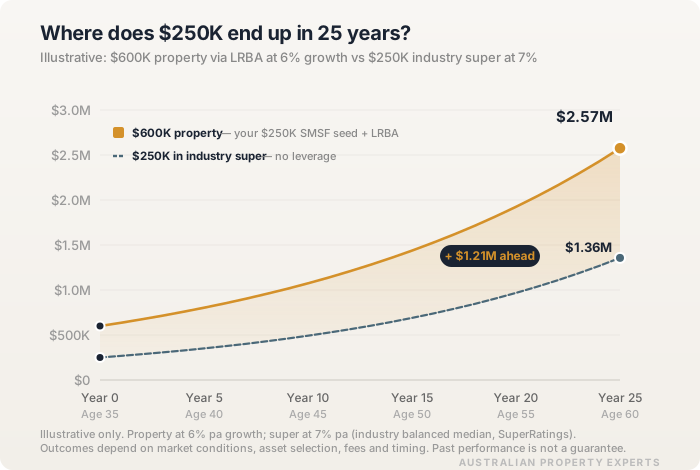
Take a 35-year-old investor with an SMSF balance of around $250,000. That covers a 20-30% deposit plus stamp duty and a buffer. With an LRBA, that $250,000 could fund a $600,000 residential property purchase. Without the LRBA option, the same $250,000 sits in a balanced super option and compounds on its own.
Run both paths for 25 years. The property grows at 6% a year, above Cotality’s national average of 5.2% a year over the past decade. The super balance earns 7% a year, just under SuperRatings’ estimate of 7.3% a year for the median balanced option since super began.
- The property route: $600,000 grows to around $2.57 million by age 60. Inside super, fund earnings are taxed at 15% in accumulation and 0% in pension phase. After paying down the loan over the same horizon, ending equity sits at roughly that property value.
- The no-leverage route: $250,000 compounds to around $1.36 million.
That’s a gap of roughly $1.2 million from one decision: using leverage inside super versus not.
Without an exchange before the cliff, the same investor has to find another way to build that exposure inside super. Cash works if your fund has the balance. Buy a smaller property outright and you’ve given up the leverage entirely. Build the equivalent exposure outside super and you’re on a different tax base for the whole hold. Over 25 years, each of those can leave you well behind the leveraged path.
No government has flagged a policy reversal. So the working assumption is that residential SMSF leverage closed on 10 August and stays closed.
The 45-day trigger was the contract date
This is the practical detail that decided what was possible in the time left.
The Act protects a borrowing where “the acquisition of the asset (to which the borrowing under the arrangement relates) happens under an arrangement entered into before that commencement”. Its note adds “even if the settlement for the acquisition of the asset happens after that commencement”. The ATO puts it simply: a binding contract exchanged before 10 August is protected. That holds even if the contract settles, or the LRBA is signed, on or after that date.
The ATO adds that later contract variations generally don’t change this. A contract changed so much that its fundamental terms no longer exist may be treated as a new arrangement.
What the run-up looked like
This section is a record of the run-up. It covers the six weeks between the announcement and the ban. At the time, the question was who could realistically exchange before 10 August. The answer depended on which group you were in:
SMSF and bare trust already established, finance pre-approved: yes. Property identification, due diligence (building and pest, valuation, contract review for sole purpose test alignment) and exchange were achievable in the time, especially with off-market access.
SMSF established, no finance yet: marginal. It came down to whether a broker could line up a lender quickly enough.
No SMSF yet: the road had essentially run out. Establishing the fund and its bare trust took time the window didn’t have. Forcing it meant buying whatever was available, and a rushed wrong property inside super is worse than missing the window.
Whenever you exchanged before 10 August: settlement on a normal cycle can happen after the cliff. The transitional rule protects you.
Three things made the deadline tight: lender approval times for SMSF loans, bare trust establishment for funds starting from scratch, and each state’s own contract exchange process.
If you already hold an SMSF residential LRBA
Nothing changes about your existing arrangement. There is no forced sell-down, no LVR reset, no value trigger that unwinds the loan. Standard SMSF compliance continues (sole purpose test, related-party rules, in-house asset limits). Your existing structure runs to natural completion.
Can you refinance the existing loan later?
Yes. The Act excludes an arrangement that “is for maintaining (or refinancing) a borrowing of money under another arrangement entered into before that commencement”. The ATO treats refinancing as a new loan contract for the same asset, with the same or a new lender. So you can move your existing LRBA to a different lender without losing grandfathered status.
One caveat. The exemption applies only “to the extent” the new arrangement maintains or refinances the old borrowing. A top-up or equity release goes beyond that and may be caught by the ban. Check any change beyond a like-for-like refinance with your SMSF accountant first.
If your existing LRBA rate sits well above what lenders now offer, a like-for-like refinance is worth pricing.
If you can’t make the 45-day window
Some SMSF investors ran out of clock. The right Plan B depends on what’s already in the fund, the investor’s age, and the time to preservation age. A few options worth raising with your accountant:
- Cash purchase inside the SMSF. If the fund has the balance, residential property can still be acquired outright by the SMSF. No leverage, but the asset still sits in the 15%/0% tax environment.
- Business real property pivot. If you run a business that needs premises, the SMSF LRBA pathway is still open for business real property. That includes commercial premises used wholly and exclusively in a business.
- Outside-super property purchase. Different tax treatment, different leverage, different estate considerations. Worth a clean comparison rather than a default, which you can run in the investment structure calculator. See our property portfolio outside super breakdown.
- Hold and wait. Future governments can reverse the ban. Industry pushback has been sharp: a joint MFAA, CAFBA and AFIA statement said it would choke off investment. A future reversal isn’t impossible, but planning around it isn’t a strategy.
Forcing a bad property through the door before the cliff was a worse outcome than missing the window. The maths above only works on the right property.
What we’re doing with SMSF clients now
Three points now shape our guidance for SMSF buyers.
First, residential property inside super is now a cash purchase. That suits funds that can buy outright and still hold a cash buffer, where an unleveraged house or unit still makes sense against the alternatives. For smaller balances the residential path has closed, and the question becomes whether the fund should hold property at all.
Second, borrowing is still possible. It is limited to business real property. The sole purpose and arm’s length rules are unchanged. For self-employed members that is a live option. It’s one we source for as a commercial buyers agent.
Third, existing residential LRBAs are grandfathered, including the right to refinance. If you hold one, nothing forces a sale, and the loan can be moved to a lender with a better rate. Our SMSF property investment guide covers the rules as they now stand.
If you’re buying interstate inside an SMSF, coordinate the buyers agent and your accountant from day one. The bare trust and contract dates have to line up even on a cash purchase.
Sources
- Treasury Laws Amendment (Tax Reform No. 1) Bill 2026 (Parliament bill page)
- ATO: Changes to limited recourse borrowing arrangements
- ATO SMSF newsroom: Changes to LRBAs for property from 10 August
- Treasurer’s second reading speech (Chalmers)
- PM’s media release, 23 June 2026
- Greens media release on the deal
- SMS Magazine: LRBAs banned for residential property
- GrowSMSF deep-dive on the bill text
- The Adviser: industry response to the ban
- SuperRatings: FY26 returns and long-run balanced median
Verified against Schedule 5 of the Treasury Laws Amendment (Tax Reform No. 1) Act 2026 (Act No. 49 of 2026, Royal Assent 26 June 2026). Also checked against the ATO’s July 2026 guidance, the Parliament bill record, and the 23 June 2026 PM and Greens releases. Last fact-checked 26 September 2026. For how this fits the wider reform package, see our 2027 negative gearing and CGT playbook.
This post is general information only and is not financial product advice or tax advice. SMSF decisions and LRBA structures are personal financial product advice that can only be given by a licensed adviser. The mechanics described above reflect the Act as passed and the ATO’s published guidance. Speak to your SMSF accountant and a licensed financial adviser before acting on any of the above.
See how we source properties for SMSF buyers.
If you have an established SMSF and want guidance on whether an outright residential purchase, or business premises bought with borrowing, fits your strategy, book a free discovery call. We can run the property search and execution while your accountant and adviser handle the structural side.