If you’re thinking about hiring a buyers agent, the first question is almost always the same. What’s it going to cost?
Most established buyers agents in Australia charge a flat fee between $15,000 and $30,000 + GST. Our own buyers agent fees page sets out what both fee models cost at real purchase prices. It also shows what sits inside the fee. The industry average sits around $22,000 + GST.
The actual number you’ll see on a quote depends on the fee model, the experience behind it, and what’s bundled into the scope. Whether that number earns its keep is a separate question. We’ve run the maths in does a buyers agent pay for itself.
Flat price vs percentage: the two ways you get charged
A flat fee is a fixed dollar amount. You pay the same number whether the property comes in at $450,000 or $650,000. Most investment-focused agencies use this model. It’s the one we use at Australian Property Experts. The reason is alignment. If our fee doesn’t move with the price, we have no commercial reason to push you toward something more expensive than your strategy needs. We get paid the same to find you the right one as we do to find you a flashy one.
Flat fees on the open market start at around $8,000 at the entry level and climb to $30,000+ at the top. The lower end is usually newer agents building a client base, or agencies running a narrower scope. Compare an agent who has personally transacted on five properties with one who has transacted on five hundred. The rolodex is very different, and so is the feel for a room. Fees tend to reflect that gap.
The other model is percentage of purchase price, usually 1.5% to 3% + GST. On a $500,000 purchase that’s $7,500 to $15,000. On a million-dollar purchase it’s $15,000 to $30,000. You see percentage pricing more often in the prestige and owner-occupied space, where the brief looks more like finding a dream home than building a portfolio. For investors the maths gets uncomfortable. The more expensive the property, the bigger the agent’s payday. That’s the wrong incentive to have sitting on your side of the negotiation table.
What that cost actually buys you
A full-service engagement runs end to end. Strategy session to lock in your goals, budget and timeline. Suburb research, comparable sales, rental data and growth signals, all worked from data. Sourcing across both on-market and off-market channels. Inspections and shortlisting before anything lands in front of you. Due diligence, including coordinating building and pest, strata reports, and risk assessment. Negotiation on your behalf. Settlement coordination through to handover.
What sits outside the fee is the building and pest report itself (usually $400 to $800), conveyancing, and any bank valuations. Those line items exist on every engagement, ours included.
If a quote looks unusually low, that’s where to look. Lower-priced offerings often stop at “we’ll find you a property” and hand the rest of the process back to you. You’re buying a smaller service at a smaller price.
Costs that sit outside what the buyers agent charges
A few line items aren’t part of the buyers agent fee but you’ll pay them on every purchase. Worth budgeting for so the all-in cost of getting into a deal doesn’t surprise you at settlement.
| Item | Typical cost |
|---|---|
| Building and pest inspection | $400 to $800 |
| Strata report (units and townhouses) | $200 to $600 |
| Conveyancer or solicitor | $1,200 to $2,500 |
| Bank valuation | Usually lender-covered; $300 to $500 if upfront |
| Depreciation schedule (post-settlement, investors only) | About $600 to $800 |
None of those are negotiable through your buyers agent. They’re third-party services. A good agent coordinates them on your behalf so you’re not chasing five quotes the week before settlement.
Service tiers, briefly
Not every engagement is full-service. The common tiers across the industry, and what you actually pay for at each level:
- Full-service ($15,000 to $30,000 + GST): strategy, search, due diligence, negotiation, settlement coordination
- Search-only ($5,000 to $10,000): the agent sources the property, you handle due diligence and negotiation yourself
- Negotiation-only ($3,000 to $8,000): you find the property, the agent runs the negotiation and settlement
- Auction bidding only ($500 to $1,500): the agent attends and bids on the day
Full-service is the standard for serious investors. The lower tiers tend to suit buyers who already have a specific property in mind, or who only want help with one slice of the process.
Those tiers are for homes and residential investments. Buying an office, shop or warehouse brings a lease and a tenant into the due diligence, which our commercial buyers agent page walks through.
What it costs in each capital city
Prices move with the median. Sydney is the most expensive because it has the highest median in the country. Melbourne sits at the lower end, with the lowest median of the mainland state capitals at 31 August 2026. We keep the city-by-city numbers, worked against each capital’s current median, on our buyers agent fees page rather than repeating them here.
The engagement fee
Most agents charge an upfront engagement fee somewhere between $3,000 and $10,000. It comes off the total at settlement, so you’re paying part of the fee earlier, with nothing added on top. It covers the research that kicks off the search. It also filters for serious buyers, so the agent can give your search real time instead of spreading it across a roomful of half-committed clients. As a boutique agency we work with a select group of clients at a time for exactly this reason.
Is the cost of a buyers agent tax deductible?
For investment property, the fee generally forms part of the cost base. That means it reduces your capital gains tax when you eventually sell, instead of coming off your taxable income now. For owner-occupied purchases it isn’t deductible at all. Worth running through with your accountant against your specific ownership structure.
Does a buyers agent cost less than it saves you?
Cotality’s September 2026 Home Value Index points to longer selling times, larger vendor discounting and low auction clearance rates. That is a buyer’s market. It rewards whoever is doing your negotiating. On a $600,000 purchase, a 1% to 3% negotiated saving is $6,000 to $18,000.
Off-market access is one of the biggest things you’re paying for when you hire a buyers agent. We go deeper on it in our guide to finding off-market properties. A thorough building and pest inspection also tends to surface issues that would have cost five figures to fix after settlement. Catch one of those and the fee is already covered.
Worked example: $600,000 purchase, 10-year hold
Take a $600,000 listed Brisbane property and run it both ways.
Going it alone, you usually pay close to the asking price. Call it 2-3% under after the usual back-and-forth, so a purchase price of $585,000. At 6% annual capital growth, the property is worth around $1,047,000 in ten years.
Working with a full-service agent at $22,000 + GST, you’re now in off-market territory. Say that deal lands at $565,000. It saves $20,000 on entry against the unrepresented buyer’s price, and more again against the listed price. Same 6% growth gets the property to around $1,011,000 in ten years.
The bigger edge comes from selecting the right property in the first place. Half a percent of additional annual growth, because the suburb was chosen on data, compounds to roughly $52,000 of additional equity by year ten on a $600,000 entry. The fee is a one-time line item. The selection decision compounds for the entire hold.
Real numbers from a recent purchase
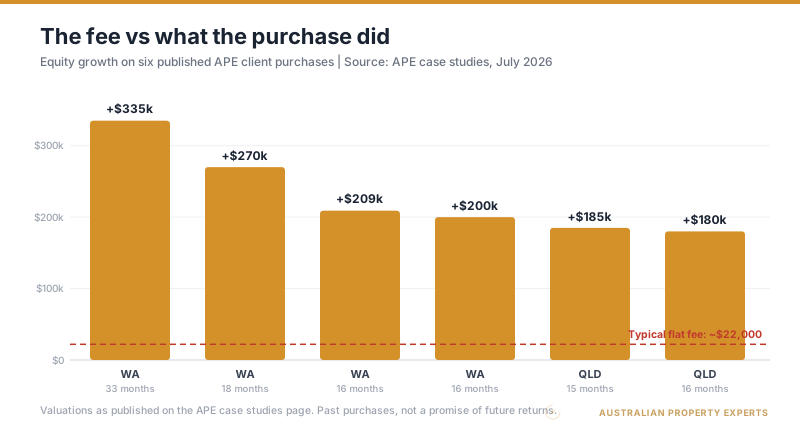
A Queensland property our team purchased for a client at $440,000. The deal included a $20,000 reduction off the original asking price. We negotiated it through the building and pest stage, on issues worth pressing on but nothing structural. Twelve months later the property valued at $580,000. That’s $140,000 of equity in a single year.
We have eighteen more like it on our case studies page, across five states. Not every deal moves that fast, but the negotiation discipline and the off-market access are the part that repeats.
What to look for when you’re choosing one
Start with the fee structure. You should be able to read the engagement letter once and know exactly what you’ll pay and when. Vague pricing tends to mean vague service.
Specialisation matters more than people expect. Investment buyers and owner-occupiers need very different selection logic. An agent who works across both is rarely operating at the same depth in either. The day-to-day brief should match what you’re trying to do.
Press hard on track record. Ask for actual purchase prices and current values on real deals, and treat curated testimonials as a bonus. While you’re at it, check independence. If they take commissions from developers or selling agents, the shortlist they put in front of you isn’t really yours.
Volume is the last one worth asking about. Ask how many properties they’ve personally transacted on, whatever the age of the website. And check licensing in your state through Fair Trading or the equivalent body, which takes about 30 seconds online.
If you’re weighing it up
For an experienced, full-service buyers agent in Australia, budget $15,000 to $30,000 + GST as a flat fee, with the industry average around $22,000. The flat fee model takes the conflict of interest out of the room and gives you a number you can plan against from day one. A 1% to 3% negotiated saving on a $600,000 purchase is $6,000 to $18,000. The off-market access, the time back, and the due diligence all sit on top of that.
This is general information only and not financial or tax advice. Speak to your accountant about how buyers agent fees apply to your specific situation.
See how we earn the fee finding properties for investors.
If you’d like to see what our fees look like against your specific brief, book a free discovery call.