Does a buyers agent pay for itself? It is the right question to ask before you hand anyone $22,000. Below is the maths, including the cases where the answer is no.
The fee, in context
Most full-service buyers agents in Australia charge a flat fee between $15,000 and $30,000 plus GST. The industry average sits around $22,000. See our buyers agent fees page for how a flat fee is structured. The full fee breakdown covers the models and what drives the number. For this post, use $22,000 as the working figure.
$22,000 is real money. It is also between 3% and 4% of a $600,000 purchase, paid once. Every other number in this post compounds for as long as you hold the property. So the ROI question is how a one-off fee compares with what the property earns over the years you hold it.
One decision vs one invoice
The fee buys one thing, a better purchase decision. So the way to price it is to ask what a better decision is worth.
Take two investors with $650,000 to spend. One buys a property in a market that compounds at 7% a year for the next 15 years. The other buys in a market that does 5%. Both spend the same budget on the same day, and only the choice of market differs.
- At 7%: $650,000 grows to roughly $1,793,000
- At 5%: $650,000 grows to roughly $1,351,000
That is a $442,000 gap from a two percentage point difference in selection, on one property, before rent is counted. The numbers are hypothetical and growth is never guaranteed. The shape of the maths still holds. Selection quality is worth six figures over a hold, and the fee is five. So the test is whether a professional delivers better selection. The next section shows what our purchases did.
What real purchases did
These six purchases are on our case studies page with prices and dates. Against each, the typical fee.
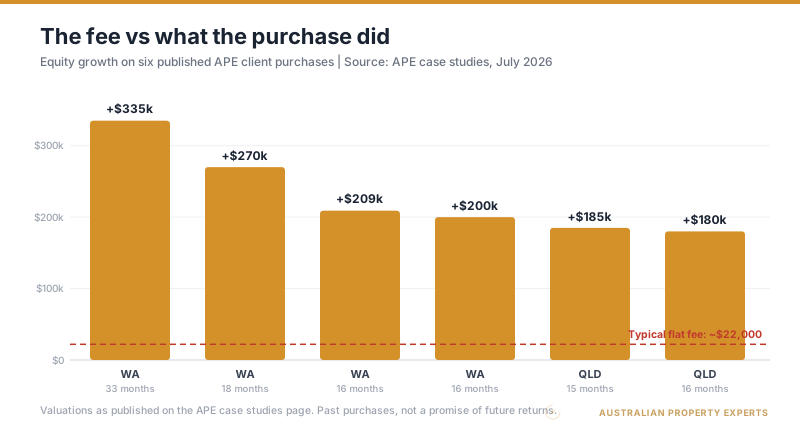
- $355,000 purchase in WA, valued at $690,000 or more 33 months later. Equity growth around $335,000
- $670,000 purchase in WA, valued at $940,000 within 18 months. Around $270,000
- $610,888 purchase in WA, valued at $820,000 or more within 16 months. Around $209,000
- $650,000 purchase in WA, valued at $850,000 or more within 16 months. Around $200,000
- $505,000 purchase in QLD, valued at $690,000 or more within 15 months. Around $185,000
- $420,000 purchase in QLD, valued at $600,000 or more within 16 months. Around $180,000
These purchases landed during a strong run in WA and QLD. That run has turned. Cotality’s index had Perth values down 3.2% and Brisbane down 2.7% in the three months to 31 August 2026. The same selection discipline in a flatter market produces flatter numbers. The job was picking those markets before the run, with data pointing there.
The cost of the wrong property
ROI has a second side that fee comparisons miss, which is the purchase you avoid.
The spread between a strong suburb and a weak one in the same city, at the same budget, is wide. We’ve written up the affordable vs blue-chip data showing how differently segments of the same market behave through a cycle. Buy the wrong asset and you carry higher vacancy, softer rent and a harder resale on top of slower growth. You usually hold the mistake for years. Getting out is expensive. The stamp duty you paid going in is already gone, and selling adds agent fees and possibly CGT. On a $600,000 investment purchase, duty alone runs from $20,025 in Queensland to $31,070 in Victoria.
There is also the slow bleed of not buying at all. One of the QLD purchases above cost $420,000. Sixteen months later it carried a valuation of $600,000 or more. An investor who spent those 16 months researching, second-guessing and waiting for certainty paid many multiples of the fee in a higher entry price.
When it doesn’t pay
The maths does not always land in favour. A buyers agent is probably not worth the fee if:
- You’re buying in your own suburb and you genuinely know it. If you have watched every sale on those streets for years and can act fast, you already hold most of the edge a local agent sells.
- Your budget is under about $300,000. A $22,000 fee is over 7% of the purchase. The percentage maths gets hard to justify at the bottom of the price range.
- You’d override the data anyway. If you have already decided on a suburb for emotional reasons, paying a professional to confirm it is expensive theatre.
- The low fee is low for a reason. Flat fees from $8,000 to $12,000 usually mean a newer agent building a book, or a narrower scope of service. Our guide to choosing a buyers agent covers the questions that separate data-led operators from order-takers.
If none of those describe you, the gap between a five-figure fee and a six-figure selection gap is the answer. That goes double if you are buying interstate with no local edge at all.
Run it on your own brief
You don’t need to take any of the numbers above on faith. The test works on your own situation in three steps.
Price the selection gap in your target market. Pull five years of growth for the three suburbs you’d pick yourself. Then do the same for the suburbs a data-led search would consider across every state. If you can’t name the second list, that gap is the product.
Price your time at your actual rate. Count the realistic hours for search, inspections, due diligence and negotiation. Multiply them by what your working time earns. For interstate purchases, add flights or the risk of buying sight-unseen without a process.
Then compare the quote. Ask any agent you’re considering for published, dated outcomes. Put their fee against the two numbers above. If they can’t show outcomes, you have nothing to compare their fee against.
When the fee pays for itself, and when it does not
A buyers agent fee is a one-off five-figure cost set against a decision that compounds for decades. When the service delivers better selection, the published outcomes above show what that looks like in practice. When it can’t, or when you already hold the edge yourself, keep the fee. Whether it is worth it depends far more on the quality of the purchase than on the fee.
This is general information only and not financial advice. Past results shown are real client purchases as published on our case studies page and are not a promise of future returns. Speak to a qualified professional before making investment decisions.
See how we select markets and properties for investors.
If you want to know what the fee would buy on your brief, book a free discovery call.