Choosing a buyers agent means handing a stranger several hundred thousand dollars of decisions. You pay them a fee on top.
Choose badly and you pay twice, once in the fee and again in the wrong property.
It is worth knowing the going rate first, so start with the buyers agent fees across the industry. These are the seven questions that separate an independent, investment-focused agent from a salesperson in disguise, plus the one check you should never skip.
Why the choice matters
A buyers agent’s fee is real money. A flat-fee investment agent typically charges $15,000 to $30,000 plus GST. But the value, or the damage, comes from the property they help you buy.
A well-chosen investment property that grows and rents well pays that fee back many times over. We’ve put real numbers on that trade-off. A poorly chosen one, bought in the wrong market or at the wrong price, costs you for as long as you hold it. So ask whether you can trust this person to put your strategy ahead of their own payday. The seven questions below are how you find out.
Do they work only for buyers?
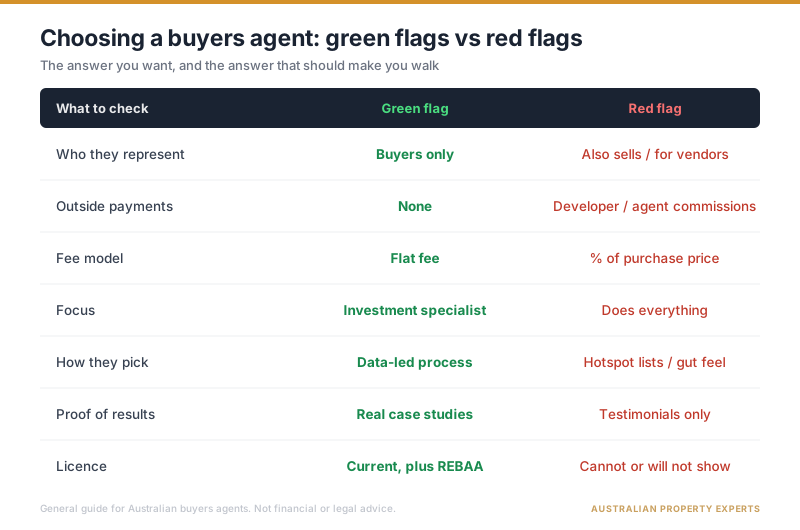
This is the first and most important question. The title “buyers agent” is not protected the way you might assume. Some agents who call themselves buyers agents also act for sellers or developers. They take a fee from both sides of the same deal. That is a genuine conflict. They cannot get you the lowest price while being paid by the person who wants the highest.
A true buyers agent represents you and only you. They do not sell property or list it. Nor do they take a cent from the other side. Ask it directly: do you ever act for vendors or developers? The answer you want is a flat no.
Do they take any kickbacks?
Related, but worth its own question. Some agents earn commissions from developers, project marketers or particular agencies for steering buyers toward their stock. Say your agent is paid a kickback to put you into a specific new apartment or house-and-land package. They’ve chosen that property because it pays them, whether or not it suits you.
Ask: do you receive any commission, referral fee, or rebate from developers, agents, or anyone other than me? An independent agent’s only income is the fee you agreed to. That is the entire point of hiring one.
Flat fee, or a percentage?
There are two ways buyers agents charge. The fee model shapes the agent’s incentive.
A percentage fee, usually 1.5% to 3% of the purchase price, means the agent earns more the more you spend. On a $500,000 purchase that is $7,500 to $15,000. On a $1,000,000 purchase it is double. That is an awkward incentive for someone negotiating the price on your behalf.
A flat fee is a fixed amount regardless of price. The agent is paid the same to find you a $500,000 property as a $900,000 one. They have no reason to push you past what your strategy needs. We charge a flat fee at Australian Property Experts.
Investment specialists, or generalists?
Buying an owner-occupied home and building an investment portfolio are different jobs. One is about lifestyle and emotion. The other is about growth, yield, cash flow and how a single property fits a broader plan.
An agent who does both is a generalist. An agent who only does investment lives in the data every day. If you are building a portfolio, ask how much of their work is investment versus owner-occupied. Also ask how many investment properties they have actually bought. Experience in the exact job you are hiring for counts for more than a polished website.
How do they pick where to buy?
Ask an agent how they choose a market and a property, then listen for whether the answer is data or vibe.
The answer you do not want is a hotspot list, or a suburb that was on the news. “This is where everyone’s buying right now” is just as bad. The answer you want is a repeatable process. Ask how they weigh growth drivers, yield, supply, vacancy and affordability. Ask how they screen a property once they are in the right market. A good agent can explain their method, not just their picks. If they lean on affordable markets over blue-chip guesswork, even better, because that is where the numbers usually stack up.
Do they buy across the country?
The best investment opportunity at any given moment is rarely in your own city. Markets around Australia move in different cycles. An agent who works one city can only ever offer you what that city has today.
Ask whether they buy nationwide. If they do, ask how they run inspections, due diligence and negotiation in markets that may be hundreds of kilometres away. For investors, buying interstate is often where the best numbers sit. An agent’s reach directly shapes the quality of what they can find you.
Can they show real results?
Anyone can say they get good results. Ask to see them. You want real case studies with real numbers, showing what they paid, what it was worth, what it rents for and how it has performed since. Testimonials about how lovely they were to deal with tell you nothing about results.
Be wary of an agent who cannot or will not show you specifics. A track record you can check is one of the few things in this industry that cannot be faked. Our client case studies are the kind of detail you should expect to see.
The licence check you can’t skip
This one is non-negotiable and takes two minutes. A buyers agent must hold a licence in each state where they buy. A Victorian licence alone does not cover a Queensland purchase.
Running a buyers agency takes a full real estate licence, not just a registration. The name varies, buyers advocate in Victoria and buyers agent elsewhere, but the licence requirement does not.
Check their licence on the relevant state register before you sign anything. Membership of an industry body such as REBAA, the Real Estate Buyers Agents Association of Australia, is a further signal. To join, an agency must be licensed in every state it buys in and carry at least $2 million in professional indemnity insurance. It must have operated as a buyers agency for at least 12 months, and it cannot list properties for sale or act as a selling agent.
Making your shortlist
You are choosing whose incentives sit on your side of the table.
The agent you want works only for buyers, takes no kickbacks, charges a flat fee and specialises in investment. They follow a data-led process, buy where the numbers are best rather than where they happen to be based, and can prove it with real results. Ask the seven questions, check the licence, and the choice usually makes itself.
For nine established agencies sorted by who each one suits, see our list of the best buyers agents in Australia.
If you are still deciding whether to use a buyers agent at all, start with is a buyers agent worth it and what one actually costs.
Sources
- REBAA: licensing requirements for buyers agents in each state
- REBAA: membership requirements
- NSW Government: property agent licence check
- Buyers agent fees in Australia: flat fee vs percentage
This is general information only and not financial advice. Speak to a qualified professional before making investment decisions.
See how we find and buy properties for investor clients.
If you want a flat-fee, investment-only buyers agent working across Australia, book a free discovery call.