Using your home equity to buy an investment property puts the equity you have already built to work. It saves you raising a second deposit from scratch. If you own a home that has risen in value, you may be closer to your first investment property than you think. This covers how home equity works, how it reaches the deposit and the two structuring mistakes that cost investors later.
What usable equity actually means
There are two equity numbers, and lenders only use one of them.
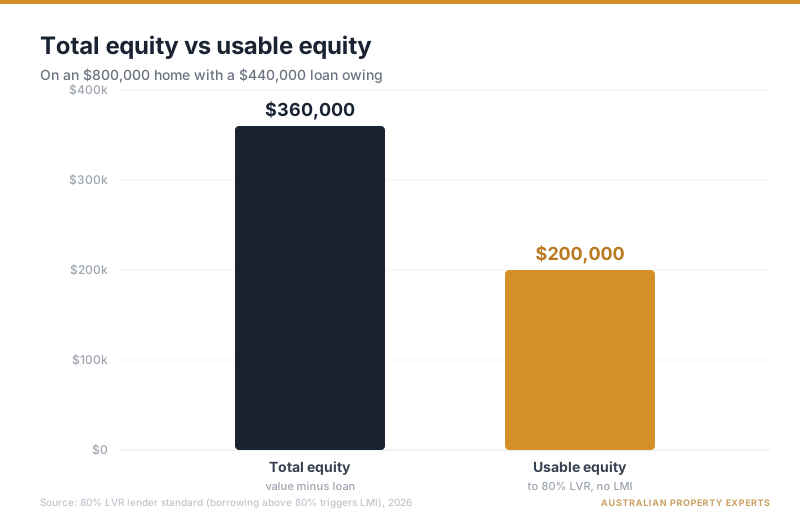
Your total equity is your home’s value minus what you owe. If your home is worth $800,000 and you owe $440,000, your total equity is $360,000.
Your usable equity is smaller. Lenders will generally let you borrow up to 80% of your home’s value before they charge Lenders Mortgage Insurance (LMI). So the sum is 80% of the value, minus your loan:
- 80% of $800,000 = $640,000
- Minus the $440,000 you owe = $200,000 usable
That $200,000 is what you have to work with. The other $160,000 ($360,000 minus $200,000) sits above the 80% line, where LMI kicks in and lenders turn cautious. Values do fall. Sydney dwelling values were 7.1% below their February 2026 peak at the end of August (Cotality).
How the equity reaches the deposit
Equity only becomes spendable once you convert it into a loan. There are a few ways to do that:
- Top-up: your existing lender lifts your home loan limit up to the 80% mark and releases the funds.
- Separate equity loan (a split): a standalone loan account secured against your home, kept apart from your existing mortgage. This is usually the better structure, for reasons below.
- Refinance: move to a new lender and release the equity as part of the switch. The equity recycling modeller maps when the next purchase becomes possible.
However you do it, the released funds become your deposit and buying costs on the investment property. A $200,000 release covers a 20% deposit plus stamp duty and legals on an affordable investment property. Take a $600,000 purchase:
- 20% deposit: $120,000 ($600,000 x 20%)
- Stamp duty: from $15,720 in the ACT ($11,400 + 4.32% of the $100,000 above $500,000) to $31,070 in Victoria ($2,870 + 6% of the $470,000 above $130,000)
- Conveyancing, building and pest, loan fees: $3,500
That totals $139,220 to $154,570 depending on the state, which leaves $45,430 to $60,780 of the $200,000 as a buffer. Our property purchase cost calculator breaks those upfront costs down state by state.
The lender’s valuation sets the number, whatever your own estimate says. Banks tend to value conservatively. A valuation that comes in low shrinks your usable equity on the spot. Ask your broker for an upfront or desktop valuation before you build a plan around a figure.
Keep your interest deductible
The first trap is mixing what one loan pays for.
The ATO decides whether your loan interest is tax deductible by what you use the borrowed money for (ATO). Borrow against your home to buy a property that is rented or held to produce income, and the interest on that borrowing is generally deductible. The security being your own home does not change that.
A redraw gets the same test. The ATO treats money redrawn from a loan as a new borrowing, so its use sets the deduction (ATO TR 2000/2). Redraw from your home loan to pay the investment deposit and that interest is generally deductible. Redraw from the investment loan for a new TV and that part is private.
Mix the purposes, though, and you create a mess. Say you draw equity into your existing home loan account. You spend some on the investment deposit and some on a car or a holiday. Now one loan is doing two jobs. The interest has to be split between the deductible and private portions for the life of the loan. The ATO says you can’t choose to repay only the private portion. Every repayment is apportioned across both.
Keep the investment borrowing in its own separate loan account. That keeps the deductions clean. For the full list of what you can claim once the property is running, see our investment property tax deductions guide. And talk to your accountant before you draw a dollar.
Avoid cross-collateralisation
When you buy the investment property, the bank will often suggest securing the new loan against both properties, your home and the investment. This is cross-collateralisation. For an investor building a portfolio it is usually the wrong move.
Tie both properties to both loans and you hand one lender control of everything. Sell the investment later and the bank can direct where the proceeds go, or force a revaluation of your home. Refinance one and both get revalued. One low valuation can block the whole move. We’ve written up the full set of traps, with the clean structure diagrammed.
The alternative keeps them separate. Release the equity from your home as its own standalone loan under 80% LVR, then take a separate loan for the investment, often with a different lender. Structured this way each loan sits at or under 80%, so you can also sidestep LMI.
Can you actually service it?
Having the equity is only half the test. The bank still has to be satisfied you can repay the new debt. The rules also tightened in 2026.
Two rules set the ceiling.
- The 3% buffer. Lenders assess you at your actual loan rate plus APRA’s 3 percentage point serviceability buffer. The average variable rate on new investment loans was 6.4% in July 2026 (RBA table F6). Add the buffer (6.4% + 3%) and you are being tested at about 9.4%. Your real borrowing power is smaller than today’s rate makes it look.
- The DTI limit. From February 2026, APRA limits each bank’s new lending at a debt-to-income (DTI) ratio of six times or more to 20% of new loans (APRA). The limit applies to owner-occupier and investor lending separately. Releasing equity pushes your total debt up, so high-equity investors are exactly who this constrains. Loans for the purchase or construction of new dwellings are exempt.
None of this stops you, but it changes the order you do things in. Get your borrowing capacity checked by a good mortgage broker before you start looking at properties. Interest-only lending on the investment debt lowers your repayments while you hold. It does not lift borrowing capacity. APRA expects banks to assess interest-only loans on principal and interest over the term left after the interest-only period (APRA APG 223).
What to buy with the equity
What you buy with the equity matters more than how you release it. The temptation is to buy something comfortable and close to home. We buy in affordable markets across the country where the growth and yield numbers stack up. The best opportunity at any moment is seldom in your own suburb. Over the five years to August 2026, Brisbane dwelling values rose 64.1% and Adelaide 64.0%. Sydney rose 5.6% and Melbourne fell 3.9% (Cotality).
Used well, one property’s equity funds the next, and the one after that. That is how a single home becomes a portfolio. To see what those purchases look like, browse our case studies. For the full sequence, see how to build a property portfolio from scratch. If you are still weighing up the basics, start with our property investment for beginners guide.
Sources
- How usable equity and the 80% LVR rule work, Hunter Galloway
- Home equity calculator, Westpac
- Interest expenses on rental property loans, ATO (updated 21 May 2026)
- Interest deductibility depends on the use of the borrowed funds, ATO TR 95/25
- Interest on redraws and lines of credit, ATO TR 2000/2
- Housing lending rates, RBA statistical table F6 (July 2026)
- APRA keeps the 3 percentage point serviceability buffer and DTI limit, 28 May 2026
- APRA debt-to-income limit from February 2026, APRA
- APRA APG 223 Residential Mortgage Lending (interest-only assessment), APRA
- Cotality Home Value Index, August 2026
- Why investors avoid cross-collateralisation (and the 80/20 alternative), Home Loan Experts
This is general information only and not financial, tax, or credit advice. Loan structuring and deductibility depend on your circumstances. Speak to a licensed mortgage broker and a qualified accountant before acting.
See how we find the properties that equity buys. If you don’t own property yet, start with how the 5% deposit scheme fits an investor’s plan.
If you have equity in your home and want to know what it could buy across Australia’s best-performing markets, book a free discovery call.