By the time most investors ask how to reduce the capital gains tax on a sale, most of the answer is already fixed. Who sits on the title was decided at purchase. Whether the six year rule is available was decided when you moved out. Whether your cost base is complete was decided by whether you kept receipts nobody told you would matter.
Three levers are still open on the day you list. The other three were settled years earlier. If you missed them, there is nothing to be done about it now. On the $958,000 sale below, the receipts alone are worth $24,160.
What moves the number, and when
Six things move the number for most investors. Three are locked in long before you decide to sell. They are who holds the title, whether the property was ever your home, and what you can prove you spent on it. The other three are still live in the year you sell: whether you clear 12 months, which financial year you exchange in, and how you apply capital losses. Everything else makes a much smaller difference.
One warning before any of it. From 1 July 2027 the 50% discount is replaced for individuals, trusts and partnerships. Much of the standard CGT guidance from the last 20 years will no longer apply. The last section covers what survives.
If you first want to know how much capital gains tax you pay on an investment property, our guide works the bill through on an $890,000 sale.
Who holds the title, decided at purchase
The discount is not the same for every owner. Individuals and Australian trusts discount a gain by 50%. Complying super funds discount by 33.33%. Companies get no discount at all. That can make a company an expensive place to hold an appreciating property.
You cannot fix this later. Changing the owner after the fact is itself a CGT event. The structure you sign up for on your first purchase is the one you sell under a decade later. Our guide to trust structures for property investors covers where the trade-offs sit.
Avoiding capital gains tax with the six year rule
If the property was your home first, this is usually the largest reduction available. It is also the one investors most often do not know they qualify for.
You can keep treating a former home as your main residence for up to six years while it earns rent, and indefinitely if it earns nothing (ATO). Two conditions bind it. It has to have been your actual main residence first, so a property you rented out before you moved in does not qualify for that earlier period. And you cannot treat another property as your main residence for the same period, except for a six month overlap while you are moving. You also choose when the period stops, which matters if you own two properties and have to pick between them.
The six years also applies to each period of absence rather than to the property. Move back in and a later absence starts a fresh six years. The ATO says a period of absence stops when you stop renting it and either move back in or leave it vacant.
For anyone rentvesting, that rule is the difference between a fully exempt sale and a fully taxed one. It is also decided the day you move out, not the day you sell.
Your cost base, built over the hold
The cost base has five elements. Most people use one of them. Take a house bought at $612,000 and sold at $958,000.
| Cost base item | Amount |
|---|---|
| Purchase price | $612,000 |
| Stamp duty | $22,800 |
| Conveyancing on the purchase | $1,900 |
| Building and pest inspection | $650 |
| Buyers agent fee | $15,000 |
| Kitchen and bathroom, capital improvement | $37,200 |
| Selling agent commission | $19,160 |
| Marketing the sale | $4,500 |
| Conveyancing on the sale | $1,600 |
| Less capital works already deducted | -$46,000 |
| Cost base | $668,810 |
The ATO lists ten incidental costs in the second element. They cover more than people expect. They include stamp duty and the fees of a surveyor, valuer, auctioneer, accountant, broker, agent, consultant or legal adviser. Tax advice counts where a recognised tax adviser gave it. So does advertising to find a buyer, and the cost of a valuation.
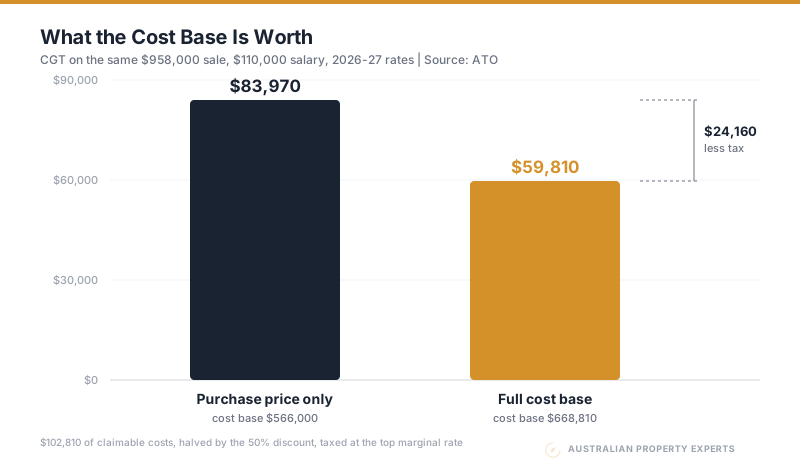
If you count only the purchase price, less the compulsory capital works adjustment, the assessable gain is $196,000. On a $110,000 salary that is a tax bill of $83,970. Build the cost base in full and the assessable gain is $144,595 and the bill is $59,810. The $102,810 of claimable costs is halved by the discount and lands at the top marginal rate. That is where the $24,160 comes from.
Every one of those line items is a receipt from a decision you made years ago. You cannot rebuild these records in the week before you sell.
There is a third element people miss on vacant land. Rates, land tax, insurance, repairs and non-deductible interest can go into the cost base, but only where you could not deduct them. On a rented property you already claimed them, so they cannot go in twice.
The capital works deduction comes back
That minus $46,000 in the table is not a mistake. Capital works deductions you have claimed under Division 43 cannot sit in the cost base. Every dollar of building write-off you took over the years increases the gain when you sell.
That is not an argument for skipping the claim. You took the deduction at your full marginal rate each year. It comes back against a gain that the discount has already halved. On a $110,000 salary, claiming $46,000 at 32% including Medicare returns $14,720 along the way. It costs about $10,810 at sale. You are still ahead, and you had the money earlier. From 1 July 2027 that changes for new claims. They come back against the part of the gain that gets no discount, so the add-back can cost more than the deduction saved. But if your depreciation schedule has been running for a decade, the add-back is larger than most sellers expect. It belongs in the numbers before you list.
The 12 month test and the contract date
Everything to this point was settled long before you thought about selling. The next three are still yours to control. The 12 month test comes first.
The 50% discount applies if you owned the asset for at least 12 months and you are an Australian resident for tax purposes (ATO). It applies to more sales than anything else on this page. It is also binary. Eleven months and 29 days gets you nothing.
The trap is which date counts. Your CGT event happens on the date of the contract, not when you settle. The ATO is explicit that property sales usually work this way. You also exclude the day you acquired the asset and the day of the CGT event when counting the 12 months.
So a purchase contract signed in March 2025 and a sale contract signed in February 2026 miss the discount, even if settlement lands in April. On the gain in the example above, waiting those few extra weeks is worth $67,960. Check your original contract date before you sign anything.
There is one extension most write-ups leave out. The ATO allows an additional discount of up to 10%, taking the total to up to 60%. It is for individuals who provide affordable rental housing to tenants on low to moderate incomes. The conditions are narrow and it will not suit most investors. It is worth checking if affordable housing is already part of what you do.
Which financial year you exchange in
The gain is assessed in the year you sign the contract, not the year you settle and not the year the money arrives. It then stacks on top of whatever else you earned that year. That is why the same gain costs different people very different amounts.
Take the $144,595 assessable gain from the example above. On a $110,000 salary it costs $59,810. On a $45,000 salary it costs $50,092. Same property, same gain, $9,718 apart, decided by which year you exchange in.
That matters if your income is about to change. Retirement, parental leave, a year between jobs or a loss-making year in a business all pull the same gain into a lower band. Exchanging in July rather than June moves it a full financial year.
The caveat is the one that applies to every idea on this page. A sale timed for tax on a property that should have been sold last year is still a bad sale.
Capital losses, in the right order
Capital losses come off the gain before the discount, never after. Where you have both kinds of gain in the same year, spending a loss on the wrong one costs you half its value.
The ATO lets you choose which gains to apply losses against. It says to subtract them from gains that are not eligible for the discount first. That gives the lowest tax. A $50,000 loss applied to a discounted property gain removes $50,000 from the gross gain, so $25,000 from the assessable amount. The same loss applied to an undiscounted gain removes the whole $50,000. So the same loss is worth twice as much against the undiscounted gain.
You do not get to bank a loss for a better year. Current year losses have to go against current year gains. The choice you have is which gain, not whether. Only the part that exceeds your gains becomes a net capital loss. It carries forward with no time limit, applied in the order you made them. Capital losses cannot come off your salary either, only off capital gains. From the 2027-28 year the Act sets the order for you, starting with any gain from before 1 July 2027.
What changes on 1 July 2027
From that date the 50% discount is replaced for individuals, trusts and partnerships. Your cost base gets indexed by CPI so only the real gain is taxed. A 30% minimum rate applies to real gains for resident individuals. Complying super funds are untouched and keep the 33.33% discount. We have modelled who pays more and who pays less. The shape of it catches people out. The new regime is gentle on weak growth and punishing on strong growth.
Three things follow for anyone holding property now.
Gains accrued before 1 July 2027 keep the 50% discount. The law splits them out at that date. You do not have to sell early to protect the gain you have already made. We covered whether to sell before the deadline separately. For most people the answer is no.
That split uses market value just before 1 July 2027 by default. You can choose a formula instead when you sell, but a valuation is the one genuinely time-sensitive item on this page. Get it and keep it.
The detail is not settled yet. The ATO’s own CGT pages say the Budget changes do not apply to Tax Time 2026 and that resources will be available later. The apportionment formula and the new-build definition are both still drafts. Until they are final, treat any figures you see as estimates.
What we tell clients
Across all six, the pattern is the same. The levers worth the most are the ones you set years before the sale. The ones still available at the end are the smallest. A $24,160 cost base is built from receipts you filed a decade earlier. A fully exempt sale under the six year rule was decided the week you moved out.
So most of the work happens at purchase. Keep the contract, the settlement statement, every invoice and the depreciation schedule from the day you buy. Get the ownership structure right on the way in, while it is still free to change.
If you already have a sale contract in front of you, focus on the last three. If you are about to buy, all six are still open to you.
Run your own numbers through our capital gains tax calculator, which models the current discount and the 2027 regime side by side. Do it before you talk to your accountant rather than after.
This is general information only and not financial advice. Tax treatment depends on your circumstances. Speak to a qualified professional before making investment decisions.
If you want the tax position modelled on a specific property before you buy or sell, book a free discovery call.
Sources:
- ATO: CGT discount
- Treasury Laws Amendment (Tax Reform No. 1) Act 2026, No. 49 of 2026
- Treasurer: consultation on the draft Tax Reform No. 3 Bill, 4 August 2026
- ATO: Treating a former home as your main residence
- ATO: Cost base of an asset
- ATO: Cost base adjustments for capital works
- ATO: Using capital losses to reduce capital gains
- ATO: Tax rates for Australian residents