Rentvesting is the strategy where you rent where you want to live and buy an investment property where the numbers actually work. It’s not new. It suits first-time buyers who are priced out of the city they live in. For the evergreen version of this guide see our rentvesting pillar page.
What rentvesting actually means
You rent the home you live in. You own an investment property somewhere else. The investment property is tenanted, generating rental income and (ideally) growing in value. Meanwhile you live where you want, without being locked into a mortgage you can barely service.
You still get into home ownership, just through a different door. Instead of stretching to buy a $1.5 million house in Sydney that eats your entire income, you rent a Sydney unit for around $755 a week. Then you buy an investment property in Adelaide, Perth or regional NSW for $530,000 to $700,000, with a tenant paying most of the mortgage.
The Sydney house median was $1,494,878 at 31 August 2026 (Cotality Home Value Index). The asking rent across all Sydney units was $755 a week in the week to 20 September 2026 (SQM Research).
The investment property builds equity. The equity funds your next purchase. Eventually, you either buy a home when you can afford it comfortably, or you build a portfolio that generates enough income to cover your rent indefinitely.
The math that makes it work
Scenario A: Buy a home in Sydney
- Purchase price: $1,100,000 (affordable end of Sydney)
- Deposit (20%): $220,000
- Stamp duty + costs: ~$50,000
- Mortgage (P&I, 6.2% on the $880,000 loan): ~$5,390/month
- Total monthly housing cost: ~$5,390
- Equity growth (assumed 5% a year): ~$55,000/year
- Tax deductions: None (owner-occupied)
Scenario B: Rent in Sydney + invest interstate
- Rent: $755/week ($3,272/month)
- Investment property purchase: $700,000 (Adelaide/Perth)
- Deposit (20%): $140,000
- Stamp duty + costs: ~$35,000
- Mortgage (IO, 6.3% on the $560,000 loan): ~$2,940/month
- Rental income: ~$2,600/month ($600/week)
- Net monthly cost: rent $3,272 + mortgage gap $340 = ~$3,612
- Equity growth (assumed 8% a year on the investment): ~$56,000/year
- Tax deductions: Interest, depreciation, management fees, insurance
The 6.2% and 6.3% rates are the RBA’s July 2026 averages on new variable owner-occupier and investor loans at the large lenders (table F6).
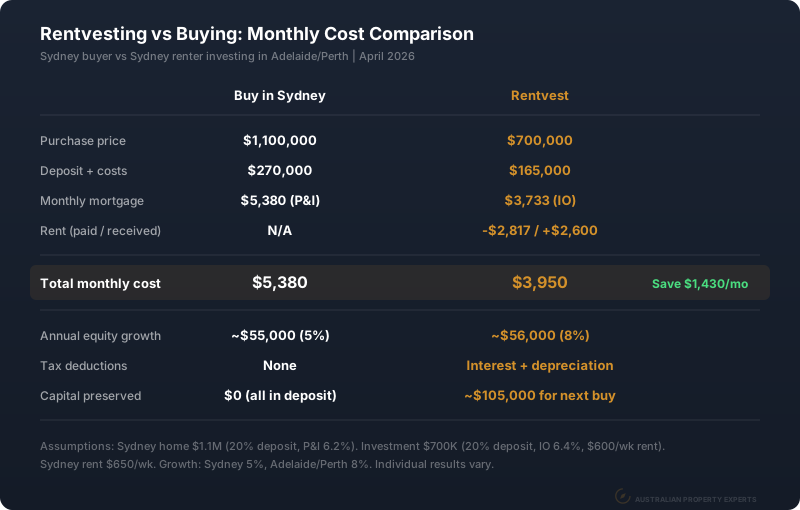
Scenario B costs ~$1,780 less per month, builds roughly the same equity, and generates tax deductions. Run your own numbers with our rent vs buy calculator. You also keep about $95,000 in your pocket (the difference in deposit and stamp duty) that can go toward your next investment. Stamp duty is the line that moves most between states. Run both sides through the stamp duty calculator before you commit to a city.
Calculate rental yield and net income on any investment property to see if rentvesting stacks up.
Use the calculator →
The trade-off is that you don’t own the home you live in. Some people can’t accept that, and for others it is a fair price for building a portfolio sooner.
How to pick where to invest
Rentvesting works best when there’s a meaningful gap between where you live (expensive, low yield) and where you invest (affordable, higher yield, strong growth).
The markets that suit rentvestors right now:
Adelaide had a vacancy rate of 0.64% in August 2026 (SQM Research). Northern suburbs such as Elizabeth North, Munno Para and Salisbury North yield about 4.3% to 4.6%. Entry starts from around $550,000 in Elizabeth North. The Osborne submarine construction yard adds a defence pipeline, with government investment in the yard now at $8.5 billion. See our Adelaide suburb guide for specific picks.
Perth dwelling values rose 15.6% in the year to August 2026, though they eased 3.2% over the latest quarter (Cotality). Midland ($695,000) yields about 4.9% and Armadale ($700,000) about 4.7%. METRONET’s final rail project opened at Midland in February 2026. Vacancy was 0.61% in August. The $999,987 median still sits below Sydney and Brisbane. See our Perth suburb guide.
Regional NSW markets like Wagga Wagga offer house yields to 4.82% in Mount Austin, with defence and healthcare employment anchors. Entry points in the key suburbs run from about $530,000 to $714,000.
Suburb medians are CoreLogic data to 30 June 2026 and rents to 31 August 2026. Yield is worked out as rent x 52 / median.
The common thread is that affordable markets with genuine economic drivers have outperformed blue chip on both growth and yield, and a rentvestor needs both. Growth builds equity for your next purchase. Yield keeps the holding costs manageable while you’re paying rent elsewhere.
For a deeper look at how to invest in a city you don’t live in, see our guide to buying investment property interstate. And if you’re buying sight unseen, here’s whether a buyers agent is worth it.
The tax angle
Rentvesting has a significant tax advantage over buying a home to live in. Your rent is not deductible (it’s a personal expense), but almost every cost on your investment property is.
Deductible expenses include:
- Loan interest (the biggest one)
- Property management fees
- Insurance, rates, and water
- Repairs and maintenance
- Depreciation on the building and fixtures
Your investment property may cost more to hold than it earns in rent, which is common in the early years on an IO loan. If so, the difference reduces your taxable income. That’s negative gearing. It’s one of the main tax levers for investors. We covered the details in our negative gearing breakdown.
One caveat changes the maths for anyone buying now. The Treasury Laws Amendment (Tax Reform No. 1) Act 2026 (Act No. 49 of 2026) received assent on 26 June 2026. For an established dwelling bought after 7.30pm on 12 May 2026, rental losses from the 2027-28 income year can no longer be offset against salary. They carry forward against future rental income or a capital gain. For sales from 1 July 2027, the 50% CGT discount on established property is replaced by indexation. From then, a 30% minimum tax also applies to capital gains. New builds keep negative gearing and the 50% discount. Our 2027 changes playbook covers what that does to a rentvesting purchase.
As a rentvestor, your investment property doesn’t qualify for the main residence CGT exemption. When you sell, you’ll pay capital gains tax on the profit. Sell before 1 July 2027 and the 50% discount applies once you’ve held it for 12 months. Sell an established dwelling after that date and indexation replaces the discount. This is a trade-off worth understanding before you commit. Speak to your accountant about how this applies to your situation.
Common mistakes rentvestors make
Buying where they’d want to live, not where the data points. Your investment property can be in a suburb you’d never live in, as long as the market has strong fundamentals: population growth, employment diversity, tight vacancy, and affordable entry.
Underestimating holding costs. You’re paying rent AND servicing a mortgage. Even with rental income covering most of the loan, there will be months with vacancies, repairs, and rate rises. Budget for a $3,000-$5,000 annual buffer.
Buying new builds because they seem “easier.” New builds carry a developer margin, offer less reno potential, and often come with inflated valuations. Established houses on decent blocks give you more options and better value, even though new builds keep the better tax treatment after 2027. This is true for all investors, not just rentvestors.
Not getting the lending structure right. Your investment loan should be interest-only to maximise cash flow. Your deposit should be structured to preserve as much capital as possible for the next purchase. A good mortgage broker who understands investment lending is essential.
When rentvesting doesn’t work
Rentvesting isn’t for everyone. It doesn’t make sense if:
- You need the emotional security of owning your home and would stress about being a renter
- Your rent is higher than what a mortgage on a comparable property would cost (rare in 2026, but possible in regional areas)
- You’re eligible for the First Home Owner Grant and would lose it by buying an investment property first (check your state’s rules)
- Your borrowing capacity is too low to service both rent and a mortgage
It works best for people who live in an expensive city (Sydney, Melbourne, inner Brisbane) and earn a good income. They also need to be willing to rent for 3-5+ years while building equity in investment properties elsewhere.
The rentvestor’s real advantage
The biggest benefit of rentvesting is how much sooner you can buy your second and third properties.
Picture a rentvestor who buys a $700,000 property in Adelaide at 25. They build $100,000+ in equity through growth and a cosmetic reno, then buy property two at 28. They are in a fundamentally different financial position to someone who spent those three years saving for a Sydney deposit and still isn’t close.
Rentvesting is often the fastest way to get into the market when you’re priced out of buying a home in your city, and the sooner you start, the longer your property has to grow.
The reverse sequence works too. If living in your first purchase for a while suits you, the 5% deposit scheme can be step one of an investment plan. Buy as an owner-occupier on a 5% deposit, build equity to 20%, then convert it to a rental.
This is general information only and not financial advice. Tax rules are complex and individual circumstances vary. Speak to a qualified accountant and financial adviser before making decisions about rentvesting.
See how we find properties for rentvestors.
If you’re considering rentvesting and want to know which markets fit your budget and strategy, book a free discovery call.