
A cosmetic renovation on an investment property is one of the quickest levers an investor can pull. Our working assumption is that $30,000-$50,000 of paint, flooring, kitchen and bathroom work can add $60,000-$100,000 in valuation on the right property. That uplift becomes the deposit for the next purchase. It only works if you keep the scope tight.
Why cosmetic, not structural
The point of a cosmetic renovation investment property strategy is to force equity fast and redeploy the capital, rather than to build a dream home or to flip.
Cosmetic work has three things going for it. It’s quick, usually 3-6 weeks from keys to revaluation. It’s predictable, because you’re swapping visual finishes, not opening up walls. And every dollar goes on the things a valuer and a tenant actually see.
Structural work is the opposite. Removing walls, re-stumping, rewiring, re-roofing, extensions. Long timelines, surprise costs, weak valuation uplift on average-priced investment stock. Structural makes sense on owner-occupied homes where you live with the result. On an investment, every extra month of work is a month of holding costs and a month of deferred equity.
The tax side is less generous than many investors expect. Repainting walls that wore while the property was rented is maintenance, deductible in the year you pay for it. Fixing wear that was already there when you bought is an “initial repair”, which the ATO treats as capital. Improvements and structural work go into capital works, generally at 2.5% a year for 40 years. More on that below.
What actually works
Five categories deliver almost all the uplift on a standard 3-bed investment property. Stick to these and you rarely overcapitalise.
Paint, interior first, exterior if it needs it. On our estimates, an interior repaint on a 3-bed single-storey runs $4,500-$8,000, a bit more in Sydney. Exterior depends on cladding and access. On our assumptions, paint returns the most per dollar on this list, partly because it fixes everything at once: yellowed ceilings, scuffed hallways, dated accent walls, tired door frames. Stay neutral. Warm whites, soft greys, one darker feature for contrast.
Flooring. Our estimate is $5,000-$10,000 for vinyl planks or timber-look laminate across living and bedrooms on a 3-bed. Carpet in bedrooms only if the comps do. Worn carpet in living areas is one of the first things a tenant and a valuer mark you down for. Vinyl planks survive tenants better than real timber, photograph well, and cost a fraction.
Kitchen refresh, not replacement. A full kitchen replacement costs far more than a refresh. On an investment property, you don’t need a premium kitchen. You need a refreshed one. Keep the layout, keep the plumbing, keep the cabinet carcasses if they’re sound. Replace the doors, benchtop, splashback, sink, tapware and appliances. Our estimate is $10,000-$25,000 for a strong cosmetic kitchen refresh that valuers read as “new.”
Bathroom refresh. Same principle. In a cosmetic refresh, the layout, tiles and waterproofing stay put. You swap the vanity, tapware, mirror, toilet, paint and accessories. On our estimates that runs $3,000-$8,000 if the bones are good, and $15,000-$25,000 if tiles have to go. Never relocate plumbing on an investment refresh unless you have no choice.
Kerb appeal. We budget $1,000-$5,000 on landscaping, a fresh front door, letterbox, house numbers, and a jet-washed driveway. This is the lowest-cost category. It sets the first photo on the listing and the valuer’s first impression.
The numbers: typical spend vs equity uplift
The figures in this section are our planning assumptions, not measured results. The ratio you’re aiming for is roughly $1 spent to $2-$3 added, on a property you bought well. If a reno isn’t returning at least 1:1.5, the property wasn’t the right candidate in the first place.
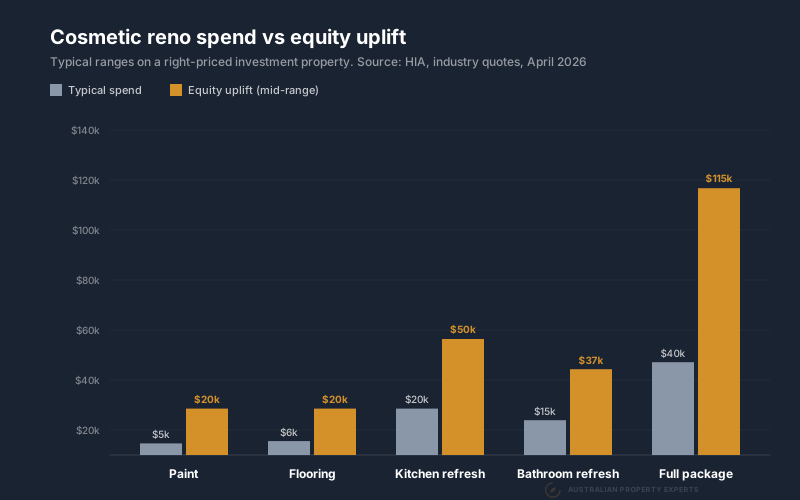
Paint pulls well above its weight because it costs so little. A $5,000 full interior repaint on a tired 1980s brick veneer can add $15,000-$25,000 in valuation once the property photographs clean. Flooring sits in the same band for similar reasons.
Kitchens and bathrooms take more capital but the absolute dollar uplift is bigger. On our assumptions, a $20,000 kitchen refresh adds $40,000-$60,000 in valuation on an older property. A $15,000 bathroom refresh, $30,000-$45,000. Full package, $40,000 spent across all four categories, $100,000-$130,000 added on the right stock.
Two conditions have to hold. The property has to have been bought below or around market on purchase. And the comps in the suburb have to support the new valuation. A $40,000 reno won’t push a $450,000 house to $600,000 if every comparable sale is $500,000. The valuer is looking at what other renovated houses in the street actually sold for.
Tax implications: Division 40 vs Division 43
The ATO splits renovation spend into two buckets and they’re treated very differently. This matters because the rules changed in 2017 and a lot of investor content online hasn’t caught up.
Division 43, capital works. This covers the building itself and the fixtures attached to it. Walls, floors, roof, tiling, plumbing, kitchen cupboards and benchtops, vanities, tapware and toilets. For a rental home, Division 43 is generally deducted at 2.5% per year over 40 years. So a $30,000 kitchen and bathroom capital works component gives you roughly $750 a year in deductions for 40 years. Slow, but real.
Division 40, plant and equipment. This covers the removable stuff. Appliances, carpets, blinds, hot water systems, air conditioners, ceiling fans, smoke alarms. These depreciate much faster based on the effective life of each asset.
The 2017 change applies if you bought a second-hand residential property after 7:30pm (AEST) on 9 May 2017. Unless you carry on a business of letting rental properties, you generally cannot claim Division 40 depreciation on the plant and equipment that came with it. Second-hand buyers often miss this. New plant and equipment you install yourself, including as part of a renovation, is still claimable.
Practical implication for a cosmetic reno: any new dishwasher, oven, rangehood, carpets, blinds, hot water system or air con you install goes into Division 40. The ATO’s effective lives are 8 years for carpets and dishwashers, and 10 for blinds and split systems. Ovens, rangehoods and hot water systems get 12. The cupboards, benchtops, tiling, bathroom fixtures and structural work go into Division 43 at 2.5% for 40 years.
Repairs and maintenance for wear that happened while the property was rented, such as repainting faded walls, are deductible in the year incurred. Fixing damage or wear that existed when you bought is an “initial repair”. The ATO treats it as capital even if you didn’t know about the problem, generally claimed as capital works over 40 years. A renovation that makes the property better or changes its character is an improvement, and also capital. Ask trades for itemised invoices so any genuine repairs can be separated from the improvements. Then get a quantity surveyor’s depreciation schedule after the reno so every item lands in the right bucket.
For the full picture on how depreciation stacks up across a portfolio, see our guide on depreciation schedules for investment property.
Tax law is specific to your circumstances. Speak to your accountant before committing a reno scope on tax grounds.
What we don’t recommend
Some categories look good on Instagram and cost investors money.
Extensions and additions. Adding a bedroom, bumping out a kitchen, building a deck big enough to double as a second living area. Council approvals, structural engineer, builder’s margin, 3-6 month timelines. On a $550,000 investment property in an affordable market, you rarely see the maths work. You overcapitalise for the suburb.
Premium finishes in average suburbs. Stone benchtops with waterfall ends, European appliances, full-height tiling, designer tapware. If the comps in the suburb are selling with laminate benchtops and budget tapware, the valuer isn’t adding for your upgrade. You’ve spent $15,000 extra that the market doesn’t recognise.
Flips. Buy, renovate hard, sell inside 12 months. Capital gains tax hits the full profit at your marginal rate and selling costs take their cut. The stamp duty on the next purchase eats another chunk. The numbers almost never beat buy-hold-reno-refinance.
Full kitchen and bathroom rip-outs when the bones are fine. A $50,000 kitchen in place of a $20,000 refresh. A $25,000 tiled bathroom when a $6,000 vanity swap would have done it. The uplift is often the same because the valuer is looking at condition, not specification.
Anything structural you didn’t plan for. Finding stumps need replacing, wiring needs updating, or the roof is shot halfway through the job turns a profitable reno into a break-even one. Pre-purchase building and pest is where you catch this. Our building and pest inspection guide covers what to look for.
Older established houses on decent blocks are where cosmetic work wins, and those are exactly the properties we look for. This ties directly to the case for affordable markets over blue-chip suburbs: more affordable stock, older stock, more reno upside per dollar.
The equity extraction cycle
Cosmetic renovations are half a strategy on their own. The other half is what you do with the equity, which we have costed end to end in equity recycling: one property into three.
The cycle is straightforward. Buy an older established property below or around market. Settle. Cosmetic reno over 3-6 weeks. Wait 6-12 months for the market to catch up and for comparable sales to stack. Order a new valuation. Refinance or redraw up to 80% LVR. Use the extracted equity as the deposit on the next property.
Take a $500,000 purchase with a $40,000 reno and an assumed 6% market growth over 12 months. That assumption is well above Cotality’s national index, which rose 2.7% in the year to August 2026. On those assumptions the property could revalue to $590,000-$620,000. Against an original $400,000 loan, refinancing at 80% LVR unlocks $72,000-$96,000 of usable equity. That is most of the way to the deposit plus stamp duty on property two in an affordable market. How far it stretches depends on the state you buy in, which the stamp duty calculator will show you.
This is the engine. It turns one property into two, two into four, and the reno is what compresses the timeline. Without it you’re waiting for the market alone, which is slower and less predictable. The full sequence, including lending structure, is in our guide to building a property portfolio. Buying below market in the first place is where a buyers agent earns their keep; here’s what that costs.
The playbook in one line
Paint, flooring, kitchen refresh, bathroom refresh, kerb appeal. Tight scope, short timeline, cosmetic only. Aim for $1 spent to $2-$3 added, and turn the uplift into the next deposit before the market does it for you.
This is general information only and not financial advice. Speak to a qualified professional before making investment decisions.
See how we find established properties with upside.
If you want a property that’s set up for a cosmetic reno and the equity extraction that follows, book a free discovery call.