Ask five buyers agents how many investment properties you need to retire in Australia and you’ll get five different numbers. Usually five. Sometimes ten. Occasionally “just one good one”.
None of those answers mean anything without context. Start with how much passive income you want, when you want it, and what price point you’re buying at. The number of properties falls out of the maths. It isn’t the starting point.
What “retired” actually costs
The ASFA Retirement Standard puts a comfortable retirement at $78,998 a year for a couple and $56,166 for a single on its June quarter 2026 figures. That assumes you own your home outright and are aged 65 to 84. That’s the benchmark most investors anchor to. ASFA updates it quarterly, so check the current number rather than this one if you are reading this later.
The full Age Pension delivers about $48,516 a year for a couple and $32,180 for a single on the Services Australia rates from 20 September 2026. That is $1,866 and $1,237.70 a fortnight, times 26. So the comfortable gap (before any assets test kicks in) is roughly $30.5k for a couple and $24.0k for a single. Pension rates index every 20 March and 20 September.
But once you hold a few investment properties, you’re generally off the pension entirely. The assets test excludes you long before the income test does. So the real target for a property-funded retirement is the full comfortable figure, not the gap.
And if you want more than “comfortable”, with more overseas travel or help getting the kids into their own property, you’re closer to $100k to $150k in passive income.
Why the standard answers are wrong
ATO taxation statistics for 2023-24 show 71.6% of individual property investors have an interest in just one rental property, and only 9.6% hold three or more. There’s more on why in our beginners guide.
The “you need five properties” rule was built around old assumptions: blue-chip suburbs, principal and interest loans, buying one every few years, holding for decades. On those numbers, five properties sounds about right because the yields are compressed and the debt service chews up most of the rent.
Change the inputs and the number changes too. Buy in affordable high-yield markets, run interest-only loans, and the maths looks very different.
The two ways property funds a retirement
There are really only two models. Most people conflate them, which is why the “how many” question keeps getting fuzzy answers.
Model 1: Live off the rent. You own enough properties that the net rent (after interest, expenses, and tax) covers your lifestyle. This is the passive-income dream most people picture. It works, but it requires a lot of equity to be built up first. The national gross yield is 3.8% (Cotality HVI, August 2026), and net yields after all costs are lower again.
Model 2: Live off the equity. You own fewer properties but hold them long enough to sell one or two at retirement and pay off the remaining loans. Then you live off the unencumbered rent plus the leftover cash. Or you stay leveraged and use an equity line to fund lifestyle while growth keeps outpacing the draw.
Model 2 is mathematically more efficient. You capture 20-30 years of compound growth on the full portfolio value, then unlock it strategically. Model 1 requires you to buy more properties upfront to generate enough raw yield.
A realistic scenario
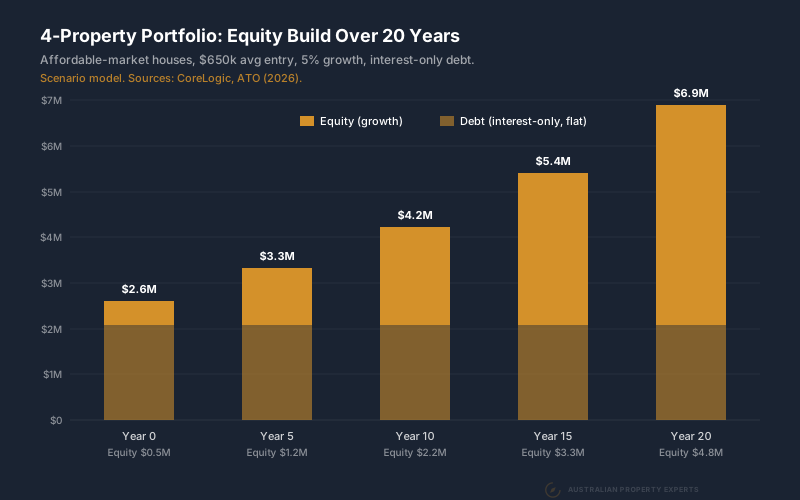
Let’s run the numbers on an APE-style portfolio: four houses bought over 5-6 years in affordable markets like outer Perth or Adelaide. Outer Brisbane is harder now, with Kingston and Morayfield house medians above $800,000.
The inputs are an average purchase price of $650,000, 80% LVR, interest-only loans and a 4.5% gross yield. For reference, Armadale in outer Perth has a $666,000 median house price and $620 a week median rent. That’s a 4.8% gross yield ($620 x 52 / $666,000), per Your Investment Property (CoreLogic prices to 30 June 2026, rents to 31 August 2026).
Assumptions, not forecasts:
- Capital growth 5% p.a. National dwelling values rose 66.5% over the 10 years to 31 August 2026 (Cotality HVI), which is 5.2% a year compounded (1.0523^10 = 1.665).
- Rent growth 3% p.a., below the 5.7% national rise over the past year.
- Interest 6.5%, the average rate on new interest-only investor loans in July 2026 (RBA table F6), held flat for 20 years.
- Expenses 25% of rent (management, rates, insurance, maintenance).
- Inflation 2.5%, the midpoint of the RBA’s 2-3% target.
- 20-year hold from the first purchase, ignoring buying and selling costs.
- Early losses carry forward. From 2027-28, losses on established homes bought after 12 May 2026 can’t be claimed against salary. They carry forward against future residential rental income or capital gains (Act No. 49 of 2026).
At year 20:
- Portfolio value: ~$6.9M ($2.6M x 1.05^20)
- Debt (unchanged on IO): $2.08M ($2.6M x 80%)
- Net equity: ~$4.82M ($6.9M less $2.08M)
- Gross rent: ~$211k per year ($2.6M x 4.5% = $117k, x 1.03^20)
- Net rent before tax: ~$23k per year ($211k less 25% expenses, less $135k interest at 6.5%)
That $23k in Model 1 doesn’t retire you. But look at what’s sitting behind it: nearly $5M in equity.
Model 2 at year 20: Sell three of the four at ~$1.72M each (gross $5.17M) and discharge the three loans ($1.56M).
A year-20 sale falls under the 2027 CGT rules, now law. They swap the 50% discount for CPI indexation of the cost base, plus a 30% minimum tax on established property. Only gains after 1 July 2027 fall under the new rules. Almost all of this gain accrues after that date, so we’ve treated the whole gain that way.
Each $650k cost base indexes to about $1.07M ($650k x 1.025^20). That makes the taxable gain on three sales about $1.98M (3 x the $1.72M sale price less the $1.07M cost base). Split it between a couple with no other income that year. At 2026-27 tax rates plus the 2% Medicare levy, the bill is roughly $862k. That’s an average rate near 44%, so the 30% minimum doesn’t bite. Under the old 50% discount the same sale would cost about $689k.
That leaves around $2.75M in cash ($5.17M less $1.56M of loans and $862k of tax). Pay off the fourth property’s loan ($520k) and you’re sitting on ~$2.23M invested. You also keep one unencumbered property producing $53k a year in gross rent.
Net rent on the one remaining property (after 25% expenses, no interest): ~$40k. Add $112k from the $2.23M invested at an assumed 5%. Total: ~$151k a year in passive income before tax. In today’s dollars at 2.5% inflation, that’s about $92k ($151k / 1.025^20).
Four properties bought and one kept, rather than five or ten.
Why the number shifts
Change any input and the answer changes.
Price point matters. Buy four houses at Sydney’s $1.49M median and the maths is worse, not better. Higher entry price, lower yield (Sydney houses average 2.9% gross, per Cotality to August 2026), more debt servicing, harder to scale. This is why we lean toward affordable markets over blue chip for investors building a retirement portfolio.
Timing matters. Buying early in a cycle versus late can make a large difference to year-20 equity. Brisbane, Adelaide and Perth dwelling values are up 64% to 80% over the past five years. Melbourne is down 3.9%, Sydney is up 5.6% and Hobart is up 11.5% (Cotality, to 31 August 2026). Those three are earlier in their cycle. We buy nationwide because the best opportunity is rarely in your home city, which is why we cover interstate investing so often.
Structure matters. Interest-only loans keep the debt flat while inflation erodes the real value of that debt over 20 years. At 2.5% inflation, a $2.08M debt in 2046 is worth about $1.27M in today’s dollars ($2.08M / 1.025^20). You don’t pay it down. You let inflation pay it down for you.
Cosmetic renovation matters. Say a $30k paint, flooring, kitchen and bathroom reno on a decent older house adds $60-80k of value. Do that on all four in the first year and you’ve added $120-200k net of the reno cost (4 x $30-50k), before the market even moves.
What matters more than the number
The number of properties is an output, not an input. What actually determines whether you get there:
Entry price discipline. Buying $650k houses on decent blocks in the right markets, not $900k houses because they feel “safer”.
Yield that sustains the portfolio. You need enough rent to service the debt so you can hold through rate cycles. A 4% gross yield on an affordable house carries a scaling portfolio further than 2.9% on a Sydney house.
Growth you can access. Houses on land, not apartments in oversupplied towers. Areas with population growth, infrastructure, and rental demand.
The right team. Mortgage broker who understands investment structuring. Accountant who knows trusts and tax. Buyers agent who buys nationwide, not just locally.
Time and patience. 20 years beats 5 years. Starting at 35 beats starting at 50. The earlier you buy, the fewer properties you need to hit the same retirement number.
The realistic answer
For most investors targeting ~$100k in passive income, three to five well-chosen affordable-market properties held for 20 years is the right ballpark. Held longer, or with more renovation and equity extraction along the way, two or three can do it. Held shorter or bought in expensive markets with low yields, you’ll need six or seven and still struggle.
See how we build portfolios of high-growth, high-yield properties.
If you’re working out how many properties you actually need to retire and where to buy them, we do this for a living. Book a free discovery call and we’ll map out a realistic portfolio plan against your retirement target.
This is general information only and not financial advice. Speak to a qualified accountant, mortgage broker, and financial adviser before making investment decisions.