Buyers agent fees typically run $15,000 to $30,000 for an experienced, full-service agent. That’s real money. So does the investment actually pay off?
Here’s what the data says.
What a buyers agent actually saves you
Negotiation savings
The most measurable value is in negotiation. CoreLogic data shows the median vendor discount on private treaty sales is around 3-4% nationally. On a $600,000 property, that’s $18,000 to $24,000. A skilled buyers agent with strong comparable sales data and negotiation experience regularly pushes beyond the median.
Even at the conservative end, a 3% negotiation saving on a $600,000 property is $18,000. At 5%, that’s $30,000. For most investors, the negotiation savings alone offset a significant portion of the fee, and in many cases cover it entirely.
For a full breakdown of fee structures, see our guide to buyers agent costs.
Off-market access
This is where the less obvious value sits. According to PropTrack data, off-market properties sell for around 4.3% less than comparable on-market properties nationally, and the discount widens to 6% or more for properties above $1 million.
On a $600,000 property, a 4% off-market discount is $24,000 in savings you wouldn’t have had access to without an agent’s network.
At Australian Property Experts, over 86% of our deals are off-market. That’s not a marketing claim. It’s a function of having purchased 250+ properties across every state and building relationships with selling agents who call us first when something comes up.
Due diligence
A professional building and pest inspection regularly uncovers issues that would cost thousands to fix after settlement.
A buyers agent coordinates these inspections as standard, and knows what to look for before the inspector even arrives. The cost of catching one major defect before settlement can exceed the entire fee.
Time
Property investment research is time-intensive. A full search, from strategy to settlement, takes significant time that most professionals simply don’t have. Our beginner’s guide breaks down exactly how much work is involved. For time-poor professionals, those are hours you’re taking from your career, your family, or your weekends.
What it costs to get it wrong
The cost of a buyers agent is clear. The cost of not using one is harder to quantify, but the numbers are telling.
Most investors never get past property one
Most property investors in Australia never get past one property. The most common reason? A bad first experience. Overpaying, buying in the wrong location, or underestimating holding costs. These mistakes are expensive and demoralising.
Early exits destroy returns
A significant percentage of landlords sell within the first year or two of purchasing.
Property is a long-term asset class. But if your first purchase is in the wrong location or at the wrong price, the temptation to cut your losses early is real, and it’s the single most expensive mistake an investor can make.
Nearly half of investors are cash-flow negative
Nearly half of all property investors in Australia are cash-flow negative. Some of that is by design (negative gearing strategies), but a significant portion is investors who didn’t properly model the numbers before buying and are now stuck with properties that cost more to hold than they expected.
The growing trend
Buyers agents aren’t a niche service anymore. Market share has grown from 4-5% of transactions in 2020 to an estimated 14-15% in 2025-26. In Sydney and Melbourne, buyers agents are now involved in over 10% of all property purchases.
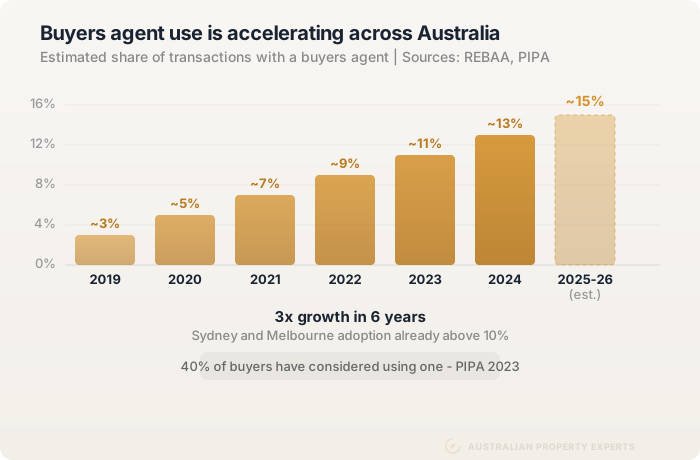
A 2023 PIPA survey found that 40% of Australians buying property had considered using a buyers agent, up from just 10% a decade ago.
The growth is driven by two things: market complexity (more data, more risk, more interstate investing) and the measurable savings buyers are seeing. You can see specific examples in our case studies.
When it’s NOT worth it
A buyers agent isn’t the right move for everyone.
- If you’re an experienced investor who has the time, the network, and the analytical skills to do your own research, negotiation, and due diligence, you may not need one.
- If you’re buying in your local area where you already know the market deeply, the value proposition is lower (though the negotiation savings still apply).
- If your budget is very tight, the fee may represent too large a percentage of your upfront costs to justify.
But if you’re time-poor, buying interstate, or entering the market for the first time (our beginner’s guide covers the fundamentals), the data strongly suggests that a buyers agent can pay for itself and then some.
Does it add up?
A full-service buyers agent typically costs $15,000 to $30,000. The negotiation savings alone usually cover that fee. Add in off-market access, time savings, due diligence, and the avoidance of costly mistakes, and the ROI becomes clear.
The real question isn’t whether you can afford a buyers agent. It’s what it costs you to buy without one.
Common questions
Is the fee tax deductible? The fee is capitalised into your cost base, not claimed as an annual deduction. That means it reduces your capital gain when you eventually sell, rather than lowering your taxable income this year. Our tax deductions guide covers how this fits with the rest of the deduction stack.
How is it different from a real estate agent? Real estate agents work for the vendor. Their job is to sell the property for the highest price. A buyers agent works only for you, and has a fiduciary duty to get you the best outcome. We break down the differences in detail in our buyers agent vs real estate agent post.
Can a buyers agent help if I’m a first-time investor? This is actually where the value is highest. First-time investors are the most likely to overpay, buy in the wrong location, or miss structural issues in due diligence. The fee as a percentage of the mistake-avoidance value is largest on property one.
This is general information only and not financial advice. Speak to a qualified professional before making investment decisions.
If you’d like to talk through whether it makes sense for your situation, book a free discovery call.