The 5% deposit scheme does not cover investment properties. Every purchase under the Australian Government’s expanded scheme must be a home you live in. The rules on that are specific. The scheme still matters to investors in two ways most articles skip. It can be the first step of a longer plan for buyers who don’t own anything yet. It is also reshaping demand at exactly the price points investors buy in.
The Short Answer: Owner-Occupiers Only
The scheme, formerly known as the Home Guarantee Scheme, is run by Housing Australia. It requires you to buy or build a home to live in. Its information guide says plainly that investment properties are not eligible. You need to move in within six months of settlement. You then keep living there for as long as the loan is under the guarantee.
Buying a property to rent out from day one is not eligible. The scheme is only open to individuals or two joint applicants. Company and trust purchases are out too. If you were hoping to pick up an investment property with a 5% deposit and no lenders mortgage insurance, this scheme is not the vehicle.
How the 5% Deposit Scheme Works in 2026
For the buyers it does cover, the mechanics are simple. You put in a deposit of at least 5%. Housing Australia guarantees up to 15% of the property’s value to a participating lender. That guarantee is what lets you borrow up to 95% without paying lenders mortgage insurance.
The scheme changed shape on 1 October 2025. The income caps were removed entirely. So was the annual limit on places, which had been 35,000 for first home buyers in 2025-26. Any eligible first home buyer with a 5% deposit can now apply, at any income, with no waiting list.
Price Caps by State and City
The caps decide what the scheme can buy. They were raised in the same October 2025 expansion, and Darwin’s has gone up again since.
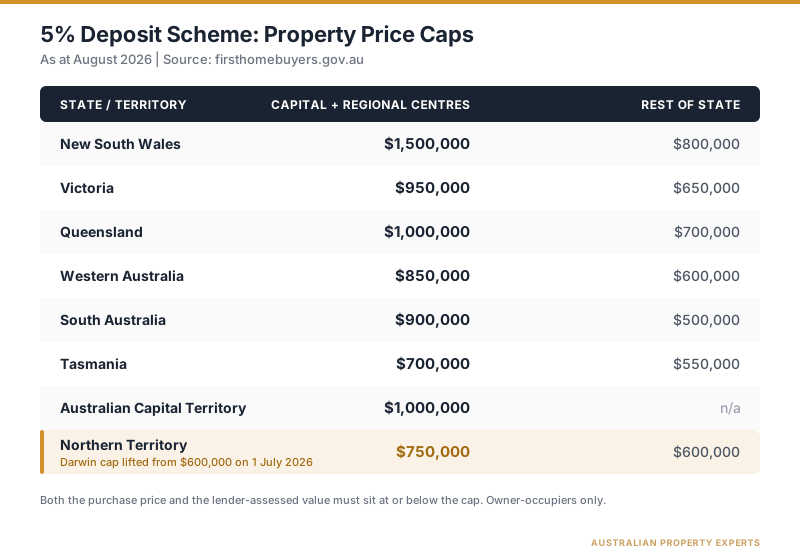
Sydney’s $1,500,000 cap sits above the city’s median dwelling value of $1,222,718 at 31 August 2026. The one to watch is Darwin, where the cap has been lifted from $600,000 to $750,000. The rest of the Northern Territory stays at $600,000. With Darwin’s median dwelling value at $647,259, the typical Darwin home now sits well under the cap.
Buy First, Rent It Out Later: The Rules
Investors usually ask us the same thing. Can you buy your first home under the scheme, live in it and convert it to a rental later? Yes, but only after the guarantee has ended. The order matters.
While the guarantee is in place, the property has to stay your home. Renting it out during that period is not allowed. The scheme’s own guide gives the example of a buyer who moves in with a partner and wants to rent his place out. The answer is no. Moving out without an exemption from your lender, or renting it out, ends the guarantee. If your loan is still above 80% of the property’s value at that point, your lender can charge lenders mortgage insurance or other costs.
The guarantee ends in a few ways that matter here. One is when your scheduled repayments bring the loan down to 80% of the property’s value. That value is the one your lender assessed when you bought. Growth does not count toward it. Neither do extra repayments you can redraw.
The other is refinancing with a lender outside the scheme’s panel. Housing Australia says most of the 34,000-plus households that had left the scheme by October 2025 did so by paying down their loans or refinancing. A refinance works off a fresh valuation, so this is where growth helps. If the new loan is at 80% or less of today’s value, there is no lenders mortgage insurance to pay.
A $600,000 first home bought with a $30,000 deposit leaves a $570,000 loan at 95%. Paying that down to $480,000, which is 80% of $600,000, takes years of scheduled repayments. Refinancing at 80% instead needs the home to be worth about $712,500, because $570,000 is 80% of $712,500. That is 18.75% growth.
Perth values rose 79.7% and Brisbane 64.1% over the five years to August 2026, well beyond that. Values also fall. Every capital except Darwin went backwards over the three months to August. The market you buy in decides the timeline. Until the guarantee has ended, you keep living there.
Two cautions before you build a plan around this. State stamp duty concessions for first home buyers carry their own residence requirements. Those run separately from the scheme. Check your state’s rules before you count on keeping the concession. Run the sequencing of loans, tax and timing past your mortgage broker and accountant. Don’t reverse-engineer it from a blog post.
This path is rentvesting run in reverse. Rentvesters rent where they live and buy where the numbers work. Here you live in the purchase first and turn it into the investment later. Whether that beats staying put and renting depends on your rent and the price you would pay. The rent vs buy calculator will settle that in a couple of minutes.
What Investors Use Instead of the Scheme
If you already own property, you usually don’t need a 5% cash deposit at all. The standard play is equity. Lenders will generally let you borrow against your home up to 80% of its value, and that released equity becomes the deposit on the next purchase. Our guide to using home equity walks through the maths. The usable equity calculator will give you your own number in about a minute.
If you don’t own property and don’t want to live in your first purchase, two options remain. One is a bigger deposit. The other is help with security. A 10-12% deposit plus lenders mortgage insurance gets some investors into the market years earlier than saving to 20%. The cost is worth modelling with a broker. A guarantor arrangement, where a family member’s property provides additional security, can remove the deposit hurdle entirely. The risks sit on the guarantor and deserve their own legal advice.
What the Scheme Means for Investors
Even investors who never touch the scheme are feeling it. Since October 2025 every first home buyer in the country has been able to bid with a 5% deposit, no income test, and no LMI. That demand lands under the price caps, which means the entry-level price points of every capital and regional centre.
It has not kept those price points immune from the downturn. Cotality’s August 2026 index shows lower quartile values now falling too, though premium markets are still generally weaker.
For investors targeting established houses in affordable markets, that means more competition at the exact stock we hunt. It also means more buyers underneath its value once bought. The scheme’s buyers are owner-occupiers, and owner-occupier depth is what gives a suburb price stability through soft markets.
Where the Scheme Fits an Investor’s Plan
If you don’t own property yet, the scheme can be the lowest-cost entry ticket you will ever get. That is a first home on 5% down with no LMI, in a market chosen for growth. It can become your first investment property once the guarantee has ended and your lender agrees. If you already own, your pathway is equity. Either way, the scheme is worth understanding. The demand it has unleashed at the affordable end is now part of the data every investor should be reading.
This is general information only and not financial advice. Speak to a qualified professional before making investment decisions.
If you want a plan for your first or next investment purchase, book a free call.
Sources:
- Australian Government 5% Deposit Scheme, firsthomebuyers.gov.au
- Australian Government 5% Deposit Scheme Information Guide, firsthomebuyers.gov.au
- Property price caps, firsthomebuyers.gov.au
- Housing Australia: unlimited places and higher price caps from 1 October 2025
- Housing Australia: expanded 5% Deposit Scheme
- Housing Australia: 50,000 Home Guarantee Scheme places for 2025-26
- Master Builders NT: Darwin cap lifted to $750,000
- Cotality: Home Value Index, August 2026 results (data to 31 August 2026)