
It’s one of the first decisions every property investor faces: house or unit? Both can work. But the data over 30 years tells a clear story about which asset type has built more wealth, and why.
The answer isn’t as simple as “always buy houses.” Your budget, your strategy, and your portfolio position all matter. But if you’re going to put hundreds of thousands of dollars into a single asset, you should understand what the numbers actually say.
30 years of growth data
CoreLogic’s long-term data (the company is now Cotality) is the most useful starting point here.
Across Australia’s combined capital cities, house values increased by 453% in the 30 years to July 2022. Unit values increased by 307% over the same period. In regional markets, the gap narrows slightly: houses up 314%, units up 213%.
Annualised, that’s roughly 5.9% per year for houses versus 4.8% for units across the capitals. A 1.1 percentage point difference doesn’t sound like much. But compounding changes everything.
A $500,000 house growing at 5.9% per year is worth approximately $1.57 million after 20 years. A $500,000 unit growing at 4.8% is worth approximately $1.28 million. Same starting price, same holding period, almost $300,000 difference.
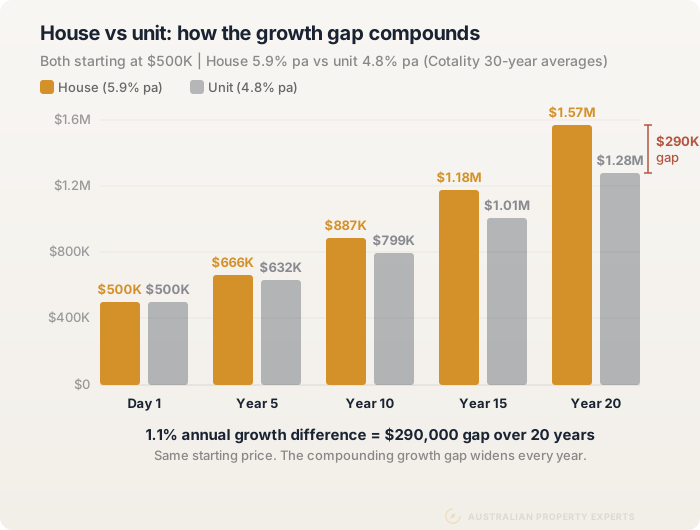
That gap is the main reason we lean toward houses when capital growth is the job.
It is a long-run tendency, and shorter periods can run the other way. Over the year to August 2026, Cotality has unit values ahead of house values in seven of the eight capitals. Canberra is the exception.
Why houses grow faster: the land factor
Buildings depreciate. Land appreciates. That’s the structural driver behind the growth gap.
When you buy a house on its own block, you’re buying direct exposure to land value. In established suburbs with limited supply, that land becomes scarcer over time as populations grow. Scarcity drives price.
When you buy a unit in a 50-lot apartment complex, you own 1/50th of the building’s land value. Even if the land underneath appreciates strongly, your share of that growth is diluted across every lot holder. The majority of what you’ve paid for is the building itself, and that building is depreciating from the day it was built.
There’s a second factor. When demand rises in an area, developers can build more apartments on available sites. New supply enters the market and moderates price growth. You can’t do that with established houses in tightly held suburbs. There’s no more land to build on.
The 30-year gap was wider across the capital cities than in regional markets. CoreLogic pointed to lower regional unit supply and demand for holiday and retirement units as possible reasons.
Where units actually win: rental yield
Units deliver higher gross rental yields than houses in every capital city in Cotality’s index at 31 August 2026. Across the combined capitals, houses yield 3.3% and units 4.6%. Melbourne at a $500,000 budget is a clean illustration. The three markets under $500k are all units, yielding 4.55% to 4.89%. Houses in the same three suburbs yield 3.70% to 3.81%. Neither combined capital city figure clears the 5.04% an 80% loan needs just to cover interest, which is the bar most investors never work out.
The reason is straightforward: units have lower purchase prices relative to the rent they generate. A $500,000 unit renting for $500 per week delivers a 5.2% gross yield. A $900,000 house renting for $600 per week delivers 3.5%.
For investors focused on cash flow, or those who need better serviceability to expand their portfolio, that yield advantage matters. Our guide to capital growth vs rental yield covers how to balance these two forces across a portfolio.
Compare rental yields between a house and a unit to see which gives better returns.
Use the calculator →
The strata cost that erodes unit yields
Strata costs complicate the yield advantage.
Units come with strata levies (called body corporate fees in Queensland). These cover building insurance, common area maintenance, sinking fund contributions, and management fees.
Levies vary widely from building to building, even inside one suburb. A walk-up block with no lift costs far less to run than a tower with a lift, a pool and a concierge.
A unit with a 5.2% gross yield and $6,000 in annual strata fees might deliver a net yield comparable to a house at 3.8% with no strata. The headline yield number for units is often misleading without factoring in these costs.
And strata fees aren’t fixed. They rise over time. Older buildings with deferred maintenance can hit owners with special levies for major repairs, waterproofing, cladding remediation, or structural work. You have no control over when they’re issued or how much they cost.
With a house, maintenance is variable but it’s your decision. You choose when to replace the roof, repaint, or fix the fence. With a unit, the owners corporation makes those calls for you, and you pay your share whether you agree or not. For a deeper look at what strata fees cover, how to read the report, and red flags to check before buying, see our guide to body corporate fees.
Depreciation: the one tax advantage units have
Units typically offer higher depreciation deductions than houses. The building component (depreciable at 2.5% per year for up to 40 years) makes up a larger share of a unit’s value. Apartment complexes also include shared plant and equipment like lifts, air conditioning systems, security, and common area fit-outs that generate additional claims.
For investors using negative gearing, this can improve after-tax cash flow in the early years. That benefit has narrowed. For established homes bought after 7.30pm on 12 May 2026, rental losses carry forward from 2027-28 against residential rental income and gains. But depreciation is a tax timing benefit, not a wealth creation tool. It reduces your cost base, which means higher capital gains tax when you sell. Talk to your accountant about how this applies to your situation.
The supply question in 2026
CBRE’s September 2025 outlook forecasts around 60,000 apartments a year over 2025 to 2030. It puts the supply needed to stop vacancy falling further at roughly 75,000 a year. That’s a forecast shortfall of about 15,000 apartments a year, compounding over time.
SQM Research has the national rental vacancy rate at 1.3% in August 2026. The capitals range from 0.4% in Darwin to 2.1% in Canberra. CBRE puts the previous decade’s average capital city apartment vacancy at 2.5%.
This undersupply supports both rents and values for existing units in the short to medium term. But it doesn’t change the long-term structural dynamics. As development sites become available and construction catches up, new apartment supply can enter the market in ways that new houses in established suburbs simply can’t. For a decade-long worked example of that happening, see Parramatta apartments: ten years, no capital growth.
Current median prices: houses vs units
Cotality’s median values at 31 August 2026 show the entry point difference.
| City | Median house | Median unit | Gap |
|---|---|---|---|
| Sydney | $1,495,000 | $878,000 | $617,000 |
| Melbourne | $920,000 | $629,000 | $291,000 |
| Brisbane | $1,181,000 | $855,000 | $326,000 |
| Perth | $1,043,000 | $733,000 | $310,000 |
| Canberra | $1,008,000 | $586,000 | $422,000 |
| Hobart | $798,000 | $599,000 | $199,000 |
For many investors, particularly those buying their first or second property, the entry point difference is the real constraint. A house in Sydney requires significantly more deposit and borrowing capacity than a unit. For investors working with limited capital, our beginner’s guide breaks down the numbers.
When a unit can make sense
Despite the long-term growth advantage of houses, there are situations where a unit is the right call.
When your budget doesn’t stretch to a house in a strong location. A well-located unit in a supply-constrained, established suburb will often outperform a poorly located house on the outskirts. Location matters more than dwelling type. A Brisbane unit 5km from the CBD can beat a house at the same price 45km out with no infrastructure and oversupply risk.
When you need yield to sustain your portfolio. If you already own growth-focused houses and the holding costs are stretching your cash flow, a higher-yielding unit can balance the portfolio. It can also free up borrowing capacity for your next purchase.
When it’s a small block unit, not a high-rise apartment. A villa unit, townhouse, or unit in a small complex of 4 to 8 has a higher land-to-building ratio than a 200-lot tower. These “unit” types often behave more like houses in terms of capital growth, especially in established suburbs.
When you’re buying interstate on a budget. Entry prices for units in cities like Brisbane and Perth are significantly lower than houses, letting you access strong markets with less capital.
When a house is clearly better
Over the long run, houses have generally been the stronger wealth-building asset for a portfolio. The cases where this is clearest:
You’re early in your investment journey. Your first property sets the trajectory. A house in a growth suburb compounds equity that you’ll leverage for property two and three. Starting with a slow-growth unit makes it harder to build the equity needed to expand.
You have the borrowing capacity. If you can afford a house in a well-located suburb, the 30-year data strongly favours doing so.
You’re investing for 10+ years. The compounding growth gap between houses and units widens dramatically over longer holding periods. Over 10 years, the difference is significant. Over 20, it’s substantial.
What actually matters most
The house vs unit debate matters, but location matters more. A house in a declining regional town with no employment diversity will usually underperform a well-located unit in a supply-constrained capital city suburb.
The best investment decisions are driven by data, not by rules of thumb. What does the suburb’s growth history look like? What’s the vacancy rate? What’s the supply pipeline? What’s the land-to-building ratio? These questions matter more than “house or unit” in isolation. We put three of them into a repeatable order in are apartments a good investment, which measures seven unit markets 118 points apart over the same decade.
At Australian Property Experts, we score land content, supply risk and growth fundamentals on every property. The dwelling type is one input, not the whole answer. You can see the results of that process in our case studies.
This is general information only and not financial advice. Speak to a qualified professional before making investment decisions.
See how we choose investment properties for clients.
If you want help working out which property type fits your strategy and budget, book a free discovery call.




.jpg)