Investors ask us for the best suburbs to invest in Melbourne under $500k more than almost any other budget question. The answer has changed, and most of the articles ranking for that search still quote old medians.
We checked every suburb the popular lists name against CoreLogic medians for the twelve months to June 2026. Three markets genuinely sit under $500,000. All three are units rather than houses.
What $500,000 buys in Melbourne
Every “under $500k” list still points at Melbourne’s outer west, where the affordable house stock used to be. Those suburbs have moved.
| Suburb | House median | Unit median |
|---|---|---|
| Melton | $565,000 | $425,000 |
| Melton South | $586,500 | $409,000 |
| Kurunjang | $615,000 | $450,000 |
| Werribee | $660,000 | $480,000 |
| Broadmeadows | $660,000 | $517,500 |
| Frankston North | $715,000 | $610,000 |
| St Albans | $730,500 | $558,000 |
| Dandenong | $780,000 | $494,500 |
Not one house median starts with a four. The lowest house median on that list is Melton at $565,000. Melton grew 16.49% in the year to June 2026, which is how it got there.
At $500,000 in Melbourne you are buying a unit, so the rest of this guide compares unit markets.
The three markets under $500,000
These are the ones that clear the budget on CoreLogic’s numbers and have enough sales for the median to mean something. In each one the rent, the median and the yield reconcile with each other.
Melton South units. $409,000, renting at $380 a week, 4.83% gross. Fifty-four unit sales in twelve months and 25 days on market. Growth was 7.63%, the slowest of the three. Melton South is also the most affordable entry in metropolitan Melbourne that we would look at twice.
Melton units. $425,000, renting at $400 a week, 4.89% gross. It has the strongest growth of the three at 11.84% and the shortest time on market at 19 days. The catch is depth: 35 unit sales in a year is a thin market, so a median built on it moves around more than you want.
Werribee units. $480,000, renting at $420 a week, 4.55% gross. This is the one with real depth. Two hundred and five unit sales in twelve months against Melton’s 35, growth of 10.34%, 22 days on market. Werribee is a genuine regional hub with a hospital, a train line and its own employment base. The unit market is liquid enough that you can buy and sell without being at the mercy of one or two comparable sales.
Why the other lists are wrong
The articles ranking for this search are quoting numbers that were right a while ago and have never been refreshed.
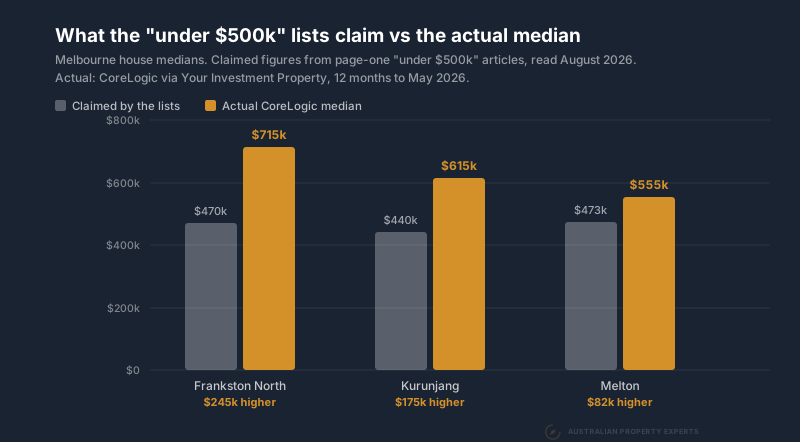
Frankston North gets named constantly at a $470,000 median. CoreLogic has it at $715,000. That is a $245,000 gap. Kurunjang gets quoted at $440,000 against an actual $615,000. Melton gets quoted at $473,074 against $565,000.
If you budget $500,000 for a Frankston North house on the strength of one of those lists, you are $215,000 short before you start. Before you rely on any suburb list, check that it gives a data source and a date.
Two suburbs that show up on the affordable lists did not make our three. Kurunjang units look like they qualify at $450,000, but only 19 sold in twelve months. The published 4.37% yield also implies $378 a week against a listed median rent of $410. When a suburb’s own numbers disagree with each other by more than about 5%, one of them is wrong. We would rather leave it out than guess which.
Dandenong units are the borderline case. The median has slipped to $494,500 on 315 sales. The $490 rent now works out to a 5.15% gross yield. That leaves $5,500 of headroom, so it sits on the $500,000 line rather than under it.
Units are the trade-off at this budget
We buy established houses on decent blocks for clients, because land is where the growth sits and a house gives you levers a unit does not. You can renovate for equity, add a granny flat or subdivide later. In the eight blue chip unit markets we tested, the yields are higher and the five year growth is negative in every one.
So when the budget is $500,000 in Melbourne, be clear about what you are accepting. You are trading the land component and the value-add options for a lower entry price and a higher yield. Sometimes that trade works. We think it does in two situations.
The first is a villa unit on its own title in a low-density block. Two to six on a site, single storey, its own courtyard and driveway. There is a real land component, the body corporate is small, and the growth profile sits much closer to a house than to an apartment.
The second is when the yield genuinely does the work. At 4.89% gross in Melton against 3.77% on a house there, the unit carries itself better while you build the deposit for the next purchase.
What we would not do at this budget is buy a high-rise apartment in a tower with three hundred neighbours and a large sinking fund. When your tenant moves out, you can be competing with forty identical units for the next one. The house or unit question has a longer answer, but that is the short version.
What to check before you buy
Five things separate a workable unit at this price from a problem.
The land component. Look at the site plan, not the floor plan. How many units share the block, and does yours have exclusive-use outdoor space attached to the title?
The body corporate. Get the last two years of minutes and the sinking fund balance before you go unconditional. A special levy for concrete cancer or a roof replacement can wipe out three years of yield.
Sales depth. Melton’s 35 unit sales in a year means the median is built on a small sample. Werribee’s 205 gives you something far more solid to price against, and an exit that does not depend on one buyer turning up.
New supply nearby. Werribee approved 909 new apartments and townhouses in the five years to June 2026, about 31 for every 100 already there. That is well above Melbourne’s rate of about 18. Our screen of 153 Melbourne unit markets has the figure for each suburb.
Owner-occupier share. A block that is 90% investor-owned behaves differently in a downturn to one where half the owners live there. Ask the agent, then check it against the strata roll.
Where $500,000 still buys a house
If the land component matters to you more than the postcode does, $500,000 goes considerably further outside Melbourne. Victoria is earlier in its cycle than Queensland or Western Australia. We buy there for clients, just not usually at this budget in units.
Our Adelaide and Darwin suburb guides carry the current medians and yields for markets where a house on a block is still in reach. Closer to Melbourne, our Ballarat guide has houses from $513,500. Buying interstate covers how that works when you cannot inspect in person. If Melbourne is where you want to be and the budget can stretch, our Melbourne suburb guide covers the house markets from $565,000 up. A buyers agent in Melbourne is looking at a different set of streets to one working the interstate markets.
Which one we would buy first
At $500,000 in Melbourne the real choice is between a unit close in and a house further out. It comes down to what you want the asset to do over ten years more than what it costs on settlement day. Werribee at $480,000 with 205 sales behind the median is the one we would look at first, for depth with room left under the budget.
This is general information only and not financial advice. Speak to a qualified professional before making investment decisions.
If you are weighing a Melbourne unit against a house in another state, book a free discovery call.
Sources
- Suburb medians, rents, yields, growth, sales volumes and days on market: CoreLogic data via Your Investment Property suburb profiles. Medians, growth, sales and days on market are for the twelve months to 30 June 2026; rents are to 31 August 2026. Yields are computed as weekly rent x 52 / median. Individual profiles: Melton, Melton South, Werribee, Kurunjang, Broadmeadows, Frankston North, St Albans, Dandenong.
- Claimed medians were read from the articles currently ranking on page one for “best suburbs to invest in Melbourne under $500k” in August 2026.