Darwin is the only Australian capital where the rent on a median dwelling covers the interest on the loan. Every other capital leaves the owner funding the gap out of salary every week. In Sydney that gap runs to $409.
That makes the best suburbs to invest in Darwin worth a serious look in 2026. Growth in the five below also runs well ahead of Darwin’s citywide 14.6% in the year to 31 August 2026.
Why Darwin stands out in 2026
We modelled what an investment property costs you per week in all eight capitals, using Cotality’s medians and yields at 31 August 2026. On an 80% loan at 6.3% interest, the gross yield a property needs for rent to cover interest is 5.04%. Darwin was the only capital that cleared it.
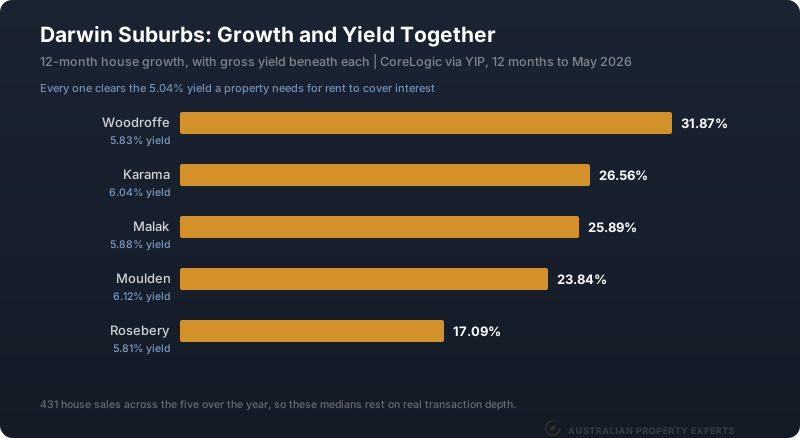
All five suburbs below clear it too, with room to spare. What makes them worth writing about is the growth. They cleared it while also rising between about 20% and 30% over the year. Investors are usually asked to trade one of those away for the other.
The five suburbs, by the numbers
| Suburb | Median house | Gross yield | Weekly rent | 12-mth growth | Sales | Days on market |
|---|---|---|---|---|---|---|
| Moulden | $548,750 | 5.88% | $620 | 26.15% | 82 | 48 |
| Woodroffe | $600,000 | 5.63% | $650 | 30.43% | 83 | 32 |
| Karama | $610,000 | 5.80% | $680 | 21.76% | 87 | 48 |
| Malak | $620,000 | 6.04% | $720 | 25.89% | 51 | 34 |
| Rosebery | $700,000 | 5.87% | $790 | 19.66% | 107 | 32 |
CoreLogic house data via Your Investment Property, fetched from the live suburb profiles on 26 September 2026. Medians, growth, sales and days on market cover the 12 months to June 2026. Rents are to August 2026. Yields are rent x 52 divided by the median shown, so they differ slightly from YIP’s own yield column.
Put one of them through the same model. Moulden at $548,750 on an 80% loan is $439,000 borrowed, which at 6.3% is $532 a week in interest against $620 a week in rent. That is $88 a week in your pocket before expenses. The same purchase at Sydney’s median runs $409 a week the other way. Karama lands at $89 a week and Rosebery at $112.
Those figures are interest only. Rates, insurance, management and maintenance still have to come out of them. These suburbs still cost something to hold, but they start from the right side of zero, which almost nothing in a capital city does in 2026.
Three things are worth pulling out of that table. 410 houses changed hands across these five over the year, so the medians rest on real transaction depth rather than a handful of sales. The whole set sits between $548,750 and $700,000. That straddles Cotality’s Darwin median of $647,259 at 31 August 2026, so these sit in the middle of the market rather than out on the fringe. And the income does not follow the price. Malak pays the most at 6.04%. Moulden, the lowest-priced of the five, is next at 5.88%. Rosebery, the dearest, is a whisker behind at 5.87%.
One geographic note before the suburbs. Moulden, Woodroffe and Rosebery sit in Palmerston, the satellite city about 20 kilometres from the Darwin CBD. Karama and Malak are in Darwin’s northern suburbs. They trade as one market for tenants and financiers, but Palmerston carries the newer stock and Darwin’s north the older houses on bigger blocks.
Moulden and Karama: the low-entry end
Moulden has the lowest entry on the list at $548,750, yielding 5.88%. Karama sits at $610,000 on 5.80%. Both are established Darwin and Palmerston suburbs with the older housing stock we prefer. Each put on more than 21% over the year.
They also carry the longest selling times here at 48 days, which is about two weeks slower than Rosebery and Woodroffe. Slower turnover works in your favour when you are the one buying, because it gives you room to negotiate.
Woodroffe: the growth outlier
Woodroffe grew 30.43% over the year, the fastest of the five. It still yields 5.63% at a $600,000 median, and the 83 houses that sold took 32 days on average.
No market keeps growing at 30.43% a year. The quarterly figure underneath it was 5.26%, so the run was still going at the end of the period rather than having stalled. Treat it as a market that has repriced hard and check what you are paying against recent comparable sales rather than the median.
Rosebery: the depth pick
Rosebery is the most expensive at $700,000 and the slowest grower at 19.66%. That reads like the weakest entry until you look at the volume. It had 107 house sales, the most of any suburb here. Its 32 days on market is level with Woodroffe for the fastest.
With that many sales, Rosebery is easier to value, finance and sell. It also carries the highest weekly rent on the list at $790. Its 5.87% yield sits just behind Malak and Moulden. If you want the Darwin yield without the thinnest end of the market, this is where it sits.
What to check before you buy in Darwin
Darwin is a small market with a real cycle. It fell hard after the last construction boom ended and took years to recover. The current run is strong, and strong runs in small markets are exactly where investors overpay. Base your offer on today’s rent and recent sales rather than last year’s growth rate.
Check cyclone rating and insurance before you offer. Northern Territory insurance costs sit well above the national norm and vary by build era and certification. Get a quote before you go unconditional, not after, because it comes straight off the yield you take home.
Confirm the yield is current. Yields compress when prices rise this fast. These suburbs rose about 20% to 30% in a year. A figure from twelve months ago will overstate what you will collect.
Watch the employment base. Darwin leans on defence, government and resources. That is a narrower base than the other capitals, so the tenant pool moves with a smaller number of decisions.
Where Darwin fits in a portfolio
Darwin needs watching and should only ever be one part of a portfolio. Right now it is the one capital where a median purchase pays its own interest, in suburbs that also grew double digits. That is the mix we look for, and it is rare in 2026.
For the wider picture on this market see our Darwin property market update. For how the two halves of the return work together, growth versus rental yield covers why we insist on both. If you want the citywide context and how we buy up there, the Darwin buyers agent page has it.
This is general information only and not financial advice. Suburb data changes and past growth is not a guide to future returns. Speak to a qualified professional before making investment decisions.
If you want these Darwin suburbs run against your own budget and strategy, book a free discovery call.