
Two numbers decide what property management actually costs you. Only one of them gets quoted at you up front.
The first is the management fee, a percentage of the rent taken out before the money reaches your account. The national average sits around 7.5% of weekly rent. It moves a long way by state. The second is the letting fee, a one-off charge every time a new tenant goes in. That one usually runs one to two weeks’ rent. It covers the advertising, the inspections, the tenant screening, the lease, the bond lodgement and the ingoing condition report.
Everything else on the invoice is either negotiable, optional, or buried.
Average PM fees by state
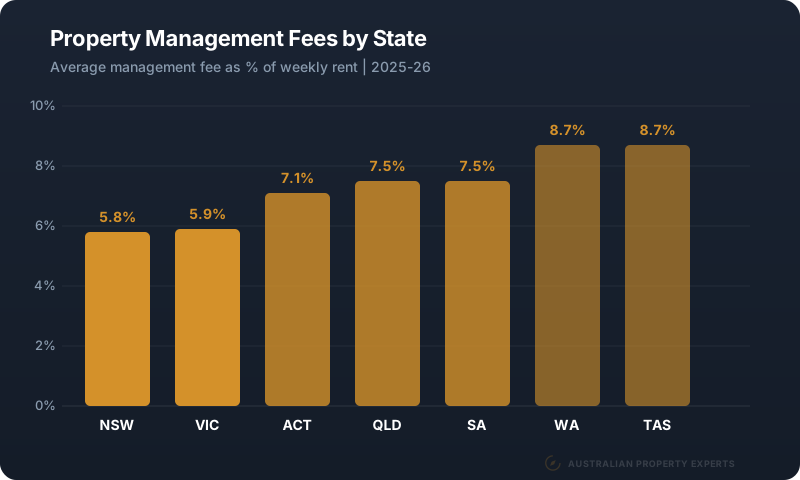
These figures come from LocalAgentFinder, an agent comparison site, which publishes them as approximate 2026 averages. They are averages of what agencies charge, not regulated rates. Each agency sets its own fee. WA Consumer Protection lists the level of fees they will charge among the things to weigh when you choose a manager. We checked the table on 26 September 2026.
| State | Management Fee | Letting Fee |
|---|---|---|
| NSW | 5.8% | 1.1 weeks |
| VIC | 5.9% | 1.5 weeks |
| QLD | 7.5% | 1.0 weeks |
| SA | 7.5% | 1.9 weeks |
| ACT | 7.1% | 1.2 weeks |
| NT | 8.5% | 1.0 weeks |
| WA | 8.7% | 1.7 weeks |
| TAS | 8.7% | 2.0 weeks |
NSW has the lowest average management fee in the country at 5.8%, with Victoria close behind at 5.9%. WA and Tasmania have the highest at 8.7%. That is 2.9 percentage points above NSW (8.7 minus 5.8). The Northern Territory sits just behind them at 8.5%. Where you bought for rental yield, that fee comes straight off it.
Read the second column too. South Australia averages the same 7.5% as Queensland, then charges 1.9 weeks’ rent every time the tenant changes. That is nearly double Queensland’s 1.0 weeks. On a $500 a week rental that turns over every year, the extra 0.9 weeks is $450 a year ($500 x 0.9). It never appears in the headline rate.
Factor in property management fees, vacancy, and all expenses to see your true net yield.
Use the calculator →
What the management fee buys
Rent collected and passed on to you, usually monthly. Routine inspections with photos attached, as often as your state’s rules allow. Someone to take the maintenance calls, chase quotes and book tradespeople, with your sign-off on anything big. Day-to-day tenant queries, so your mobile stays quiet. Smoke alarm checks and compliance with your state’s rental rules. Statements you can hand your accountant in July without assembling them yourself.
That is the standard list, and most agencies will tell you the same one. What separates them is everything sitting just outside it.
The fees that aren’t in the headline
Lease renewal is the common one. Some agencies renew a tenant for nothing. Others bill you a fee every twelve months for a document that barely changes.
Advertising is next. The letting fee is supposed to cover finding a tenant. Some agencies still bill the portal listing on top. Condition reports can be charged the same way, once for the ingoing and again for the outgoing, even where routine inspections are included. If a tenancy ends up in front of the tribunal, attendance can be billed per hearing or by the hour. Then there are the small monthly ones, such as statement, admin and technology fees, for things you would struggle to describe.
The one worth asking about directly is maintenance. Some managers add a percentage on top of the tradesperson’s invoice. Some charge a flat coordination fee per job, and some do neither. Ask which one you are signing up for.
Add it all up before you compare. On a $500 a week rental, the year’s rent is $26,000 ($500 x 52). An all-inclusive 8% costs $2,080 a year ($26,000 x 8%). A headline 5.5% costs $1,430 ($26,000 x 5.5%). That $650 gap can disappear once a renewal fee, an advertising bill, two condition reports and twelve months of admin fees land on the lower-priced quote.
Strata management: who does what
Own a unit and there are usually two managers, working for different people. Your property manager works for you. They find the tenant, collect the rent and look after the lease. The strata manager works for the owners corporation, which is every owner in the building. They can run the meetings and AGMs, raise the levies, keep the records and enforce the by-laws.
Their fee comes out of the administrative fund, so your levies already pay it. A scheme does not have to hire one at all.
The rules depend on the state. NSW requires a strata managing agent licence. Since 3 February 2025 a NSW strata manager has had to itemise insurance quotes, commissions included. If the owners arrange and pay for the insurance themselves, the manager cannot take a commission on it. Queensland does not license body corporate managers, but an engagement can run no longer than three years and any commission has to be disclosed.
A March 2026 review by the NSW Productivity and Equality Commission modelled strata management at $577.66 per lot for 2025, before commissions. That is $275.59 in core fees, $212.64 for extra services and $89.43 in disbursements. Our guide to body corporate fees covers the rest of the levy.
What the fee does to your yield
On a $500 a week rental, this is what each management fee rate takes out over a year. The last column shows what it does to the yield on a $550,000 property.
| Fee Rate | Annual Cost | Impact on Yield ($550K property) |
|---|---|---|
| 5.5% | $1,430 | -0.26% |
| 7.5% | $1,950 | -0.35% |
| 8.5% | $2,210 | -0.40% |
| 10% | $2,600 | -0.47% |
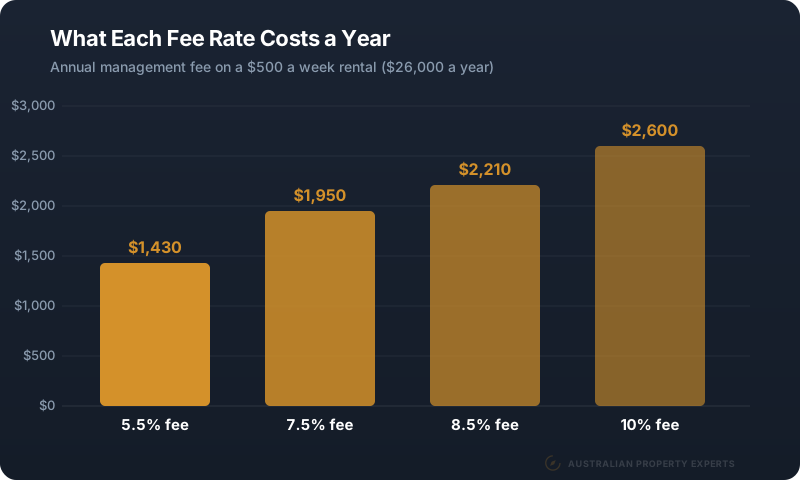
Each row starts from $26,000 of rent a year ($500 x 52). Multiply by the fee rate for the annual cost, then divide by the $550,000 price for the yield impact. At 7.5%, that is $26,000 x 7.5% = $1,950, and $1,950 / $550,000 = 0.35%.
Top to bottom, the gap is $1,170 a year ($2,600 minus $1,430), or 0.21 of a percentage point of yield (0.47 minus 0.26). On one property you would barely feel it. On four you are handing over an extra $4,680 a year (4 x $1,170).
Use the number you will actually be charged in the cash flow calculator, not the rate on the brochure. The ATO treats real estate commissions on a rental as fully deductible in the year you pay them. So the after-tax gap is narrower than the table makes it look. There is more in our guide to investment property tax deductions.
When a dearer manager costs you less
Picture a low-fee manager who does not return calls and takes three weeks to fill a vacancy. They put the first applicant through without checking a reference. That manager will cost you more than the fee difference ever saved.
Pay the premium when you are investing interstate and have no way of walking through the place yourself. Pay it on an older property. There, a manager with tradespeople who turn up and do not gouge saves you money on every single job. It is also worth paying where the rental market is tight and turnaround speed is what protects your income.
Push back on the rate when you have several properties with the same agency. A portfolio gives you room to ask for a discount. Push back when the place is newish, low-maintenance and in a suburb where twelve groups turn up to every open. And get three quotes in the same area before you sign anything. Compare the annual total in dollars.
There is more on separating the good ones from the rest in our guide on how to choose a property manager.
Vacancy costs more than the fee
One extra week vacant on a $500 a week rental costs you $500. The whole annual gap between a 6% and a 9% management fee is $780 ($26,000 x 3%). So a manager who fills your vacancy a week faster than the low-fee one wins back $500 of that $780. Two weeks faster is $1,000. That puts them $220 ahead.
Which means the percentage is the wrong thing to negotiate hardest on. Ask for the numbers instead. Average days to fill a vacancy, what share of tenants renew, and what happens on day three of arrears. An agency that cannot answer those three questions has just told you something useful.
We vet managers on exactly those numbers as part of the handover after every purchase we run. Here is whether a buyers agent is worth it.
Sources
- LocalAgentFinder: average property management fees by state (approximate 2026 averages, checked 26 September 2026)
- ATO: how to claim rental expenses (last updated 23 July 2026)
- NSW Productivity and Equality Commission: review of strata manager commissions, final report (March 2026, Table 9)
- NSW Government: buying a strata property (last updated 1 April 2026)
- Queensland Government: body corporate manager
- WA Consumer Protection: using a property manager (last updated 20 November 2024)
This is general information only and not financial advice. Speak to a qualified professional before making investment decisions.
See how we find properties that rent well and grow.
If you want help finding reliable property managers in markets across Australia, book a free discovery call.



.jpg)