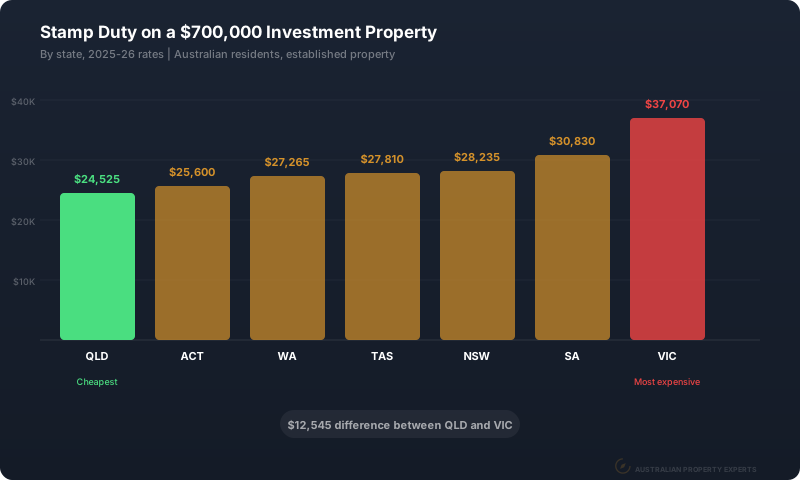
Stamp duty is the single biggest upfront cost when buying an investment property. It varies enormously by state. A $700,000 investment property costs $20,040 in stamp duty in the ACT and $37,070 in Victoria. That is a $17,030 difference on the same purchase price. It affects your cash-on-cash return from day one.
Most stamp duty guides also skip one thing. Investors don’t qualify for any of the concessions that reduce stamp duty for owner-occupiers. That means no first home buyer exemptions, no principal place of residence discounts and no waivers, so you pay the full general rate.
This is what stamp duty costs on an investment property in each state for contracts signed in the 2026-27 financial year.
The investor stamp duty comparison
These figures are for Australian resident investors purchasing established residential property. Foreign buyers pay additional surcharges (covered below). All amounts use the 2026-27 rate schedules. They may vary slightly with the exact property value and transaction details.
| State | Stamp duty on $500K | Stamp duty on $700K | Highest rate |
|---|---|---|---|
| ACT | $11,400 | $20,040 | 6.40% |
| QLD | $15,925 | $24,525 | 5.75% |
| NSW | $16,687 | $25,687 | 5.50% |
| WA | $17,765 | $27,265 | 5.15% |
| TAS | $18,248 | $26,748 | 4.50% |
| SA | $21,330 | $32,330 | 5.50% |
| NT | $23,929 | $34,650 | 5.95% |
| VIC | $25,070 | $37,070 | 6.50% |
For exact calculations on your specific property, use our upfront cost calculator or the relevant state revenue office calculator.
Calculate exact stamp duty for any property price across all Australian states. Includes bracket breakdowns and first home buyer concessions.
Use the calculator →
The spread between the lowest-duty jurisdiction (the ACT at $20,040) and the most expensive (Victoria at $37,070) on a $700,000 property is $17,030. For investors buying interstate, the choice of state affects your return.
State-by-state breakdown
Queensland
Queensland has the lowest stamp duty of any state for investment properties in the $500,000-$800,000 range. Only the ACT is lower. It is a much smaller market with land rent and leasehold quirks of its own. In Queensland, the general transfer duty rates apply to all investor purchases, with a top rate of 5.75% above $1 million.
What makes QLD attractive is that the rate structure is relatively flat through the mid-range. So investors buying in the $500,000-$750,000 range pay less upfront in Queensland than in any other state. No concessions apply to investors. First home buyer exemptions and the home concession rate are owner-occupier only.
New South Wales
NSW uses the same rate structure for investors and owner-occupiers. The progressive rates run from 1.25% to 5.50%. A 7% premium rate applies to residential properties above $3,870,000 (2026-27 threshold, CPI-adjusted annually).
On a $900,000 to $1,100,000 investment property, NSW stamp duty runs $34,687 to $43,687. That’s a significant chunk of capital. It could otherwise be your deposit on a second property in another state.
Stamp duty is payable within three months of signing the contract, or at settlement if that comes first.
Victoria
Victoria is the most expensive state for stamp duty on investment property. The non-principal-place-of-residence rates are higher than the owner-occupier rates. Properties between $960,001 and $2,000,000 attract a flat 5.5% on the entire purchase price, not just the marginal excess.
On a $600,000 investment property, VIC stamp duty is $31,070. On $800,000, it’s $43,070. Victoria’s land tax also starts at just $50,000 of land value (see our land tax comparison). Together, the costs of buying and holding in VIC are higher than in QLD, WA or NSW.
Victoria’s lower prices can still narrow the gap. On each city’s median dwelling at 31 August 2026, Melbourne duty is $42,273. Sydney duty is $49,209.
Western Australia
WA charges investors and companies the same general rate. Only first home buyers and homes under $200,000 get a concessional rate. The top rate of 5.15% is among the lowest of any state (only Tasmania’s 4.50% is lower). That benefits investors buying at higher price points.
For properties in the $500,000-$750,000 range, WA’s stamp duty lands in the middle of the pack. The rates are straightforward. There are no surprise surcharges or cliff effects.
South Australia
SA’s stamp duty runs from 1% to 5.50% across progressive brackets. On a $700,000 investment property, you’re paying $32,330. No investor concessions exist. Foreign investors pay an additional 7% surcharge on top of standard rates.
Tasmania
Tasmania’s rates have been unchanged since 21 October 2013, with a top rate of 4.50% above $725,000. That’s the lowest top rate of any state. On a $500,000 property, Tasmanian stamp duty is $18,248.
ACT
The ACT has the lowest investor duty of the eight at both $500,000 and $700,000. Its brackets climb steeply above $750,000, though. Non-owner-occupier (investor) rates run from 1.20% to 6.40%, then a flat 4.54% on the whole price above $1,455,000. Notably, the ACT is one of only two jurisdictions (along with the NT) that does not impose a foreign buyer surcharge on stamp duty.
What investors miss out on
If you’re buying an investment property, none of these apply to you:
- First home buyer exemptions/concessions (all states)
- Principal place of residence concession rates (VIC, QLD, and others)
- NSW First Home Buyer Assistance Scheme (exempt up to $800,000 for owner-occupiers)
- QLD first home buyer stamp duty exemption (from 1 May 2025, covers new builds for first-time owner-occupiers only)
- VIC principal place of residence rates (significantly lower than investor rates)
This catches some first-time investors off guard, especially rentvestors who are buying their first property as an investment while renting elsewhere. The stamp duty bill is higher than they expected because the online calculator defaulted to owner-occupier rates. Always select “investment property” or “non-owner-occupier” when using a stamp duty calculator. The Queensland home concession alone is worth up to $7,175.
Foreign buyer surcharges
If you’re a foreign investor (non-Australian citizen or permanent resident), each state adds a surcharge on top of standard stamp duty:
| State | Foreign buyer surcharge |
|---|---|
| NSW | 9% |
| VIC | 8% |
| QLD | 8% |
| TAS | 8% |
| SA | 7% |
| WA | 7% |
| ACT | No surcharge |
| NT | No surcharge |
On a $700,000 property in NSW, that’s an additional $63,000 on top of the standard $25,687. Total duty comes to $88,687. With no duty surcharge, the ACT and NT cost foreign investors far less at purchase.
How to factor stamp duty into your budget
Stamp duty is not a deductible expense in the year you pay it. Instead, it gets added to the cost base of the property, reducing your capital gains tax when you eventually sell. You can see how the cost base flows through to the final bill with our capital gains tax calculator. But in the short term, it’s cash out of your pocket that doesn’t come back until sale.
For a practical budget, add stamp duty plus these costs to your 20% deposit:
- Stamp duty: see table above
- Legal/conveyancing: $1,500-$3,000
- Building and pest inspection: $400-$600
- Loan application fees: $0-$600
- Other upfront costs
On a $700,000 property in QLD with a 20% deposit, you need $167,525 in cash. That is $140,000 (deposit) + $24,525 (stamp duty) + $3,000 (other costs).
The same property in VIC needs $140,000 + $37,070 + $3,000, or $180,070. That is $12,545 more of your own money for the same-priced property in Victoria.
For investors building a portfolio, this is why buying in states with lower stamp duty can accelerate your growth. Lower upfront costs mean you preserve more capital for the next purchase. A buyers agent who works nationally makes that practical; here’s what one costs.
Figures refreshed 26 September 2026. Every duty amount on this page is computed with our stamp duty calculator. Its brackets were checked on 26 September 2026 against the 2026-27 rates each revenue office publishes. The sources are Revenue NSW, SRO Victoria, Queensland Revenue Office, RevenueSA, RevenueWA, SRO Tasmania and the ACT Revenue Office. The Territory Revenue Office publishes no rate table, so the NT formula was checked against Schedule 1 of the Stamp Duty Act 1978.
This is general information only and not financial or legal guidance. Stamp duty rates change and individual transactions may vary. Confirm all figures with your solicitor or conveyancer before committing to a purchase.
Stamp duty is only half the state tax bill. We modelled it alongside ten years of land tax in which state costs most to hold. Canberra, with the lowest duty rate of the eight capitals, finished the most expensive.
See how we buy for investors across every state.
If you’re comparing investment options across states and want to understand the full upfront cost picture, book a free discovery call.