Land tax is the ongoing cost that’s easiest to miss on your first investment property. Unlike stamp duty (which you pay once at purchase), land tax hits you every year. It also compounds as your portfolio grows. Two properties in the same state can push you over a threshold that triggers thousands in annual tax. The same two properties split across different states might pay nothing.
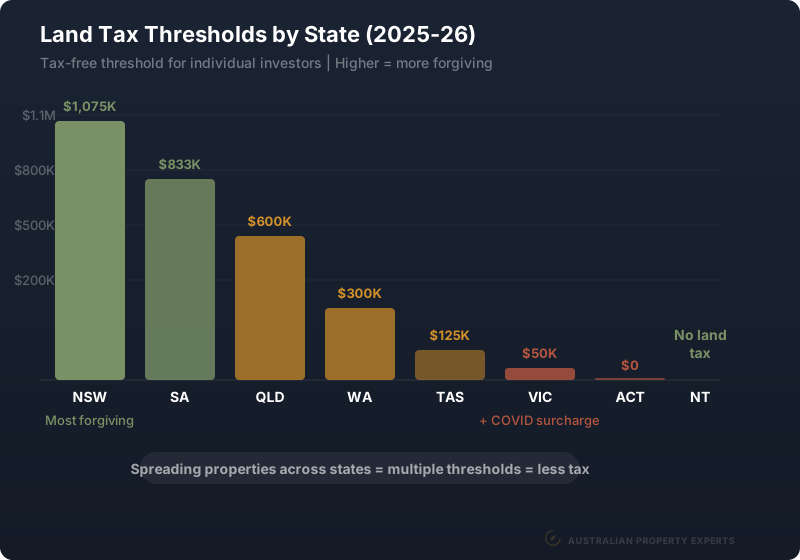
The rules are different in every jurisdiction. Thresholds range from $50,000 in Victoria to $1,075,000 in NSW. Victoria’s COVID debt surcharge is legislated to 30 June 2033. NSW fixed its thresholds from 1 January 2025, so bracket creep is now a structural cost for NSW investors. And the Northern Territory still doesn’t levy land tax at all.
The breakdown below goes state by state.
How land tax works for investors
Land tax is calculated on the unimproved land value of your investment properties, not the total property value. A house worth $700,000 might sit on land valued at $400,000 by the Valuer General. That $400,000 figure sets your land tax.
Your principal place of residence is exempt in every state. But every other property you own counts. That includes investment properties, vacant land, and holiday houses.
The critical rule for portfolio builders: all your investment properties within one state are aggregated. If you own three properties in NSW with land values of $300,000, $350,000, and $500,000, the total taxable land value is $1,150,000. That pushes you $75,000 over the NSW threshold and triggers land tax on the excess.
This is why we buy across multiple states. Each state has its own threshold. Two properties in different states each get their own tax-free threshold. Two properties in the same state share one.
The state-by-state comparison
| State | Tax-free threshold | First rate above threshold | Top marginal rate |
|---|---|---|---|
| NSW | $1,075,000 (frozen) | 1.6% | 2.0% (premium) |
| SA | $936,000 (2026-27), $25,000 for trusts | 0.5% | 2.4% |
| QLD | $600,000 (individuals) / $350,000 (trusts and companies) | 1.0% individuals, 1.7% trusts and companies | 2.25% individuals, 2.75% trusts and companies |
| WA | $300,000 (+ 0.14% metro MRIT) | Flat $300 to $420,000, then 0.25% | 2.67% |
| TAS | $125,000 | 0.45% | 1.5% |
| VIC | $50,000 | Flat $500 to $975 | 2.65% (COVID surcharge included) |
| ACT | No threshold; fixed charge $1,778 (2026-27) | 0.54% | 1.26% |
| NT | No land tax | Nil | Nil |
Compare land tax across all states for individuals, trusts, SMSFs, and companies.
Use the calculator →
NSW land tax threshold: $1,075,000
Revenue NSW sets the highest tax-free threshold in the country at $1,075,000. You can own one or two investment properties without paying any land tax at all, as long as the combined land value stays under that figure. Above the threshold, you pay $100 plus 1.6% of the excess. The premium rate of 2.0% kicks in above $6,571,000.
The catch is that Revenue NSW fixed both thresholds from 1 January 2025. There’s no annual indexation. Every year of land-value growth pushes more of your portfolio above the line while the threshold stays put. Over a ten-year hold, that bracket creep becomes a cost you pay every year.
If each property carries $300,000 to $500,000 of land value, two of them total $1 million at most and sit under the threshold. Property three is where NSW land tax starts to bite. The frozen threshold means that day arrives sooner than it did before 2025.
The threshold was $969,000 for the 2023 land tax year and has sat at $1,075,000 since 2024. The NSW Treasurer is due to review it by 1 June 2027.
Revenue NSW compares the threshold with the average of your land values over three years, which softens a single big revaluation. It counts only what you own at midnight on 31 December. A purchase that settles in early January is not counted until the following 31 December.
Victoria land tax rates: a $50,000 threshold
Victoria sits at the tough end. The State Revenue Office threshold is just $50,000. Almost every investment property in the state triggers land tax from day one. There’s no grace period.
The COVID debt surcharge is built into the current rates from the 2024 land tax year. It adds a flat $500 on land from $50,000 to $100,000 and a flat $975 above that. From $300,000, the rate also rises by 0.10 percentage points. It is legislated to 30 June 2033. Absentee owners pay a further 4% surcharge. Properties held in trusts pay trust surcharge rates.
The combined effect: an investment property with a land value of $500,000 in Victoria costs $1,950 a year in land tax ($1,350 plus 0.3% of $200,000). The same land value in NSW costs nothing, because it’s under the threshold. In QLD, also nothing, as it’s under the $600,000 threshold.
If you’re entering Victoria now, factor land tax into your cash flow modelling from day one. It isn’t a surprise cost, but it’s an easy one to underestimate from interstate.
Who pays land tax in Victoria
Whoever owns taxable land in Victoria at midnight on 31 December pays land tax for the year that follows. The State Revenue Office adds up the site values of all the taxable land you own at that moment and assesses the total. Your own home is exempt. Land tax applies to investment properties, commercial property and vacant land.
If you settle on 2 January, the seller still owned the land on 31 December, so you aren’t assessed on it for that year. Your first assessment comes the following year.
Queensland land tax threshold: $600,000, with a trust trap
The Queensland Revenue Office sets the individual threshold at $600,000. That’s enough room for one or two properties with modest land values to sit under it. Above the threshold, an individual pays $500 plus 1% of the amount over $600,000, up to $1 million. Higher rates apply above that, with a top rate of 2.25% above $10 million.
One important structural detail: QLD’s threshold for trusts and companies drops to $350,000, with rates starting at 1.7%. If you’re holding QLD investment properties in a family trust, you’ll hit the land tax threshold much sooner than the individual numbers suggest. Discuss the structuring implications with your accountant before settling.
QLD only taxes land you own in Queensland. Your NSW or VIC land holdings don’t get folded into your QLD calculation.
Western Australia: low threshold, low rates
RevenueWA sets a threshold of $300,000. That’s relatively low. But the tax starts at a flat $300, and the first marginal rate is just 0.25%. On a single investment property with $300,000 to $500,000 of land value, land tax runs from nil to $500 a year. At $500,000 that’s $300 plus 0.25% of $80,000.
WA’s rates rise progressively to a top rate of 2.67% for land values above $11 million. It only affects large portfolios or commercial investors.
One add-on Perth investors miss: the Metropolitan Region Improvement Tax (MRIT) is a separate 0.14% levy on metro land above $300,000. It funds land for roads, parks and open space. The levy sits on top of the standard land tax bill. On $500,000 of Perth land it adds $280.
South Australia: high threshold, indexed annually
SA’s threshold of $936,000, indexed for 2026-27, is the second-highest after NSW. At $300,000 of land each, three Adelaide properties total $900,000 and still sit under the threshold.
Unlike NSW, SA indexes its thresholds annually based on the Valuer-General’s land value movement. SA gazetted the 2026-27 thresholds on 4 June 2026. If site values fall, the thresholds stay put, which softens bracket creep over time. Above the threshold, rates start at 0.5% and rise progressively to 2.4%. Trusts are the exception, with trust rates from a $25,000 threshold. For individuals, SA is one of the more forgiving systems for building a portfolio in one state.
Tasmania and ACT
Tasmania’s threshold is $125,000. It’s low enough that most investment properties trigger some land tax. The rates start at $50 plus 0.45% above the threshold. Above $500,000 of land value, the bill is $1,737.50 plus 1.5% of the excess.
The ACT has no tax-free threshold. Every investment property pays land tax, calculated as a fixed charge ($1,778 from 1 July 2026) plus a rate based on the average unimproved value. The flip side: the ACT is phasing out conveyance duty over time, so you pay less upfront but more annually. Our stamp duty calculator covers every state if you want the upfront half of that trade-off in dollars. Over a ten-year hold in the ACT, more of your tax cost comes from holding the property than from buying it.
The Northern Territory does not levy land tax on any property. It’s the only jurisdiction with no land tax for investors. That doesn’t make NT a default buy. But if your portfolio is concentrated in higher-tax states, a Darwin or Alice Springs purchase can pull the average land tax bill down.
The multi-state portfolio advantage
Each state calculates land tax independently. Put $400,000 of land value in NSW and $400,000 in QLD. You’re under the threshold in both states and pay zero land tax in either. The same $800,000 of land value concentrated in QLD pushes you $200,000 over the threshold. That costs $2,500 a year ($500 plus 1% of $200,000). We have worked the four-property version of this through in how to reduce land tax on investment property, including the trust traps.
For investors building a portfolio across multiple states, this is a structural advantage. Three properties across three states might pay zero or minimal land tax. Three Victorian properties with $400,000 of land each ($1.2 million combined) cost $6,450 a year. That’s $4,650 plus 0.9% of $200,000. If you want help buying interstate, here’s whether a buyers agent is worth it.
It isn’t the only reason to spread geographically, but it’s a meaningful one that compounds as the portfolio grows. Our land tax calculator lets you model the difference between the two paths on your specific land values.
Worked example: where to buy property four
Take an investor with three properties already held: one in Sydney (land value $480,000), one in Brisbane (land value $410,000), and one in Adelaide (land value $290,000). All three sit below their respective thresholds today. The annual land tax bill is zero.
Now they want to add a fourth investment property with a $400,000 land value. Where it lands matters more than most investors realise:
- Add it in NSW: combined NSW land $880,000, still under the frozen $1.075M threshold. Land tax stays at zero, but only $195,000 of land value growth tips you over.
- Add it in QLD: combined QLD land $810,000, $210,000 over the individual threshold. First year land tax is $2,600 ($500 plus 1% of $210,000).
- Add it in SA: combined SA land $690,000, still $246,000 under the $936,000 threshold. Land tax stays at zero, with SA indexation softening any future creep.
- Add it in VIC: that $400,000 alone triggers $1,650 a year from day one ($1,350 plus 0.3% of $100,000, COVID surcharge included). No threshold protection at all.
With the same property value and yield, the annual land tax ranges from zero to $2,600 depending on the state. Once you hold a few properties, land tax becomes part of deciding which state to buy in.
Is land tax tax deductible?
Yes, on an investment property. If you earn rent from it, the ATO lets you claim the land tax as a deduction. You claim it in the income year the liability relates to, not the year you pay it. If you pay land tax in arrears for an earlier year, you amend that year’s return. When you sell, any land tax adjustment you receive at settlement counts as rental income.
On a $3,000 annual land tax bill at a 37% marginal rate, the after-tax cost is roughly $1,890.
Factor land tax into your holding costs
Work it out before you buy. When comparing properties across states, add the annual land tax to your holding cost calculation alongside rates, insurance, management fees, and maintenance. For a full picture of holding costs and tax deductions, speak to a property-focused accountant.
Thresholds and rates verified against the state revenue offices linked in each section above. Last fact-checked 26 September 2026. Check the relevant state revenue office for the latest published figures before relying on them.
This is general information only and not financial or tax advice. Land tax thresholds and rates change annually. Confirm all figures with your accountant or the relevant state revenue office before making investment decisions.
For how land tax stacks up against stamp duty over a full hold, see our model of the ten-year state tax cost in every capital.
See how we build multi-state portfolios for investors.
If you’re building a multi-state portfolio and want to understand how land tax affects your strategy, book a free discovery call.
Thresholds and rates refreshed 26 September 2026 and checked against our land tax calculator, RevenueSA and the ACT Revenue Office. SA and the ACT both index on 1 July, so this table reflects the 2026-27 year.