Depreciation is one of the most valuable tax deductions available to Australian property investors. Yet many claim interest and rates without a second thought and skip depreciation entirely because it feels complicated. A quality depreciation schedule can add anywhere from a few hundred to several thousand dollars back into your pocket each financial year. It arrives as reduced tax. For negatively geared investors trying to manage holding costs, that matters.
This guide explains how depreciation works, what you can claim, and why getting a proper schedule done is almost always worth the cost.
What property depreciation is
Depreciation is the natural wear and tear of a building and its fixtures over time. The ATO allows property investors to claim this wear and tear as a tax deduction, even though no cash actually leaves your account. Take a brand new oven installed in your rental property. It won’t last forever. The ATO recognises that it loses value each year and lets you deduct a portion of that decline in value against your taxable income.
Depreciation claims come in two categories.
Division 43: capital works
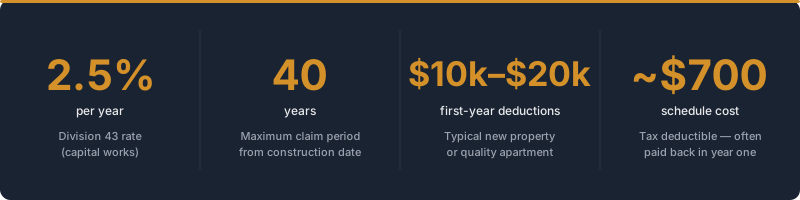
Division 43 covers the structural components of the building itself. Think the concrete slab, brickwork, roof, internal walls and fixed structural items like built-in wardrobes and kitchen cabinets. The ATO allows investors to claim 2.5% of the original construction cost each year, for up to 40 years from the date construction was completed. A property that cost $300,000 to build could generate $7,500 per year in Division 43 deductions alone. That assumes construction commenced after 15 September 1987.
Construction date matters here. Homes where construction started before 18 July 1985 are not eligible for Division 43 at all. Those started between 18 July 1985 and 15 September 1987 get 4% a year, but only for 25 years, so those claims have run out. Always check before assuming.
Division 40: plant and equipment
Division 40 covers the removable assets within a property. Dishwashers, air conditioning units, hot water systems, carpets, blinds, ceiling fans, and similar items all fall under this category. Each item has its own effective life, set by the ATO. Items depreciate under either the prime cost or diminishing value method. A split-system air conditioner has an effective life of 10 years. Carpet bought from 1 July 2019 is eight years.
Legislation changes in 2017 significantly affected who can claim Division 40 on second-hand assets. If you bought a residential rental property after 7:30pm on 9 May 2017, you generally cannot claim the plant and equipment already in it. That applies with or without tenants. You can only claim assets you buy new and install yourself. Exceptions cover investors running a rental business and entities such as companies. Ask a qualified quantity surveyor and your accountant here. The rules are specific. Getting them wrong flows through your tax returns for years.
Why investors under-claim depreciation
The ATO does not provide depreciation schedules. Your accountant can only claim what they can substantiate. Without a formal schedule from a qualified quantity surveyor, most items go unclaimed.
A quantity surveyor physically inspects the property and identifies every claimable asset. They estimate each asset’s value at the time of inspection and produce a schedule your accountant can use directly. The surveyor is also trained to identify original construction costs and apply the right depreciation methods to each asset class. Most accountants will not estimate plant and equipment values themselves, because that is a quantity surveyor’s job.
A depreciation schedule typically costs about $600 to $800 for a standard residential property. Washington Brown, for example, lists $590 to $770 for an established home. The ATO lets you deduct the fee. For investors in higher tax brackets, the first-year depreciation claim alone often returns several times the cost of the report.
How much can you actually claim?
It varies based on the age of the property, construction quality, and what fixtures are included. Our depreciation calculator works it out from the construction cost, the construction and settlement dates, and the fittings you paid for. Here are some general ranges for scale.
As a rough guide, a brand new house or townhouse might generate $10,000 to $20,000 of deductions in the first year. The claims taper off as assets reach the end of their effective lives. In one BMT case study, a new $730,000 house produced $15,500 in its first full financial year. A newer apartment with quality finishes can produce similar numbers.
An older property whose construction started after 15 September 1987, but not recently renovated, will generate more modest claims. Most of it comes through Division 43 at 2.5% of construction cost. Plant and equipment claims stay limited unless the owner has upgraded fixtures.
A property built before September 1987 with no renovations may have almost nothing claimable. Older properties can still be good buys, because established suburbs often outperform on capital growth. Just expect a smaller depreciation claim.
New properties vs established properties
New properties have a clear depreciation advantage. Every item is brand new and claimable at full value. You also know the construction cost. Off-the-plan purchases often come with a depreciation schedule from the developer’s quantity surveyor as part of the settlement package.
But higher upfront depreciation does not automatically make a new build a better investment. The depreciation benefit typically offsets the developer premium built into the purchase price. Established properties on good land size tend to outperform on capital growth over time.
Established properties are more nuanced. Division 43 claims are still available if construction started after 15 September 1987 and the 40 years have not run out. Any renovations completed by the current or previous owner can add claimable construction costs. A $50,000 kitchen renovation by the previous owner, for example, restarts the clock on the structural components of that work. If you have renovated an investment property yourself, make sure your quantity surveyor knows about all works completed and approximate costs. It directly affects what you can claim.
How depreciation affects your cash flow
Depreciation is a non-cash deduction. You are not actually spending money, but the ATO treats it as an expense against your rental income.
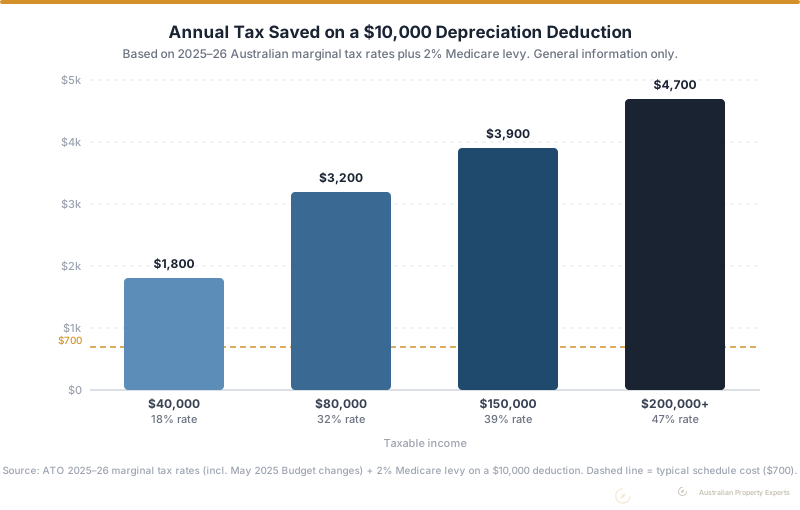
An investor on $80,000 taxable income who claims $10,000 in depreciation drops to $70,000. At the 30% marginal rate plus the 2% Medicare levy under the 2026-27 rates, that’s $3,200 back in real tax savings. It’s about four times the cost of a depreciation schedule. An investor on $200,000-plus saves $4,700 on the same deduction. Even at the lower end of the tax brackets, the return typically exceeds the schedule cost in year one.
That assumes the deduction can reduce your other income. From 2027-28, rental losses on an established home bought after 7:30pm on 12 May 2026 cannot. They carry forward against residential rental income and gains instead (Act No. 49 of 2026). New builds and homes bought before that time keep the old treatment.
For negatively geared investors, this effect compounds. The combination of interest deductions, property expenses, and depreciation can reduce the real after-tax cost of holding a property well below what the headline numbers suggest. Our post on capital growth vs rental yield covers how holding costs affect strategy in more detail. The case studies page shows the full return picture on real client purchases.
See how depreciation reduces your after-tax holding costs. Adjust the depreciation amount to compare scenarios.
Use the calculator →
Getting your schedule done right
A few practical things worth knowing before you engage a quantity surveyor.
You only need one schedule per property. A well-prepared schedule covers the entire depreciation life of the property, typically 40 years, and is valid for as long as you own it. You don’t pay again each year.
Say your existing schedule is several years old and you have completed renovations since then. You will need an updated report or an addendum to account for the new works.
Use a quantity surveyor who is a member of the Australian Institute of Quantity Surveyors (AIQS). Credentials matter here because the ATO can audit depreciation claims. A poorly prepared schedule creates real risk.
Make sure your accountant receives the schedule before your return is lodged. Adding depreciation retrospectively means filing an amendment. That brings extra work, delays, and occasionally scrutiny you do not need.
What about SMSF-owned properties?
SMSFs that own investment properties can also claim depreciation. The same Division 40 and Division 43 rules apply. The key difference is the tax rate. Super funds are generally taxed at 15% in accumulation phase. So each dollar of depreciation delivers less cash benefit than it would for an investor on the top marginal rate. It still reduces the fund’s tax liability. Factor that into your SMSF property analysis.
At Australian Property Experts, commissioning a depreciation schedule is part of the post-purchase checklist we run through with every client. Getting it done in your first financial year of ownership means you do not lose a year of claims. Depreciation is one part of building a property portfolio that covers its costs.
For how the Division 43 column comes back at sale, with the dollar figures, see how much capital gains tax you pay on an investment property.
This is general information only and not financial or tax advice. Speak to your accountant or a qualified quantity surveyor about how depreciation applies to your specific property.
See how we pick properties where the full return stacks up.
If you want to talk through how we approach property selection and the full picture of investor returns, book a free discovery call.