Hobart’s median prices still sit below their 2022 peak, and it is not alone in that: Melbourne never retook its March 2022 high through the 2024-26 upswing either. Values fell 10-12% through the correction and had clawed back around 6% entering 2026, leaving the market 7-9% below peak at that point. At the same time vacancy sits at 0.4% (SQM, March 2026) and rent growth is leading the country at 12.5%.
Hobart has kept moving since. Its median dwelling value is $756,951, up 9.3% over the year and 1.4% over the quarter, on Cotality’s Home Value Index released 3 August 2026, covering July. It is one of the few capitals still rising over the quarter while Sydney and Melbourne fall.
That combination, suppressed prices and severe rental tightness, is why the best suburbs to invest in Hobart 2026 deserve a fresh look rather than a copy-paste from last cycle’s list.
How we picked these five
Five suburbs, all inside Greater Hobart, screened on four filters: median price under $800K so the numbers remain workable for a typical investor, gross yield above 4% so the cash flow covers a meaningful share of holding costs, vacancy under 1%, and exposure to at least one of the structural drivers lining up for the next cycle. The drivers we care about are Macquarie Point stadium ($1.13 billion, approved, targeting 2030 completion), the UTAS city campus move into The Forest building for Semester 1 2026, and the federal + state infrastructure pipeline feeding the northern corridor.
We picked houses on decent blocks, not apartments. Hobart has historically been a thin market for unit stock and houses hold the better growth and reno optionality.
Claremont (7011)
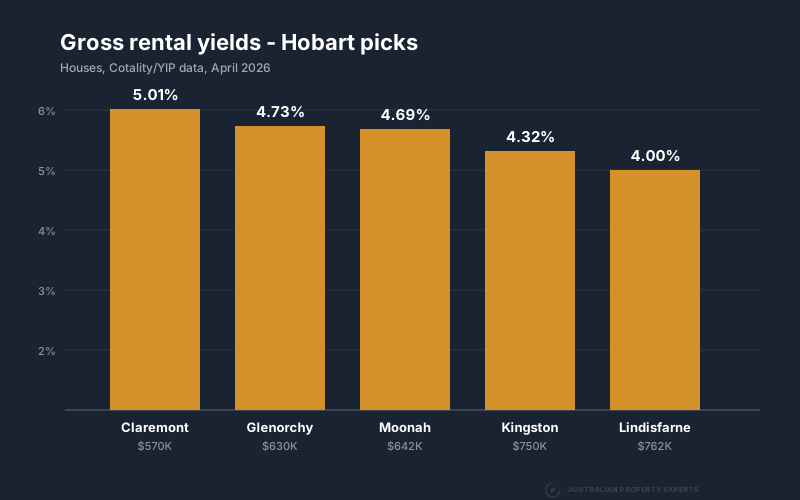
Median house price: ~$570,000 Gross rental yield (houses): ~5.0% Median weekly rent: ~$550 12-month growth (houses): ~9.6%
Claremont is the most affordable house-suburb entry point inside Greater Hobart that still has a real tenant pool. At $570,000 with a 5% yield, a $550 weekly rent covers more of your IO holding costs than anything else on this list.
The suburb sits 15km north of the Hobart CBD in the Glenorchy LGA, with the Brooker Highway running straight down to the city. Housing stock is predominantly 1960s-1980s brick on 600-700sqm blocks, which is the exact profile we look for: structurally sound, visually dated, ready for a cosmetic reno that can force $30,000-$50,000 in equity. For how that equity cycle feeds the next purchase, see our portfolio building guide.
The trade-off is demographic. Claremont has historically been softer than suburbs closer to the CBD and the yield reflects that discount. But with Hobart vacancy at 0.4%, rent growth leading the country, and the northern corridor carrying the lowest entry price in any Australian capital, the math is doing the heavy lifting here.
Glenorchy (7010)
Median house price: ~$630,000 Gross rental yield (houses): ~4.7% Median weekly rent: ~$573 Vacancy: below 1%
Glenorchy is the administrative and retail hub of the northern corridor. Northgate Shopping Centre, the MONA ferry terminal at Wilkinsons Point, and the main bus interchange all sit in the suburb. It’s 8km north of the Hobart CBD, close enough for city workers who don’t want to pay inner-ring prices.
At $630,000 with a 4.7% yield, Glenorchy gives you a more stable tenant base than Claremont without giving up much yield. The MONA proximity matters: it’s one of the handful of cultural anchors that pulls out-of-state demand, short stays, and hospitality employment into the northern corridor.
Glenorchy City Council has also been the most active of the Hobart LGAs on planning reform, with infill zoning changes through 2025 and 2026 that favour investors holding older houses on 600sqm+ blocks. Subdivision and granny-flat potential becomes a real lever here over a 5-10 year hold.
Moonah (7009)
Median house price: ~$642,000 Gross rental yield (houses): ~4.7% Median weekly rent: ~$579 Days on market: ~14
Moonah is the suburb most often compared to Brunswick in Melbourne or Marrickville in Sydney a decade ago: inner-north, industrial heritage, food scene turning over, creative tenant base moving in. It’s 5km from the CBD on the main arterial and sits inside the Glenorchy LGA.
At $642,000 the entry is higher than Claremont or Glenorchy but the location earns the premium. Houses spend around 14 days on market, which tells you demand is deep enough that a decent property doesn’t linger. The tenant mix skews younger professionals, hospitality, and university-linked, which typically means 12-month leases and lower turnover.
What matters for 2026 is the UTAS shift. The university is moving the Schools of Business and Economics, Humanities and Social Sciences into The Forest building in the CBD for Semester 1 2026. Moonah is five minutes up the road. Student and staff rental demand that previously concentrated in Sandy Bay now has a cheaper, better-connected option through Moonah.
Kingston (7050)
Median house price: ~$750,000 Gross rental yield (houses): ~4.3% Median weekly rent: ~$618 Vacancy: ~0.8%
Kingston is the southern suburb that behaves more like a satellite city than a commuter belt. It has its own shopping centres, a beach, the Kingborough Council offices, and a school catchment that parents actively target. The Southern Outlet connects Kingston to the Hobart CBD in about 15 minutes.
At $750,000 with a 4.3% yield and $618 weekly rent, Kingston is the most expensive suburb on this list but it pulls a different tenant demographic: families on 12-24 month leases, professionals working from home, and southern-corridor CBD commuters. Vacancy at 0.78% is tighter than the Hobart average.
The argument for Kingston is tenant quality and growth stability, not yield. If your portfolio strategy is balanced growth and yield rather than pure cash flow, Kingston belongs in the mix. The trade-off is less reno upside than the northern corridor suburbs, because housing stock includes a meaningful share of 1990s-2010s builds that already have modern kitchens and bathrooms. Look for the older stock on larger blocks if you want the reno lever to work.
Lindisfarne (7015)
Median house price: ~$762,000 Gross rental yield (houses): ~4.0% Median weekly rent: ~$586 LGA: Clarence
Lindisfarne sits on the eastern shore, a 10-minute drive from the CBD across the Tasman Bridge. It has a small village centre on the waterfront, a sailing club, and genuine water access. The tenant pool is split between CBD workers, airport-linked workers (Hobart Airport is a 15-minute drive), and lifestyle renters.
At $762,000 with a 4% yield this is the lowest-yielding pick on the list, which makes it an outlier on a cash flow screen. It earns its place because of the eastern-shore growth profile and the ferry network expansion. Tasmania’s commuter ferry network has been building out since 2022 and the eastern-shore stops, including Lindisfarne, reduce the CBD commute even further when the Tasman Bridge is congested.
Use Lindisfarne as a quality anchor, not a yield play. One Lindisfarne house alongside two northern-corridor houses gives you a balanced Hobart exposure: growth + yield + tenant quality, across three LGAs.
The quick comparison
| Suburb | Median | Yield | Weekly rent | Angle |
|---|---|---|---|---|
| Claremont | ~$570K | ~5.0% | ~$550 | Most affordable house entry, reno stock |
| Glenorchy | ~$630K | ~4.7% | ~$573 | Northern hub, infill reform |
| Moonah | ~$642K | ~4.7% | ~$579 | Inner-north, UTAS spillover |
| Kingston | ~$750K | ~4.3% | ~$618 | Southern satellite, family tenants |
| Lindisfarne | ~$762K | ~4.0% | ~$586 | Eastern shore, quality anchor |
Hobart market context 2026
Hobart is the only capital still below its 2022 peak. The correction ran from March 2022 to late 2024 and took around 10-12% off values. Recovery started through 2025 as the RBA eased, and the major banks are now forecasting 2-4% growth for Hobart in 2026 (ANZ 3.8%, NAB 3.6%, Westpac 4.0%, CBA 2.0%).
What matters for an investor is the combination. Vacancy at 0.4% (SQM, March 2026) is the second-tightest capital city in the country. Rent growth leading the nation at 12.5%. Medians still below peak. That’s the trifecta we looked for in Adelaide two years ago and it’s the same structural setup now, at a lower entry point.
The Macquarie Point stadium at $1.13 billion has federal funding confirmed, parliamentary approval, and a 2030 completion target. Construction starts in 2026-27. Whatever anyone’s views on the AFL licence trade, the infrastructure spend around Mac Point is real capital flowing into the waterfront precinct over a 4-year window. The UTAS shift into The Forest in the CBD for Semester 1 2026 is the other near-term driver: student and staff demand relocating from Sandy Bay into city and inner-north rental markets.
If you’re comparing Hobart against the larger capitals, read the capital growth vs rental yield piece first. Hobart is a yield-forward market in this cycle, not a growth-forward one, and the right portfolio mix depends on where you are in your journey.
What to avoid in Hobart
Sandy Bay houses as a first-time investor buy. Median houses in Sandy Bay run into the high six figures and yields sit in the 3% range. It’s an owner-occupier suburb with an investor premium that’s hard to justify on the numbers.
Off-the-plan apartments anywhere on the Hobart waterfront. The pipeline of new apartment stock has a history of settling below contract price and the rental yields on new units are thin. Hobart rewards older established houses on decent blocks, not new-build units.
Buying for the stadium alone. Macquarie Point is real but the delivery risk is also real: the timeline has already been revised to 2030, costs have climbed from $715 million to $1.13 billion, and construction hasn’t started. Treat the stadium as one of several drivers, not the thesis.
Foreign investor duty surcharge. Tasmania charges an 8% surcharge on foreign buyers of residential property. If you’re buying through a structure with any foreign ownership, run the numbers with your accountant before committing.
Over-exposure to one LGA. Glenorchy, Hobart City, Clarence, and Kingborough have different zoning, different council rates, different tenant demographics. A Hobart allocation sitting entirely inside Glenorchy LGA is a concentration risk, not a diversified play.
Where Hobart fits in a national portfolio
Hobart right now is what Adelaide was in 2022: post-correction, tight vacancy, affordable entry, early in the next cycle. For an investor building a national portfolio, the case is exposure to a yield-strong market that hasn’t run yet, at a price point where the numbers still close.
If you’re buying interstate into Tasmania, the difference between the right street in Moonah and the wrong street in Claremont is thousands of dollars a year in rent and tens of thousands in resale. A local Hobart buyers agent who knows which pockets work is the cheapest part of the trade. The affordable markets over blue chip thesis fits Hobart particularly well in this cycle. For the northern end of the state, where yields run higher on lower entry prices, see our Launceston market analysis. For real examples of that thesis at work, see our case studies.
This is general information only and not financial advice. Market data reflects conditions at time of writing (April 2026) and may have changed. Speak to a qualified professional before making investment decisions.
See how we buy affordable, high-yield properties for investors.
If you want to discuss which Hobart suburbs fit your budget and strategy, book a free discovery call.