
Auction vs private treaty is a question that comes up with every investment property purchase. Capital city clearance rates slid from around 66% in February to the low 40s by the end of July, on Cotality’s figures. They have only recovered to the low 50s since. That tilts the answer toward private treaty.
How each method works
In a private treaty sale, the vendor lists a price or range. You inspect the property, submit a written offer with conditions attached, and negotiate from there. If you reach agreement, you sign a contract that usually comes with a cooling-off period. NSW and Queensland give you 5 business days. Victoria gives you 3 clear business days. Pulling out costs 0.25% of the price in NSW and up to 0.25% in Queensland. In Victoria it is $100 or 0.2%, whichever is greater. Other states and territories set their own rules, so check where you are buying.
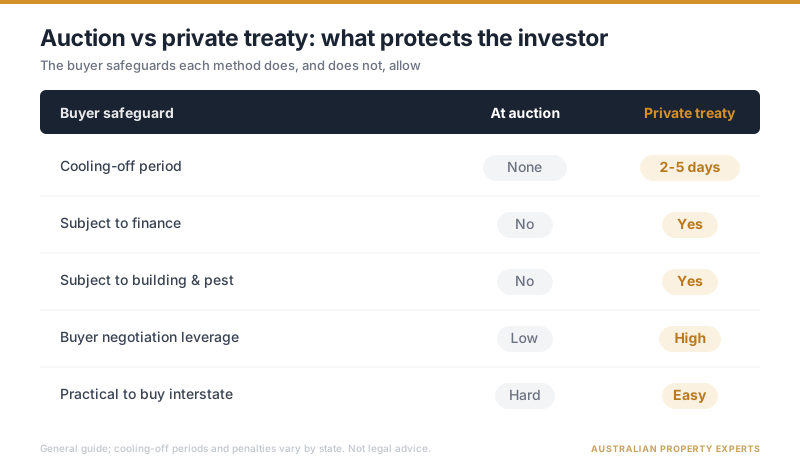
At auction, the vendor sets a confidential reserve price. Bidders compete openly on the day. If the highest bid meets or exceeds the reserve, the property sells unconditionally. There is no cooling-off period and no conditions, so nothing is subject to finance or a building inspection. The successful bidder signs immediately and is committed.
For vendors, auction creates urgency and competition. For investors buying with borrowed money on properties they may never have physically inspected, that same dynamic introduces real risk.
Auction risks investors miss
The purchase price is only part of what you pay at auction. The rest is what most investors underestimate.
No conditions. Buying at auction strips away your safety net. NSW, Victoria and Queensland all rule out a cooling-off period for auction sales. You cannot make the sale subject to finance approval or a satisfactory building and pest inspection. If the property has $40,000 in structural defects behind the walls, that is your problem the moment the hammer falls.
Due diligence costs up front. You cannot add conditions after the sale. So the building and pest inspection, strata report and contract review all happen before auction day. If you do not win, those costs are sunk. A building and pest report typically runs $400 to $800 depending on the property. Across two or three unsuccessful auctions, that money is gone.
Bidding psychology works against you. Auctions are designed to create emotional pressure. Two or three active bidders can push a price well above what the property would have settled at through private negotiation. On a $500,000 investment property, 5% overpayment is $25,000 of dead equity that earns you nothing and costs you interest every year you hold it.
Interstate buying gets harder. If you are buying investment property interstate, attending an auction means flights, accommodation and time off work. A buyers agent can bid for you and read the room on the day, so you do not have to fly in. For investors building a portfolio across multiple states without that help, this is a real friction point.
Private treaty gives you control
Private treaty sales put the negotiation leverage in the buyer’s hands, especially in a market like this one.
Conditional offers protect you. You can make your purchase subject to finance, subject to a satisfactory building and pest inspection, and subject to a valuation. If any of those fail, you walk away with your deposit. This is not a minor detail when you are borrowing 80% of the purchase price.
Cooling-off gives you a window. In NSW, Victoria and Queensland, a private treaty contract comes with a cooling-off period even after you sign. That time lets you confirm finance, review inspection results and get your accountant or financial adviser to check the numbers.
You control the negotiation. There is no countdown clock and no crowd watching. You submit an offer, wait for the vendor’s response, counter, and take your time. Cotality’s national median vendor discount widened to 3.8% over the three months to July, which gives buyers who do their homework real room to move. A buyers agent with strong comparable sales data can negotiate a saving bigger than their fee.
Off-market deals are private treaty. The best-value opportunities often never hit the portals. They trade through agent networks as off-market private treaty sales. No auction campaign, no competing bidders, just a direct negotiation between your buyers agent and the selling agent.
Clearance rates in 2026
A weak auction year hands leverage to buyers. Cotality’s combined capital city clearance rate fell from around 66% in February to the low 40s by the end of July. In the week ending 13 September it recovered to 52.6%, the strongest result in 19 weeks. That still means nearly half the homes taken to auction fail to meet their reserve. Cotality says clearance rates remain well below year-ago levels (Cotality final clearance rates, week ending 13 September 2026).
Brisbane has been the weakest capital, with its clearance rate below 40% since late May. Across the capitals, auction volumes are running well below the same time last year as fewer vendors choose the format. When auctions stop clearing, more vendors accept an offer before auction day or list by private treaty instead.
Cotality says vendors are continuing to favour private treaty over auction, because buyers have more leverage.
When auction works for investors
Private treaty is not always the better call. There are situations where buying an investment property at auction makes sense.
Tightly-held suburbs with low turnover. When a property in your target area comes up once every 10 years, auction might be the only way to secure it. Waiting for a private treaty listing could mean waiting years.
When your due diligence is done. Say you have finished the building and pest inspection, had your conveyancer review the contract, and confirmed finance pre-approval. Then the unconditional nature of auction carries less risk. You are buying informed.
Properties priced well below your limit. Say a property is guided well under your ceiling and the competition looks thin. You can set a firm walk-away number and bid with discipline. The key word is discipline. If you go past your number, the auction has won.
Hot markets with multiple private offers. In a fast-moving market where private treaty listings attract 10 offers on the first weekend, auction at least gives you an open process. You see what others are willing to pay. With competing private offers, you are negotiating blind.
But look at the current data. Clearance rates are only just above 50%, so nearly half of auctioned homes still fail to sell under the hammer. This is not a market where investors need to compete at auction to find good deals. The leverage sits with buyers. Private treaty is where you use it.
Picking the right method
For most investors buying affordable established properties outside Sydney and Melbourne’s inner rings, private treaty is the default. And it should be.
It gives you conditional offers, cooling-off protection, time for proper due diligence, and negotiation leverage. In the current environment, with clearance rates only just above 50%, close to half the vendors who go to auction pass in or withdraw.
If you are building a portfolio across multiple states, which is the right approach because the best opportunity is rarely in your home city, private treaty is significantly more practical. You can negotiate remotely, include the conditions you need, and settle without flying interstate for an auction that might not proceed.
At APE, 86% of the properties we buy for clients come from off-market channels. Those are private treaty sales by nature. In affordable markets, the properties that deliver both growth and yield are typically sold that way.
The method you buy through matters less than what you buy and whether you have done the work before you commit. But when the market hands you this much negotiation leverage, private treaty is where you use it.
This is general information only and not financial advice. Speak to a qualified professional before making investment decisions.




_(4552536456).jpg)