Newcastle is midway through a structural pivot. The largest port on the East Coast has a $2.4 billion container terminal planned. The Hunter Valley Hydrogen Hub cleared its final investment decision on 1 July 2026 and is now under construction. It has $70 million from the Commonwealth and $45 million from NSW, plus $432 million from ARENA in production credits once it is running. An offshore wind zone was declared off the coast in July 2023. And construction of the new acute services building at John Hunter Hospital, part of an $890 million redevelopment, is now complete.
In Newcastle, affordable inner-ring houses and lake-adjacent family suburbs are where the fundamentals stack up. This post walks through five suburbs, the numbers behind each and the risks worth thinking about before you buy.
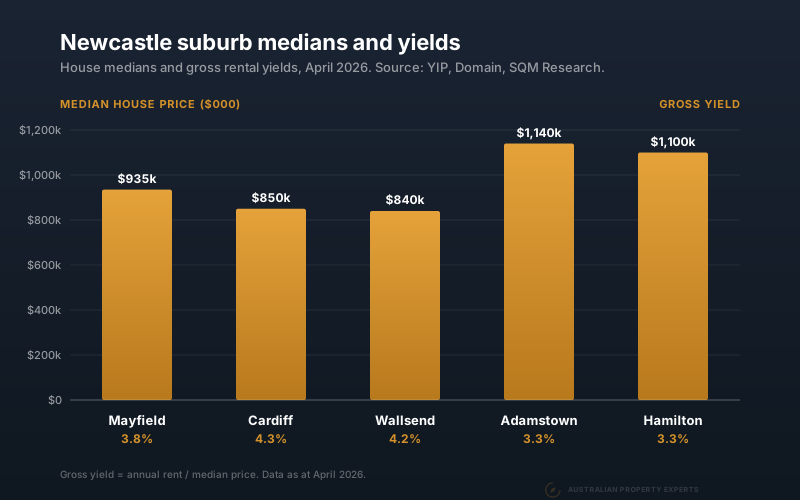
Medians, growth and sale counts below are CoreLogic house data via Your Investment Property for the 12 months to 30 June 2026. Rents are to 31 August 2026. Every figure was re-checked against the live suburb profiles on 26 September 2026. Yields are computed from those two figures (median weekly rent x 52 / median price). That keeps them consistent across all five suburbs, so you can check them yourself. Links to each profile are at the bottom.
How these suburbs were chosen
Every suburb here passed the same four tests. The median house price sits well below Merewether’s $2,137,500. The gross yield covers a meaningful share of holding costs. Vacancy is tight enough to support rent growth. And the suburb sits inside the Newcastle or Lake Macquarie LGAs, close to jobs or transport. Newcastle’s council area had 178,935 residents at June 2025. The five Greater Newcastle councils hold about 655,000. Tenant demand is spread across many employers.
The focus is established houses on decent blocks rather than new builds on the fringe or off-the-plan apartments. Older properties give you options later: cosmetic reno, granny flat, subdivision where zoning allows. For more on why this matters, see our note on affordable markets versus blue chip.
If you want the citywide context, fees and how we work in the Hunter, the Newcastle buyers agent page covers that in detail.
Mayfield 2304
Median house price: $1,050,000 Gross rental yield: 3.47% computed Median weekly rent: $700 12-month growth: +11.58% Distance to Newcastle CBD: ~5km
Mayfield is the inner-ring working-class suburb that has quietly become a yield-and-growth story. It is close to the University of Newcastle’s Callaghan campus and ten minutes from John Hunter Hospital. There’s a direct run to the port precinct too. The housing stock is a mix of weatherboard workers’ cottages and brick post-war on flat blocks.
The thesis here was that inner-ring Newcastle under $1 million was a narrowing category. That window has now closed. Mayfield grew 11.58% over the year to June 2026 and the median sits at $1,050,000. Houses still sell in 19 days on average, and the yield holds at 3.47%. It is no longer the lower-priced way into the inner ring.
Cardiff 2285
Median house price: $885,000 Gross rental yield: 4.00% computed Median weekly rent: $680 12-month growth: 8.92% Distance to Newcastle CBD: ~14km
Cardiff carries the strongest yield on this list, a fraction ahead of Wallsend. It sits on the Newcastle to Sydney rail line, which matters for tenant demand. The suburb is wedged between the Pacific Highway and the western edge of Lake Macquarie. Family-sized houses on 500 to 700 square metre blocks are standard.
Here the yield does the work. At 4.00% gross, the gap between rent and repayments is the narrowest of the five suburbs here. Cardiff grew 8.92%, the second slowest of the five after Hamilton. That is what you would expect from the pick that leans on income rather than growth.
Wallsend 2287
Median house price: $889,444 Gross rental yield: 3.86% computed Median weekly rent: $660 12-month growth: +11.18% Distance to Newcastle CBD: ~12km
Wallsend runs along the same corridor as Cardiff but closer to the John Hunter Hospital precinct. Construction of the new acute services building in the $890 million redevelopment is complete. Permanent medical, allied health and admin jobs follow once it is operating. That is tenant demand you can plan around.
At 3.86% it carries the second highest yield of the five, behind Cardiff on 4.00%. It did that while growing 11.18%. It is also the busiest of the five with 214 house sales in the year. That means the median is built on real depth rather than a handful of trades. Wallsend has flood overlays along Ironbark Creek and the suburb fringe, so contract review and insurance quotes matter here more than usual. Not a deal breaker, but a step you cannot skip.
Adamstown 2289
Median house price: $1,250,000 Gross rental yield: 3.12% computed Median weekly rent: $750 12-month growth: 16.28% Distance to Newcastle CBD: ~5km
Adamstown is the growth tilt on this list, and the numbers back it. It grew 16.28% over the year to June 2026, the fastest of the five. The entry price is now the highest here at $1,250,000. Its yield has compressed to 3.12%, the lowest of the five. The suburb sits on the rail line into Newcastle Interchange with beaches fifteen minutes east. Federation and inter-war houses on 500 to 650 square metre blocks dominate the established streets.
This is a growth-first position. You do not buy Adamstown for the yield. You buy it because lifestyle inner-ring Newcastle has shifted permanently post-pandemic. The buyer pool competing for these houses now includes remote workers, Sydney exits and local upgraders at the same time. For how growth and yield work together in a portfolio, see our guide to growth versus yield.
Hamilton 2303
Median house price: $1,150,000 Gross rental yield: 3.39% computed Median weekly rent: $750 12-month growth: +4.55% Distance to Newcastle CBD: ~3km
Hamilton is the Beaumont Street suburb. It has cafes, restaurants and a main street that actually has foot traffic on a Wednesday night. The housing is Federation and California bungalow on compact inner blocks. Beaches are ten minutes away and Newcastle Interchange is five, with Hunter New England Health facilities nearby.
The yield is close to Adamstown’s, but the growth is not. Hamilton put on 4.55% over the year to June 2026 against Adamstown’s 16.28%. That was off a price $100,000 lower and two kilometres closer to town. One year is not a trend. And 72 sales is a thin sample, so read it as a flag rather than a verdict. The risk with Hamilton is buying at the dearer end of this list in a small market. Entry timing matters more here than it does in Mayfield or Cardiff.
The market context underneath these numbers
Newcastle’s investment case rests on several structural shifts happening at once. No single project carries it.
The port is transitioning from a single coal export identity. The Port of Newcastle is planning the $2.4 billion Newcastle Deepwater Container Terminal, with capacity for 2 million containers (TEUs) a year. Contractual restrictions on a container terminal have been removed. The port says private investors are prepared to fund the full cost. Newcastle Airport now flies direct to Bali, with a same-plane connection on to Singapore. The Hunter offshore wind zone was declared on 11 July 2023, but no feasibility licence has been granted. The one licence offered, in February 2025, was declined.
Behind all of this sits the Hunter Valley Hydrogen Hub. $70 million from the Commonwealth, $45 million from the NSW government, and $432 million from ARENA paid as production credits once the plant is running. Orica took the final investment decision on 1 July 2026 and is targeting first production in early 2029.
None of this guarantees price growth. But it is the kind of infrastructure and jobs base that anchors long-term tenant demand in a way that resource-only regional cities cannot match. For how Newcastle compares to the broader regional property picture, see our market overview.
What to watch out for
Coal transition risk. Hunter coal employment will wind down over the 2030s. The open question is how fast. Suburbs that depend heavily on coal supply chain work (parts of Cessnock, Singleton, Muswellbrook) are not on this list for that reason. Inner Newcastle and Lake Macquarie are far more diversified, but it is still worth understanding which LGA your suburb sits inside.
Flood overlays. Parts of Wallsend, Maryland and the Hunter River fringe are in mapped flood zones. The NSW Planning Portal has the layers. Check before you sign a contract, and get an insurance quote before unconditional.
Sydney overflow. Some Newcastle price growth is driven by Sydney buyers shifting up the coast. This is real demand, but it also means Newcastle trades with one eye on Sydney credit conditions. If Sydney softens, the overflow slows. For how that Sydney side looks, see our Sydney market outlook.
Stock condition. A lot of the inner-ring housing is pre-war. Rewiring, restumping, asbestos in sheeting and eaves. Building and pest is not optional here, and the B&P negotiation is often where real value gets captured or lost.
Where this sits for a 2026 portfolio
Newcastle is neither the most affordable market in the country nor the highest-yielding. At this point in the cycle it is a diversified mid-sized city with a post-coal story backed by real infrastructure funding. For an investor building a multi-property portfolio, a Mayfield, Cardiff, or Wallsend slot fits naturally alongside a higher-yield regional QLD position and a growth-tilted Melbourne or Adelaide buy. Put a price from one of those suburbs into the property growth calculator to see what it could grow to over 10 to 30 years on your own numbers. The five suburbs above are where we start the conversation with a client looking at Newcastle. Our case studies show how those conversations end.
Sources
- Mayfield 2304 suburb profile - YIP/CoreLogic
- Cardiff 2285 suburb profile - YIP/CoreLogic
- Wallsend 2287 suburb profile - YIP/CoreLogic
- Adamstown 2289 suburb profile - YIP/CoreLogic
- Hamilton 2303 suburb profile - YIP/CoreLogic
- Newcastle Deepwater Container Terminal - Port of Newcastle
- Orica reaches final investment decision, 1 July 2026 - ARENA
- Hunter Valley Hydrogen Hub funding and timeline - CSIRO HyResource
- John Hunter Health and Innovation Precinct - NSW Health Infrastructure
- Hunter declared offshore wind area - DCCEEW
- Estimated resident population by LGA, June 2025 - ABS
- Flood mapping layers - NSW Planning Portal
This is general information only and not financial advice. Speak to a qualified professional before making investment decisions.
See how we source investment properties in markets like Newcastle.
If you’re weighing Newcastle against other markets for your next purchase, book a free discovery call.