Everyone has a view on where each Australian state sits in the property cycle. We buy through the cycle every week on real money for real clients. Here’s what 19 investor purchases across WA, QLD, VIC, NSW and Tasmania actually did between June 2023 and January 2026, and what the pattern says about where the states sit right now.
The dataset
Nineteen of our client purchases have been detailed publicly with settlement dates, purchase prices, current valuations and growth percentages. These sit inside a wider book of 250-plus investor properties we’ve bought across every state.
The published cases break down as:
- WA: 6 purchases, June 2023 to December 2025
- QLD: 5 purchases, November 2024 to September 2025
- VIC: 4 purchases, March 2025 to July 2025
- NSW: 2 purchases, both January 2026
- TAS: 2 purchases, both January 2026
Median purchase price across the 19 is around $500,000. The full range runs from $315,000 (regional Victoria, May 2025) to $670,000 (WA, September 2024). Every single one sits under $700,000. That is not a coincidence and I’ll come back to it.
What the state pattern shows
Sort the 19 by settlement date and the state distribution tells the cycle story on its own.
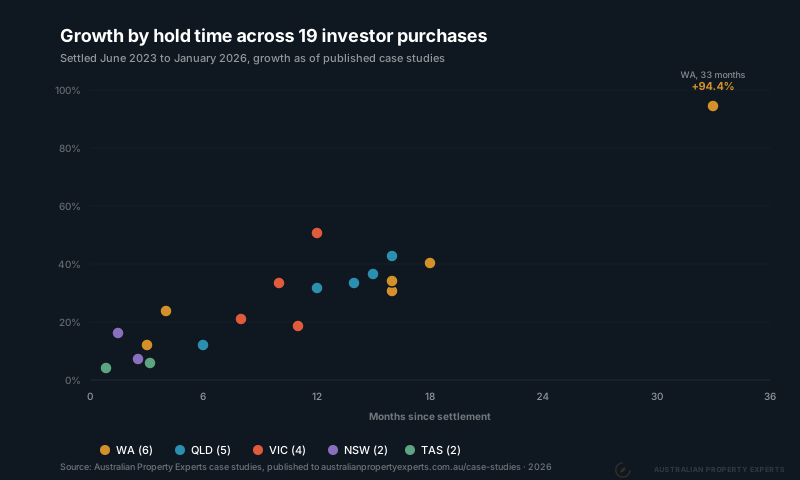
WA and QLD dominate the 2023 to 2024 settlements. That’s when we were buying heavily in Perth, Ipswich, Logan and regional Queensland. Those two states have delivered the biggest percentage gains in the dataset by a long way. The June 2023 Perth purchase settled at $355,000, was recently valued at $690,000-plus, and is renting for $630 a week. That’s a 94.4 per cent gain over 33 months.
VIC enters the dataset in March 2025. Regional Victoria specifically. The $345,000 buy that grew to $520,000 twelve months later is a Ballarat-style regional entry, not inner Melbourne. Same for the $315,000 buy that ran to $420,000 in ten months, settled May 2025. Both delivered strong growth even as capital-city Melbourne peaked in November 2025 and turned south from there.
NSW and TAS only appear from January 2026. Both purchases in each state. Small percentage growth so far because these have only had a few months to move.
The pattern is not that WA and QLD are magic. The pattern is that we buy where the data points, and the data pointed heavily to WA and QLD from 2023 through 2024. Cotality’s mid-2026 reads have Perth up 26 per cent year-on-year at a record high, Brisbane at plus 19.7 per cent also at a record high, while Sydney fell 3.2 per cent and Melbourne 2.6 per cent over the June quarter from their November 2025 peaks. The purchase timing in our dataset lines up with that macro cycle.
Hold time is doing the work
Growth in the dataset correlates cleanly with hold time. The June 2023 WA buy shows a 94.4 per cent gain at its latest valuation. The two November 2024 WA buys are up 30.8 and 34.2 per cent. The November 2025 WA buy, only four months in the ground at valuation, is up 23.7 per cent. Same state, same buying agent, wildly different reported growth. The variable is the clock.
This is worth pausing on because it’s the piece most investors miss. A property purchased in mid-2023 has had two-and-a-half years for the market to reprice, for rents to lift, and in most cases for cosmetic work to force additional equity. A property settled in January 2026 has had two months. It could be a better property in a better suburb, but it hasn’t had time to prove itself yet.
The related read on why growth compounds like this sits in our capital growth vs rental yield breakdown.
Why every purchase is under $700,000
Median across the 19 sits at roughly $500,000. Nothing above $670,000. Two-thirds sit between $400,000 and $650,000. That reflects a deliberate choice, not a compromise. We buy in affordable segments because the data on affordable versus premium is one-sided.
Lower-quartile properties have outperformed upper-quartile properties across almost every capital city in Australia over the last five years. Rents are stickier at the affordable end because tenant demand is deeper. Vacancy is generally tighter. And a $500,000 asset carries far less holding-cost risk in a rising-rate environment than a $1.5 million premium asset.
The dataset is a proof point, not the argument itself. The full case sits in affordable vs blue chip property.
The data vs the headlines
Sydney and Melbourne are down from their November 2025 peaks. Cotality’s mid-2026 index shows Sydney off 3.2 per cent for the June quarter and Melbourne off 2.6. That’s the national headline, and it’s true at the aggregate level.
But two of the four VIC purchases in our dataset were settled in May 2025 for $315,000 and $590,000. At their case study valuations they were up 33.3 and 18.6 per cent respectively, both double-digit gains during a period when the Melbourne aggregate first peaked and then turned. Regional VIC and outer growth suburbs kept moving while inner Melbourne rolled over. Different segment, different result.
This is the trap in reading Cotality and PropTrack quarterly reports without a state and price-band filter. A capital-city median tells you what happened to a broadly weighted basket of dwellings. It doesn’t tell you what happened at the affordable end of regional Victoria, or in the outer growth corridors of Brisbane, or in the middle ring of Perth. The state property cycle exists but it’s coarser than the SA3 or suburb cycles that actually determine investor outcomes.
Off-market at 86 per cent
Across the full 250-plus book, 86 per cent of purchases have been off-market. The national PropTrack read on the average off-market share of transactions is a small single-digit percentage. Ours is not a marketing figure. It reflects that most of our deals come through agent relationships that took years to build, not portal alerts anyone can set up in five minutes.
The pricing advantage on off-market is real. PropTrack’s own analysis has average off-market discounts sitting in the mid-single digits versus comparable on-market sales, wider above the $1 million mark. On a $500,000 buy that’s meaningful equity you don’t pay for. Multiply that across 19 purchases and it’s most of a deposit on the next one.
More detail on how off-market actually works, including where the pricing gap widens, sits in how to find off-market properties.
What the pattern says for buyers now
If you read the dataset straight, here’s what stands out for anyone buying in the second half of 2026:
The WA and QLD entries are looking mature. Perth is at a fresh record high and up 26 per cent year on year. Brisbane is at a record high and up 19.7. Momentum is still there but the risk-reward on new entries in those markets is not what it was in 2023. You can still buy well, but the easy metres have been paid out.
VIC, especially affordable regional VIC and the outer growth suburbs, is where the last twelve months of our purchases have concentrated. The macro read is falling but the affordable segments are still delivering, which is exactly the pattern we saw in Perth in 2022 before the wider index turned.
NSW and TAS are the newest states in the book because we’ve been finding value there again only recently. Neither has enough time in the dataset to prove the thesis, and both need another six to twelve months before the growth reads mean anything.
None of that is a recommendation to buy a specific suburb. Every brief is different and the right state depends on the client’s borrowing capacity, existing portfolio, timeline, and appetite. What the pattern does say is that macro headlines about state cycles are always three to six months behind what an active buyer sees on the ground.
Reading the dataset straight
Nineteen purchases is a sample, not a full portfolio report. The 250-plus wider book carries its own selection bias, since we don’t detail every buy publicly and the ones we do publish tend to be where the numbers landed well. Broadly, the median across the book is close to the median across the 19, and the state weighting is broadly similar to the published dataset above.
The average capital growth across the wider book sits at roughly 24 per cent. Average gross yield at roughly 6.3. Neither figure is a promise or a target for any individual purchase. They’re the pooled results of buying in affordable segments, holding for time in the market, and doing cosmetic work where the numbers support it.
If you want to see all 19 with photos, growth badges and settlement details, they’re on the case studies page. The list is updated as more valuations come in.
This is general information only and not financial advice. Speak to a qualified professional before making investment decisions.
If you’re weighing which state to buy in next, book a free discovery call and we’ll walk through the current data on your borrowing capacity and timeline.