Townsville is the kind of market most southern investors ignore until the cycle is half-finished. The numbers are published and easy to check. Vacancy runs from 0.56% to 1.40%, Rasmussen has averaged 19.62% growth a year over five years, and defence, mining services and hydrogen projects anchor the next decade. Those five suburbs sit in four different postcodes, so the vacancy reading that applies to one does not apply to the next.
Regional QLD has run, no question. But Townsville’s combination of population base (~200,000), Australia’s largest land-based Army garrison at Lavarack, James Cook University, the Port of Townsville expansion, and the CopperString 2032 transmission project gives the market more legs than a single-industry town. Below are five suburbs across different price points and strategies, with medians from CoreLogic via Your Investment Property to 31 May 2026 and rents to 31 July 2026. For the broader picture on our approach here, see our Townsville buyers agent page.
How we picked these suburbs
Five filters: price points from $575,500 to $935,000, gross yield above 3.3%, and vacancy under 1.5%. On top of that, proximity to at least one major employment node (defence, health, university, mining services or port) and an established housing stock on decent blocks. No new estates, no high-density unit oversupply pockets. For the reasoning on why we weight both growth and yield rather than chasing one, see capital growth vs rental yield.
Kirwan
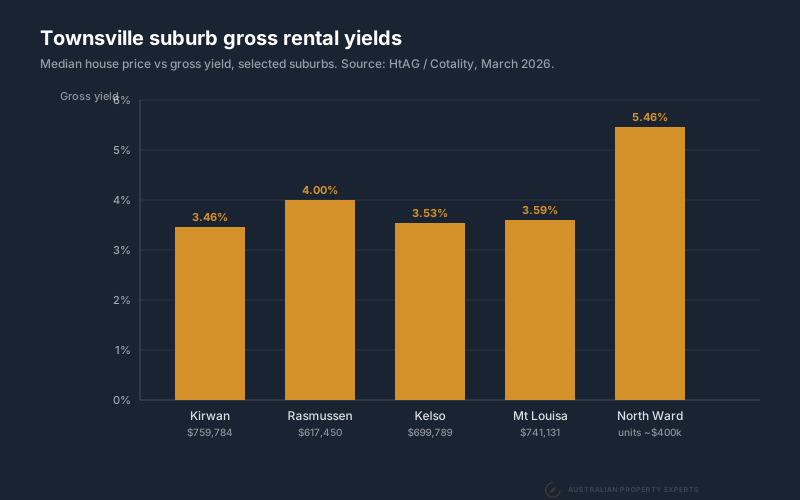
Median house price: $650,000 Gross rental yield (houses): 4.56% Median weekly rent: $570 12-month growth: +16.85% Average annual growth, 5 years: +14.61% Sales, 12 months: 431 Days on market: 18 Vacancy, postcode 4817: 0.56% in July, from 0.70% in March
Kirwan is the biggest residential suburb in Townsville and the anchor of the Thuringowa corridor. About 10km south-west of the CBD, it sits close to Lavarack Barracks, the Willows shopping centre, and the Ring Road which connects most major employment nodes.
The housing stock suits investors: brick veneer and block homes on 600-800sqm lots, most built from the 1970s to the 1990s, plenty of cosmetic reno potential. Tenant pool is a mix of defence families, healthcare workers, and Thuringowa trade workers. Low turnover is the norm.
Kirwan is the deepest of the five suburbs here, with 431 sales in the year and 18 days on market. Vacancy in postcode 4817 is the tightest of the four postcodes in this guide at 0.56%, down from 0.70% in March. At $650,000 with a computed 4.56% yield the cash flow works, and average growth of 14.61% a year over five years is why this suburb keeps appearing on shortlists.
Rasmussen
Median house price: $575,500 Gross rental yield (houses): 4.88% Median weekly rent: $540 12-month growth: +16.26% Average annual growth, 5 years: +19.62% Sales, 12 months: 121 Days on market: 17 Vacancy, postcode 4815: 1.40% in July, from 1.23% in March
Rasmussen sits further south-west in the Thuringowa corridor, about 14km from the CBD. It has historically been the cheaper cousin to Kirwan and Kelso, and the five-year record is where that gap has been closing. Average growth of 19.62% a year is the strongest of the five suburbs here.
The median is $575,500, the lowest of the five, and the computed yield of 4.88% is the highest. The suburb has a decent mix of older three and four-bedroom homes on 700-900sqm blocks. Granny flat potential on the bigger lots is a real lever for investors who want to push the yield up further once they’ve settled.
Volume is thinner here, at 121 sales in the year, second-smallest of the five behind North Ward. The risk with Rasmussen is that some streets are closer to flood-affected areas than others. Buying here without verifying the flood overlay on the specific property is a mistake. Do the work on council maps before you put pen to paper.
Kelso
Median house price: $594,250 Gross rental yield (houses): 4.73% Median weekly rent: $540 12-month growth: +19.63% Average annual growth, 5 years: +17.98% Sales, 12 months: 258 Days on market: 17 Vacancy, postcode 4815: 1.40% in July, from 1.23% in March
Kelso neighbours Rasmussen and Kirwan and functions as the middle-tier option in the Thuringowa corridor. The stock is slightly newer on average, which means less cosmetic reno upside than Kirwan but also fewer maintenance surprises. Tenants here are typically young families and defence personnel on postings.
The access story is the quiet advantage. The Ring Road puts Lavarack, the Townsville University Hospital, James Cook University, and the CBD all within a 20-minute drive. That kind of employment catchment is what keeps vacancy tight when rents are under pressure.
At $594,250 with a computed 4.73% yield, Kelso is second of the five on yield, on twelve-month growth at 19.63% and on average annual growth at 17.98%. It leads none of those three lists and trails none of them either. The catch is the rental market. Postcode 4815 loosened from 1.23% in March to 1.40% in July, the highest reading of the four postcodes in this guide.
Mount Louisa
Median house price: $695,000 Gross rental yield (houses): 4.49% Median weekly rent: $600 12-month growth: +14.69% Average annual growth, 5 years: +13.28% Sales, 12 months: 203 Vacancy, postcode 4814: 0.94% in July, from 1.05% in March
Mount Louisa is a slightly more premium option on the northern side of the Ring Road, roughly 9km from the CBD. It sits between Garbutt and Bohle, close to the Stockland Townsville shopping centre, and has a more upmarket housing mix than Kirwan or Kelso. Some sections offer views across the city and Magnetic Island.
The rental profile skews toward professional couples and smaller families, which tends to mean lower turnover and fewer vacancy gaps. Rents at $600 per week are the highest of the five suburbs here, level with North Ward. Depth is mid-pack, with 203 sales in the year, third of the five.
Yield here is not the attraction. At 4.49% it is the second-weakest of the five, ahead of only North Ward, and twelve-month growth of 14.69% is the weakest of the five. Vacancy in postcode 4814 tightened from 1.05% in March to 0.94% in July, the second-tightest of the four here. Mount Louisa is a suburb where you pay for location and stock quality, and hope the growth continues to compound. For investors building a mixed portfolio across Townsville, Mount Louisa is a reasonable counterweight to the cheaper Thuringowa plays.
North Ward
Median house price: $935,000 Gross rental yield (houses): 3.34% Median weekly rent: $600 12-month growth: +32.62% Average annual growth, 5 years: +4.86% Sales, 12 months: 76 Days on market: 20 Vacancy, postcode 4810: 1.26% in July, from 1.52% in March
North Ward is the premium suburb in this guide. It wraps around The Strand, Townsville’s beachfront promenade, and sits a five-minute drive from the CBD.
It is also the trade-off in this guide, because the numbers pull in opposite directions. North Ward has the strongest twelve months of the five at +32.62% and the weakest five-year average of the five at +4.86%. It has the highest median at $935,000, the weakest computed yield at 3.34%, and the smallest sales count at 76. One strong year sits on top of a weak five, at the thinnest volume and the lowest rental income against price.
What you do with that depends on what you are buying for. An investor who wants the beachfront position and can carry a 3.34% yield has a case. An investor relying on the last twelve months to repeat is relying on a run the five-year record does not support.
Check the flood and storm-surge overlay on each specific block, because the proximity to the water cuts both ways.
Townsville market context in one paragraph
Townsville house values have moved hard, with average annual growth over five years running from 4.86% in North Ward to 19.62% in Rasmussen. Compounded, Rasmussen’s rate more than doubles a value over five years, and Kirwan’s 14.61% gets to about 98%. Vacancy across the four postcodes here runs from 0.56% to 1.40%, and 4815 is the one that rose between March and July. Population growth is running at over 1% per annum, anchored by defence, health (Townsville University Hospital), JCU, and a mining services economy that is about to get bigger with CopperString 2032 and the Lansdown Eco-Industrial Precinct. The Edify green hydrogen plant and other Lansdown proponents are expected to create around 5,000 construction jobs and 1,600 ongoing roles. None of this makes the growth easy to repeat, but it explains why rents have kept climbing. For the broader context, see our regional property markets guide.
What to avoid in Townsville
Cyclone insurance is the first line item most southern investors underestimate. Premiums in Townsville are materially higher than Brisbane or the southern states, often 1.5 to 2x. Budget for it before you commit. Our investment property insurance guide walks through what to expect.
Flood overlays are the second issue. Parts of the Ross River catchment, particularly around Rasmussen, Condon and some Kelso streets, sit in flood-prone areas. A property two streets over can be a completely different risk profile. Pull the council flood maps on every address before you sign a contract.
Single-industry exposure is worth thinking about, but Townsville is less concentrated than most regional centres. If mining services soften, defence and health hold the floor. If nickel prices crash, hydrogen and CopperString fill the gap. The diversification is real, but it is not absolute.
The unit market in Townsville is thin. New stock in inner-ring complexes has at times created oversupply pockets. Stick to established units in smaller complexes, not new off-the-plan builds, and underwrite the body corporate fees before you commit. Our body corporate fees guide covers what to look for, and for the general case on choosing between houses and units, see house or unit for investment.
Finally, do not buy an outer acreage block and call it a “Townsville investment.” The data in this guide is about established residential stock on standard lots, close to employment. Lifestyle acreage is a different product with a different tenant pool.
Townsville is late in the run: what that means
Townsville is late in the current run, not at the start of one. That does not mean the story is over, it means the margin for error is smaller. The suburbs in this guide all still have yield and employment fundamentals on their side. But an investor buying in Townsville today needs to be buying the right stock on the right block at the right price, not just the postcode. That is the difference between a result worth having and a five-year hold that goes nowhere. If you want help picking the specific property rather than the broad area, that is what we do. Our case studies show the results.
This is general information only and not financial advice. Speak to a qualified professional before making investment decisions.
See how we buy high-yield properties in regional markets.
If you want to invest in Townsville but want the property selection, negotiation and due diligence done for you, book a free discovery call.
Data sources. Median price, twelve-month growth, average annual growth, sales volume and days on market are CoreLogic via Your Investment Property, to 31 May 2026. Weekly rents are to 31 July 2026. Every yield on this page is computed by us as weekly rent times 52 divided by the median. We do not use the published yield column, because it draws the rent and the median from different months and so does not reconcile against the prices shown. Vacancy rates are SQM Research, July 2026, with the March 2026 reading shown alongside. Days on market for Mount Louisa did not return a value. All figures pulled 30 August 2026.