Regional Victoria property investment in 2026 buys you the cheapest entry of any regional market in the country, in towns where rental vacancy sits under 1%. Over the five years to May 2026, regional Victoria gained 21.0% while regional Western Australia gained 93.3% and regional South Australia 77.6% (Cotality). Same five years, one quarter of the growth.
That gap matters because regional Victoria did not have the boom that the rest of regional Australia had, which means investors buying there today are not paying for one.
Why regional Victoria lagged
Every other rest-of-state market ran hard through the last cycle. Regional Queensland put on 70.2% over those same five years and regional New South Wales 35.3%. Regional Victoria managed 21.0%, and in calendar 2025 it grew 6.0%, the weakest rest-of-state result in the country while combined regional Australia rose 9.7%.
The reason is mostly Melbourne. Victoria’s capital has been the weakest capital city market in the country for four years, and regional Victoria takes its cue from Melbourne buyers, sea-changers and commuters. When Melbourne stalls, the regions it feeds stall with it.
What that has produced is a set of towns where prices moved slowly but rents did not. Regional rents nationally rose 41.9% over five years against wage growth of 17.5%. Rents kept climbing through the flat years, which is why the yields below are what they are, and why vacancy is where it is.
Shepparton: health and rail, delivered
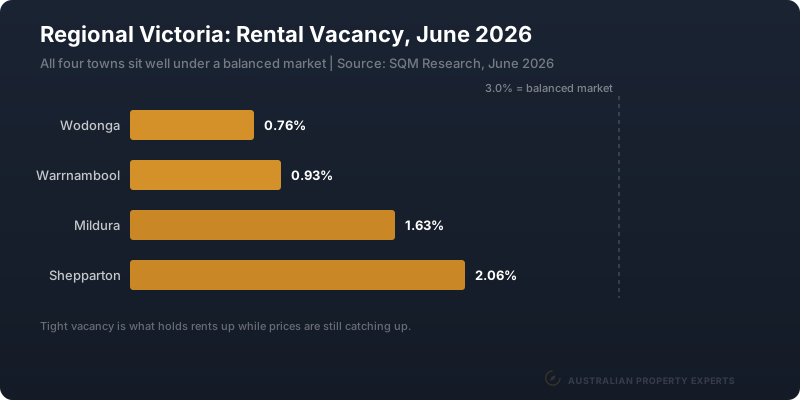
Shepparton has the lowest entry price of the four. The median house is $525,000 on a 4.88% gross yield and $495 a week in rent, with houses selling in 34 days (YIP/CoreLogic, 12 months to May 2026). Vacancy was 2.06% in June 2026, the softest of the four and up from 1.50% a year earlier (SQM Research).
The economy runs on health and food. Goulburn Valley Health employs more than 3,000 staff across six sites and serves a catchment of about 150,000. Food manufacturing accounted for more than 85% of the Goulburn Valley’s manufacturing exports, worth $640m as at 2023.
Shepparton’s infrastructure pipeline has already been delivered rather than promised. The $229.3m hospital redevelopment finished in late 2024, doubling emergency capacity to 44 treatment points. The $414.2m Shepparton Line Upgrade finished in December 2025 and now runs nine weekday return services to Melbourne. Both are done. There is no major project under construction today, so treat Shepparton as a town that has just been upgraded rather than one about to be.
Mildura: the fastest sales in the state
Mildura posted the strongest capital growth of the four at 20.43% for the year to May 2026, with a median house at $560,000, a 4.83% yield and $520 a week. Houses sold in 15 days, which is roughly half the time of anywhere else on this list and the clearest signal of demand running ahead of stock. Vacancy was 1.63% in June 2026, tightened from 1.05% a year before.
The Mildura Base Public Hospital employs over 1,200 people. Mildura Rural City Council puts gross regional product at $4.65bn and local jobs at 25,016 as at February 2026, up from 22,368 in 2016. A $36m residential alcohol and drug treatment facility has been under construction since April 2026 and completes in 2027, the only large project currently being built in the area.
Population is the soft spot. The Mildura local government area grew by 175 people in 2024-25 to 57,309, a rise of 0.3% and the slowest of the four (ABS). Internal migration ran at minus 383, offset by overseas arrivals. A market can grow on tight supply alone for a while, but thin population growth is the thing to keep an eye on here.
Warrnambool: the tightest rental market
Warrnambool is the most expensive of the four at a $640,500 median, yielding 4.76% on $600 a week. Vacancy was 0.93% in June 2026. At that level there is effectively no rental slack, and it has been under 1% for at least a year.
It also has the strongest infrastructure story on this list. The $396.1m Warrnambool Base Hospital redevelopment has been in major construction since January 2026 and completes in 2028, bringing about 800 construction jobs, a 32-bed inpatient unit and a new multi-storey clinical services building. South West Healthcare already employs 2,211 people and describes itself as the region’s largest employer, serving a catchment of 110,000.
Warrnambool is also unusually concentrated in dairy. Cheese and other dairy product manufacturing employs 620 people, 3.6% of local workers against 0.1% nationally. That is roughly 36 times the national share, which cuts both ways: it is a genuine specialisation, and it is a single sector to watch.
One number needs context. The 8.56% growth for the year to May 2026 is a suburb house median from CoreLogic, while Cotality’s broader regional index had Warrnambool at minus 0.4% over the three months to January 2026. Different measures over different periods, so do not read the annual figure as current momentum.
Wodonga: defence and 0.76% vacancy
Wodonga has a $639,500 median on a 4.42% yield and $550 a week, the lowest yield of the four. What it has instead is the tightest rental market and the strongest population growth: vacancy of 0.76% in June 2026, and the local government area added 514 people in 2024-25 to reach 44,717, up 1.2% (ABS).
Its distinguishing feature is defence. Defence employs 1,168 people in Wodonga, 5.6% of the local workforce against 0.3% across Victoria, roughly eighteen times the state share. The $395.7m Albury Wodonga Military Area Redevelopment has been under construction since mid-2025 and runs to mid-2033, with the schedule deliberately stretched over five and a half years to match local trade capacity. That is a long, steady demand signal rather than a spike.
Albury Wodonga Health employs 3,190 people across the border pair, and the Logic Wodonga industrial estate has drawn more than $270m of private investment across 11 tenants and 600-plus jobs.
Two things worth being precise about. The $558m Albury Wodonga Regional Hospital is being built on the Albury campus in New South Wales, not in Wodonga, and New South Wales still lists the overall project as in planning with the main clinical building due in late 2028. And Wodonga council’s line about being Victoria’s fastest-growing regional city does not hold up against ABS data, where Mitchell, Greater Geelong, Bass Coast, Moorabool, Ballarat, Baw Baw and Macedon Ranges all grew faster. Wodonga is the fastest growing of these four towns, which is a smaller and true claim.
Four towns side by side
| Town | Median house | Gross yield | Weekly rent | Vacancy (Jun 26) | LGA population |
|---|---|---|---|---|---|
| Shepparton | $525,000 | 4.88% | $495 | 2.06% | 69,865 |
| Mildura | $560,000 | 4.83% | $520 | 1.63% | 57,309 |
| Warrnambool | $640,500 | 4.76% | $600 | 0.93% | 36,255 |
| Wodonga | $639,500 | 4.42% | $550 | 0.76% | 44,717 |
Medians, yields and rents are CoreLogic house figures for the 12 months to May 2026 via YIP. Vacancy is SQM Research, June 2026. Population is ABS estimated resident population for the local government area at 30 June 2025.
The pattern is the one you would expect from an early-cycle region. Yields sit in a tight band between 4.42% and 4.88%, which is well ahead of what the same money buys in Melbourne, and vacancy is under 2.1% everywhere and under 1% in two of them. Nothing here is a standout on yield alone. The case rests on paying pre-boom prices for rental markets that are already tight.
What to check before you buy
Population growth is doing the heavy work in Wodonga and very little in Mildura. Check it per town rather than assuming the region moves together, because these four are 400 kilometres apart and run on different economies.
Watch employer concentration. Warrnambool’s dairy share and Wodonga’s defence share are both strengths right now and both are single points of failure. A town where one sector is eighteen or thirty-six times the national average is a town whose rental demand moves with that sector.
Separate finished infrastructure from funded infrastructure. Shepparton’s hospital and rail upgrades are complete, so the benefit is already in the price. Warrnambool’s hospital and Wodonga’s military redevelopment are being built now, which is a different proposition. Announced but unfunded projects should count for nothing, and we found several around these towns that get quoted as though construction were imminent.
Finally, check the rent against the median yourself. Every figure in the table above reconciles to within about 2% when you multiply the median by the yield and divide by 52, and we cross-checked each against SQM’s asking rents. Numbers that do not reconcile usually mean one of them is a year old. If you want the method we use, it is in our guide to researching a suburb before you buy.
Where regional Victoria fits
Regional Victoria does not carry the highest yields in the country or the fastest growth. What it has is growth that has not happened yet, in a state whose capital has been flat for four years, with rental markets that tightened anyway. For investors weighing capital growth against rental yield, it is one of the few places left where you are not paying a premium for a run that has already occurred.
The rest of the state’s regional centres are worth the same look. We have market notes on Bendigo, Ballarat and Geelong, the three larger regional cities that sit closer to Melbourne and behave more like commuter markets than these four do.
Sources
- 2025 delivers strong housing gains but 2026 set for a softer landing - Cotality
- Regional property markets surge as capital city growth cools - Cotality
- Cotality Home Value Index, index results as at 31 May 2026 (five-year change by rest-of-state market)
- Shepparton suburb profile - YIP/CoreLogic
- Mildura suburb profile - YIP/CoreLogic
- Warrnambool suburb profile - YIP/CoreLogic
- Wodonga suburb profile - YIP/CoreLogic
- Residential vacancy rates - SQM Research
- Regional population 2024-25 - ABS
- Goulburn Valley Health Shepparton Hospital redevelopment - Victorian Health Building Authority
- Shepparton Line Upgrade Stage 3 - Australian Government Infrastructure Investment Program
- Mallee alcohol and other drugs treatment facility - Victorian Health Building Authority
- Mildura economic profile - Mildura Rural City Council
- Warrnambool Base Hospital redevelopment - Victorian Health Building Authority
- South West Healthcare Annual Report 2024-25
- Warrnambool 2021 Census QuickStats - ABS
- Wodonga 2021 Census QuickStats - ABS
- Albury Wodonga Military Area Redevelopment - Parliament of Australia
- Albury Wodonga Regional Hospital project - NSW Government
This is general information only and not financial advice. Market data changes and past growth is not a guide to future returns. Speak to a qualified professional before making investment decisions.
If you want these four towns run against your own brief and budget rather than in the abstract, book a free discovery call.