Launceston dwelling values are up 14.9% in the year to August 2026 on Cotality’s index. The national market fell 0.9% in August alone, its fifth monthly fall in a row (Cotality HVI). Tasmania sat out the mainland boom, and its growth is only now picking up.
Why Tasmania Sat Out the Boom
Over the five years to August 2026, regional Western Australia gained 85.4% and regional South Australia 76.0%. Regional Queensland put on 58.1%. Regional Tasmania managed 32.4% (Cotality HVI).
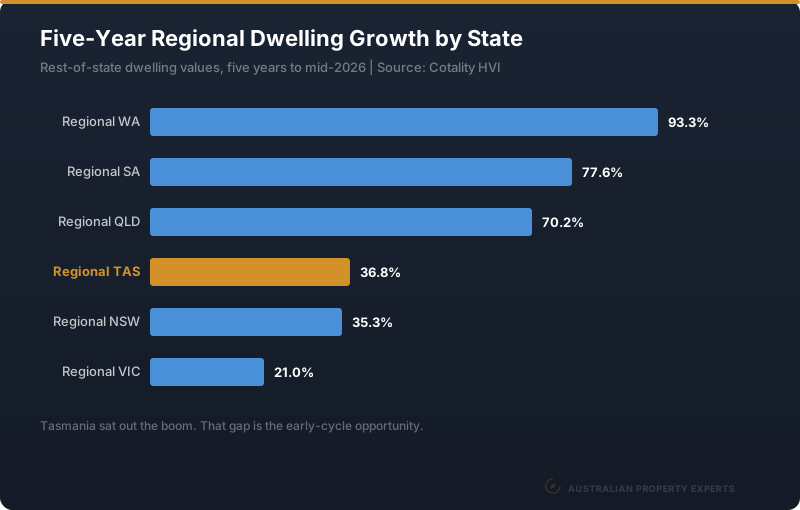
Same five years, just over half the growth of Queensland and well under half of Western Australia. Regional New South Wales put on 24.5% and regional Victoria 13.2%. Tasmania sits in the bottom half with them, for a similar reason. When your capital city stalls, the regional markets it feeds stall with it. Hobart peaked in March 2022 and at August 2026 still sits 1.1% below that peak (Cotality HVI, September 2026).
What changed is timing. By August 2026, Cotality’s Home Value Index had Launceston dwelling values up 14.9% over twelve months. Regional Tasmania set a record high in June 2026. At August it sat just 0.2% below that peak, at $616,076, with annual growth of 12.7%.
A market that missed the boom and is now growing while the national index falls looks like it is early in its cycle. Whether that lasts depends on what is driving it.
Launceston by the Numbers
Launceston’s median dwelling value is $672,071 on Cotality’s August 2026 index. That is roughly $80,000 below Hobart and about $410,000 below Brisbane. For investors, the city splits into a higher-yield north and a higher-priced south.
The north side, covering Ravenswood, Mowbray and Newnham, offers entry from around $442,000 with gross house yields between 4.7% and 5.3%. Houses in Newnham are selling in 9 days. This is where the cash-flow numbers work hardest.
The south side and riverside belt, covering Kings Meadows and South Launceston through to East Launceston, trades from $620,000 to $945,000 at yields of 3.2% to 4.6%. Tenants tend to stay longer and these suit a longer hold, but the cash flow is lower.
| Suburb | Median house | Rent per week | Gross yield | Annual growth | Days on market |
|---|---|---|---|---|---|
| Ravenswood | $442,000 | $450 | 5.29% | 16.32% | 15 |
| Mowbray | $540,000 | $500 | 4.81% | 24.14% | 14 |
| Newnham | $605,500 | $550 | 4.72% | 16.44% | 9 |
| Kings Meadows | $620,000 | $550 | 4.61% | 12.52% | 12 |
| South Launceston | $642,500 | $550 | 4.45% | 17.89% | 14 |
| East Launceston | $945,000 | $580 | 3.19% | 5.00% | 31 |
House figures from YIP/CoreLogic. Medians, growth and days on market cover the 12 months to June 2026; rents are to August 2026. Yields are rent x 52 / median, so they differ from YIP’s own yield column.
Vacancy across Launceston’s three main postcodes sat between 0.6% and 0.8% in August 2026 (SQM Research). Regional Tasmania’s rents grew 10.1% over the financial year, the equal fastest in the country alongside Darwin (Cotality). When rents climb that quickly and vacancy is that tight, the cash flow that looked marginal six months ago now works.
We look for capital growth and rental yield rising together, and Launceston has both right now.
Launceston’s Demand Drivers
Launceston has about 71,300 people in the council area. Health care is the largest employer, anchored by the Launceston General Hospital.
Health infrastructure. The Tasmanian Government committed $580 million over ten years to the LGH in 2021, within a masterplan running to 2041. Stage 3 (2024 to 2027) is the major construction stage. That includes a mental health precinct, a redesigned acute care zone and a new medical inpatient unit. A separate $53.5 million expansion will nearly double the emergency department, the biggest renovation of the ED since 1981. Construction jobs during the build, permanent healthcare positions after.
University. The University of Tasmania completed its $304 million relocation from the old Newnham campus to the Inveresk precinct in the city centre. The target is 10,000 students by 2032. Invermay and Mowbray are the suburbs closest to the new campus.
Sport. The $130 million UTAS Stadium redevelopment is under way, jointly funded by the federal and state governments. The western stand infill was due by September 2026 and the eastern stand by March 2027. Full completion is scheduled for October 2027, ahead of Tasmania’s AFL entry in 2028.
Economy. TasWater has $435 million allocated to its Launceston sewer transformation this pricing period. Add a $35 million convention centre and an $11 million airport expansion. Tasmania’s Treasury forecasts about 8% per capita economic growth over four years, with unemployment staying low (Premier of Tasmania, May 2026).
Most of these projects have money behind them, and several are already being built.
Hobart vs Launceston
Investors weighing Tasmania usually start with Hobart. The two compare like this on the latest Cotality index.
| Metric | Hobart | Launceston |
|---|---|---|
| Median dwelling value | $752,397 | $672,071 |
| Annual growth | +8.1% | +14.9% |
| Gross yield (houses) | 4.3% | 4.7% to 5.3% (north) |
| vs previous peak | 1.1% below (March 2022) | Regional Tas 0.2% below (June 2026) |
| Vacancy | 0.6% | 0.6% to 0.8% |
Values, growth and Hobart yield from Cotality HVI, September 2026, data to 31 August 2026. Launceston yields from YIP/CoreLogic. Vacancy from SQM Research, August 2026.
Hobart is the bigger, deeper market with more transactions and more liquidity. It also costs more and yields less. Launceston is smaller, grows faster right now, and pays better rent on lower entry prices. The trade-off is market depth. Fewer sales per suburb means medians can swing on a handful of transactions. Exit timing is harder too.
Hobart slipped just 0.2% in August 2026, the smallest fall of any capital, while Darwin was the only one to rise. Both Tasmanian cities are holding up better than most mainland capitals, at different speeds and from different bases.
For an investor who already holds mainland properties and wants geographic diversification into an early-cycle state, Launceston’s combination of lower entry and higher yield makes sense. For a first purchase where market depth matters more, Hobart is the safer start. Devonport and Burnie, on the north-west coast, are a third option. Our Tasmania buyers agent page covers them too. See buying investment property interstate for more on the decision.
What to Check Before You Buy
Population is flat. Launceston’s estimated resident population was 71,341 at June 2025, down 0.3% on a year earlier (ABS). Treasury projects the council area to grow about 0.1% a year, to around 75,000 by 2053 (Tasmanian Treasury). This run is built on affordability and undersupply rather than migration, so it may not outpace local incomes for long.
Thin sub-markets. Several suburbs trade so few units that a dozen sales can swing the median 20%. Treat unit data in Launceston with caution and buy houses on decent blocks where the comparable sales base is deep enough to value against.
Levee and flood zones. Invermay and Inveresk sit on a floodplain protected by an upgraded levee system. The levee held in 2016. But insurers and lenders treat levee-zone stock differently, and residual risk is real. Check the flood mapping and get insurance quotes before you commit.
Employer concentration. Health care as the largest employer is a strength because it is government-funded and counter-cyclical, which makes it more stable than mining. But it still represents a significant single-sector share. If state funding priorities shift, the tenant base shifts with them.
Growth rates revert. Nearly 15% off a low base after years of flat growth does not mean another five years at the same rate. The investment case rests on tight vacancy, funded infrastructure, and affordable entry. If the growth rate is your only reason, the thesis is weaker than it looks.
Launceston in a National Portfolio
Launceston in 2026 has the same setup Adelaide had in 2022. The broader state is post-correction, vacancy is very tight, entry is affordable, and a new cycle is showing early signs. In a national portfolio, Launceston adds a market that hasn’t had its run yet. At these prices the rent covers more of the holding cost while you wait for growth.
The affordable markets over blue chip thesis fits Launceston well. Entry from $442,000, north-side yields up to 5.3%, and established houses on blocks where cosmetic renos can force equity. That is the profile we look for at Australian Property Experts. For suburb-level detail, see our Launceston buyers agent page.
This is general information only and not financial advice. Speak to a qualified professional before making investment decisions.
If you want to discuss whether Launceston fits your portfolio, book a free discovery call.


_(4552536456).jpg)